

How to Write a Case Management Note That Meets CMS Documentation Standards
A strong case management note shows what was done, why the intervention was needed, how the patient or caregiver responded, and what happens next. It also identifies the date and type of activity and records the qualifying time when the applicable service is time-based.
The challenge is that CMS does not prescribe one universal note format. Documentation requirements vary across CCM, TCM, APCM, behavioral health integration, Medicaid programs, payers, and care settings.
This guide explains how to structure clear notes and documentation, provides a reusable template and case management note example, and identifies the documentation gaps that can make a billed service difficult to verify.
Documentation note: Requirements vary by Medicare service, Medicaid program, payer, code, provider role, care setting, Medicare Administrative Contractor, and organizational policy. CMS compliant documentation depends on the applicable service requirements and the complete supporting record. This guide provides a practical documentation framework, not billing or legal advice.
Key Takeaways
- CMS does not prescribe one universal case management note format.
- The note should explain the need, intervention, response, outcome, and next step.
- Time must be documented when required by the specific service or billing code.
- Documentation requirements differ across CCM, TCM, APCM, behavioral health integration, state Medicaid programs, and facility-based case management.
- Templates improve consistency, but they do not replace accurate, patient-specific documentation.
What Is a Case Management Note?
A case management note is a dated record of an assessment, contact, coordination activity, intervention, or follow-up completed for a patient. It documents the need addressed, the action taken, the response or result, and the next step.
When the activity supports a Medicare or Medicaid service, the note becomes part of the documentation used to support the claim.
Does CMS Have One Standard Format for Case Management Notes?
No. This is the question most case managers actually have, and it’s the one most guides skip.
CMS doesn’t issue a single case management note template. Instead, it regulates documentation through separate billing programs. Each program has its own eligibility, service, care-plan, timing, personnel, and documentation requirements.
A note used to support CCM may be insufficient when the complete record does not establish required patient consent, qualifying time, or the applicable comprehensive care-plan activities.
Why Case Management Documentation May Not Support a Claim
When Medicare reviews a claim, the submitted record must support the service that was billed. Documentation may be insufficient when it does not establish the patient’s need, the work performed, the applicable service requirements, the author, or the required time and care-management elements.
A denial does not necessarily mean the service did not occur. It may mean the available record does not provide enough information to verify that the billing requirements were met. That is why the note must be considered together with the care plan, consent, eligibility records, orders, and other program-specific documentation.
8 Core Elements of a Strong Case Management Note
A complete case management note will generally identify:
- Patient, program, or service
- Date and contact method
- Reason for the activity
- Relevant findings
- Intervention performed
- Patient or third-party response
- Outcome and follow-up
- Author and authentication
Additional fields may be required based on the service, payer, program, provider role, and care setting.
How to Write a Case Management Note Step by Step
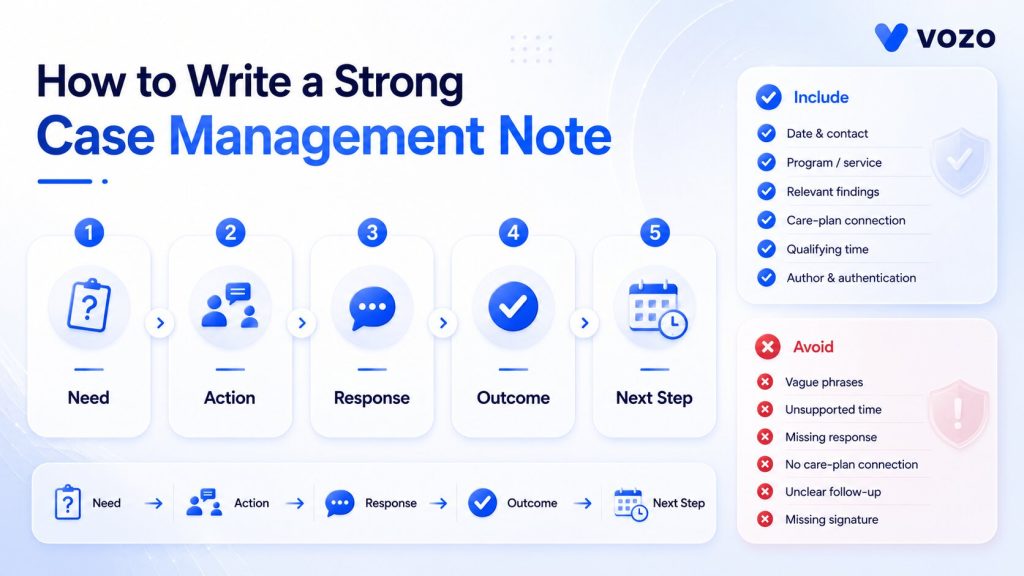
A clear note follows the sequence of the actual case management activity. Start with the patient’s need, document the intervention and response, and finish with the outcome and next action.
1. Identify the Service
Identify the care-management program or service connected to the activity. Use the approved organizational template and verify any service-specific requirements, such as consent, qualifying time, care-plan documentation, personnel, or supervision.
2. Record the Contact Details
Enter the date, contact method, participants, and author. Add duration or other time information when required for the applicable time-based service and according to payer and organizational policy.
Record whether the interaction occurred by telephone, patient portal, video, in person, or through secure messaging, along with the participants and result.
3. State the Reason for Contact
Explain what prompted the activity. Connect it to an identified condition, transition, barrier, referral, safety concern, care-plan goal, or unresolved need rather than describing it as a routine check-in.
4. Document Relevant Findings
Record the information that influenced the intervention. This may include patient-reported symptoms, medication access, functional needs, treatment adherence, social barriers, caregiver concerns, or referral status.
5. Describe the Intervention
State exactly what the case manager assessed, reviewed, explained, coordinated, arranged, communicated, or escalated. Avoid generic phrases that do not allow another reviewer to understand what occurred.
When the intervention involves an outside provider or service, a structured referral management workflow can help document whether the referral was sent, accepted, scheduled, or remains pending.
6. Record the Response
Document how the patient, caregiver, provider, pharmacy, or agency responded. Distinguish information reported by another person from the case manager’s own observations and conclusions.
7. State the Outcome
Explain the current status of the issue. Indicate whether it was resolved, partially resolved, remains pending, was declined, was unsuccessful, or required clinical escalation.
8. Define the Next Step
State what will happen next, who is responsible, and when follow-up is expected. Include appropriate escalation instructions when the patient’s symptoms, safety, medication access, or ability to receive care may require earlier action.
A specific next step makes the documentation more useful to the rest of the care team.
9. Review and Authenticate the Note
Ensure the note is correct, individual, and reflects the rest of the documentation. Fill out the necessary author identification, credentials, authentication, date and any late entry and/or amendment procedures.
Case Management Note Template
This case management note template organizes common documentation elements. It must still be adapted to the applicable service, payer, state, code, provider role, and organizational policy.
Patient and Activity
Patient:
Date of service:
Contact type and method:
Participants:
Case manager and credentials:
Program or care-management service:
Qualifying time, when required:
Reason for Contact
Describe the condition, care-plan objective, transition, barrier, referral, risk, or unresolved need that prompted the activity.
Relevant Findings
Document current patient-reported, caregiver-reported, clinical, functional, psychosocial, environmental, or utilization information relevant to the activity.
Intervention
Describe the specific assessment, education, communication, referral, coordination, monitoring, or care-plan action completed.
Response and Outcome
Document the response from the patient, caregiver, provider, pharmacy, agency, or other party. State whether the issue is resolved, pending, declined, unsuccessful, or escalated.
Care-Plan Connection
Identify the problem, goal, or planned intervention addressed. Record any care-plan update.
Follow-Up
State the next action, the responsible person, the expected date or timeframe, and escalation instructions when applicable.
Authentication
Include the author’s name, role, credentials, electronic signature, and date or timestamp according to policy.
Case Management Note Example
Example only: This sample demonstrates note structure. It does not establish that a particular service is billable. Required documentation depends on the complete record, personnel involved, code, payer, and organizational policy.
Scenario
A Medicare beneficiary receiving chronic care management has diabetes and heart failure. The care plan identifies medication access and prevention of avoidable acute-care use as active goals.
Example Note
Date of service: June 18, 2026
Contact: Outbound telephone contact with the patient
Service: Chronic care management
Qualifying time: 18 minutes
Author: Jordan Lee, RN Care Manager
Reason for contact: Monthly care-management follow-up to assess medication adherence and the patient’s report that insulin had not been obtained.
Relevant Findings
The patient reported missing insulin for 3 days saying that the prescription needed to be clarified by the pharmacy. The patient reported no confusion, weakness, vomiting, chest pain or shortness of breath on questioning.
The patient reported a home glucose reading of 268 mg/dL this morning. Patient confirmed access to testing supplies.
Intervention
Asked the patient about the medication-access barrier and documented the symptoms and glucose reading the patient reported. Contacted the pharmacy and confirmed that the prescription required clarification.
Routed the clarification request to the prescribing practitioner and notified the clinical triage nurse of the missed doses and reported glucose reading for clinical assessment.
Response and Outcome
Prescription corrected and submitted by the prescribing practitioner. The pharmacy verified that insulin would be available for pick up after 3:00 p.m. The patient reported that it could be picked up today by a family member and that a family member could repeat the instructions to call in case of emergency.
Care-plan Connection
Activity supports the goals of maintaining access to medication, improving diabetes self-management, and reducing the risk of acute deterioration. Care plan updated to include confirmation of insulin pickup.
Follow-up
Care manager will contact the patient on June 19 to confirm that insulin was obtained and treatment resumed. Clinical staff will manage any further assessment of elevated glucose or symptoms.
Authentication:
Electronically signed by Jordan Lee, RN, June 18, 2026.
Still Managing Case Notes Across Disconnected Workflows?
Vozo helps care teams connect case management notes, treatment plans, referrals, follow-up tasks, and care coordination in one clinical workflow. Reduce missing documentation, improve visibility, and keep each intervention tied to the patient’s active care plan.
Weak vs. Strong Case Management Note Example
Weak example
Called the patient about the medication. Contacted the pharmacy. Issue resolved. Will follow up.
Improved example
Contacted the patient regarding the insulin-access barrier identified in the active care plan. The patient reported missing three doses because the pharmacy required prescription clarification. Contacted the pharmacy, confirmed the missing information, and routed the request to the prescribing practitioner.
The pharmacy later confirmed that the corrected prescription would be available after 3:00 p.m. The patient plans to obtain it today. The care manager will verify pickup tomorrow.
This improved case management note example establishes the need, intervention, response, outcome, and follow-up without adding unnecessary narrative.
7 Case Management Documentation Mistakes to Avoid
Even when a case management service was properly delivered, incomplete case management documentation may make it difficult to verify the work.
1. Documenting an Activity Without Its Purpose
“Called the pharmacy” records an action, but it does not explain why the action was necessary. Connect the activity to an identified medication issue, care-plan goal, transition, risk, or patient need.
2. Using Vague Intervention Language
Phrases such as “provided support” and “coordinated care” reveal very little. State what was reviewed, explained, arranged, communicated, referred, monitored, or escalated.
3. Leaving Out the Response or Result
The note should show what happened after the intervention. Record whether the issue was resolved, remains pending, was declined, required escalation, or needs further follow-up.
4. Using Unsupported Time Entries
For a time-based service, the record must support the applicable time threshold and identify the qualifying work. Do not estimate time, double-count it, or include unrelated administrative activity. Follow the applicable code, payer, and organizational rules for recording individual or cumulative monthly time.
5. Failing to Connect the Work to the Care Plan
A series of isolated task notes may not demonstrate coordinated longitudinal care. Identify the relevant need, goal, intervention, or care-plan change addressed by the contact.
Using structured treatment goals and progress tracking can make it easier to connect each case management activity to an active care-plan objective.
6. Copying Outdated or Irrelevant Information
Copied text can introduce contradictions and make current findings difficult to identify. Review every carried-forward field and retain only information relevant to the documented activity.
7. Missing Authentication or Program-Specific Support
The author, role, date, and required authentication should be identifiable. CMS requires medical documentation to support the service billed and identifies incomplete documentation and missing authentication among common review problems.
How to Document an Unsuccessful Contact
An unsuccessful contact should identify the date, method, result, and planned next action. Record whether a privacy-appropriate message was left and whether another approved contact method or authorized representative was used.
For TCM, CMS requires interactive contact within two business days after discharge. When the first attempts are unsuccessful, document the attempts and continue outreach according to the applicable TCM guidance and organizational procedure.
An unsuccessful attempt does not automatically satisfy the requirements of a billable case management service. Confirm the applicable program and payer rules before reporting the service.
How Documentation Requirements Differ by Care Management Program
Here’s how the major programs compare, side by side.
| Program | Main Documentation Focus |
| CCM (Chronic Care Management) | Consent, eligibility, comprehensive care plan, qualifying monthly time, and care coordination |
| APCM (Advanced Primary Care Management) | Consent and applicable monthly service requirements; not time-based |
| TCM (Transitional Care Management ) | Discharge details, timely contact, face-to-face visit, medication reconciliation, and decision-making level |
| BHI/CoCM (Behavioral Health Integration / Collaborative Care Model) | Behavioral health care management, applicable assessments, care plan, collaboration, and time when required |
| Medicaid TCM (Medicaid Targeted Case Management) | State-specific eligibility, assessment, care plan, allowable service, provider qualifications, and follow-up |
These care management documentation summaries DO NOT include a complete billing checklist. Organizations need to check payer policies, internal compliance policies, and state Medicaid requirements and current CMS guidance for each service.
Pre-Submission Checklist
Before finalizing a case management note, confirm that the note and supporting record include, when applicable:
- Required qualifying-time documentation for any time-based service
- A specific care plan goal or service element referenced
- Observable intervention language, not summarized opinion
- The patient’s or caregiver’s documented response
- An outcome stated separately from the activity
- A specific follow-up action and timeframe
- Required author identification, credentials, and authentication according to policy
- Applicable consent, eligibility, personnel, and other program-supporting documentation
How an EHR Supports Consistent Case Management Documentation
A clinical workflow EHR can help standardize case management documentation by connecting notes to active care plans, displaying program-specific fields, assigning follow-up tasks, and preserving amendment histories.
Technology does not create CMS compliant documentation by itself. The documented service must still be accurate, patient-specific, properly authenticated, and supported by the applicable program requirements.
Configurable templates can reduce missing fields, but they should be reviewed whenever CMS, Medicaid, payer, or organizational requirements change.
The Bottom Line
A strong case management note connects five elements:
Need → Action → Response → Outcome → Next Step
The note should be patient-specific, attributable to its author, and consistent with the active care plan and supporting record.
CMS does not require one universal case-note format. Before billing, verify that the complete record supports the specific Medicare, Medicaid, payer, code, personnel, and care-setting requirements that apply.
Frequently Asked Questions
1. What is a case management note?
A case management note is a dated record of an assessment, patient contact, care-coordination activity, intervention, or follow-up completed for a patient. It explains the need addressed, action taken, response or result, and next step. When the activity supports a billed service, the note becomes part of the documentation used to verify the claim.
2. What are CMS documentation standards for case management?
CMS documentation standards are not defined through one universal format for every case management activity. Requirements depend on the Medicare service, billing code, payer, provider role, and care setting.
CCM, APCM, TCM, and behavioral health integration each have distinct requirements, while Medicaid case management documentation also depends on federal requirements and the applicable state program.
3. What is the difference between care management documentation and case management documentation?
Care management documentation and case management documentation may overlap, and their meaning varies by organization and program. Care management often refers to coordinated clinical services such as CCM, APCM, or transitional care.
Case management may cover broader medical, behavioral, functional, and social needs. Both should connect the identified need, intervention, response, outcome, and follow-up.
4. How long should a case management note be?
A case management note should be long enough to explain why the activity was needed, what was done, how the patient or third party responded, what resulted, and what happens next.
CMS does not prescribe a universal word or sentence count. Concise, patient-specific documentation is generally more useful than lengthy notes containing copied or irrelevant information.
5. Can an unsuccessful contact attempt be documented?
Yes. Document the date, contact method, result, and next planned action. Note whether an appropriate message was left or another approved contact method was attempted.
Whether unsuccessful outreach satisfies a service requirement depends on the program. TCM, for example, has specific rules for timely interactive contact and documented unsuccessful attempts.
6. Can SOAP, DAP, or BIRP be used for case management notes?
Practices may use SOAP, DAP, and BIRP note formats when the selected structure captures the information required for the applicable service. CMS focuses on whether the complete record supports the billed activity, not the name of the note format.
The chosen format should document the need, intervention, response, outcome, follow-up, and required authentication.
7. Can an EHR template make a case management note CMS compliant?
No. An EHR template can prompt staff to enter required fields, connect notes to care-plan goals, capture qualifying time, assign follow-up tasks, and preserve audit history.
CMS compliant documentation still depends on whether the service was performed, accurately documented, properly authenticated, and supported by the applicable CMS, Medicaid, payer, and organizational requirements.
8. Can AI draft a case management note?
AI Charting can help organize verified information and prepare a draft, but the person signing the note remains responsible for its accuracy. Every finding, intervention, patient response, time entry, care-plan update, and follow-up action must be reviewed. AI should never invent patient statements, clinical findings, qualifying time, or services that were not performed.
About the author
Lara Dixit


Lara Dixit is a Senior Business Manager at Vozo Health, specializing in EHR platforms, practice management, billing, and revenue cycle optimization. She helps healthcare providers improve operational efficiency, streamline workflows, and drive sustainable practice growth. At Vozo Health, she focuses on business strategy, healthcare automation, and scalable growth for modern medical practices.