

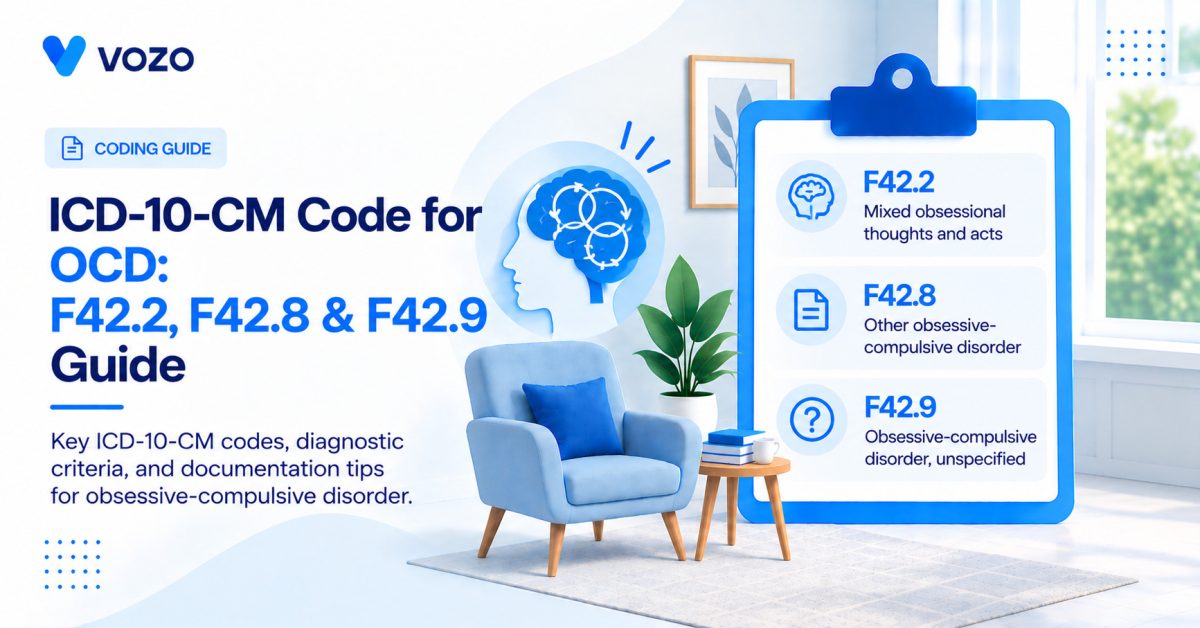
ICD-10-CM Code for OCD: F42.2, F42.8 & F42.9 Guide
A patient has intrusive contamination thoughts and repetitive washing rituals. Another has a confirmed OCD diagnosis, but the current note does not describe the presentation in enough detail.
Both may have obsessive-compulsive disorder. But should they receive the same ICD-10-CM code?
Not necessarily.
For U.S. providers, F42 is the ICD-10-CM category for obsessive-compulsive disorder, but it is not the end of the coding decision. The documented diagnosis may support F42.2 for mixed obsessional thoughts and acts, F42.8 for other obsessive-compulsive disorder, or F42.9 for obsessive-compulsive disorder, unspecified. For a broader reference, see our ICD-10 codes for common mental health conditions.
The distinction matters because ICD-10-CM coding should reflect the diagnosis established by the provider and the level of specificity supported by the medical record.
This guide explains the current ICD-10-CM codes for OCD, how the F42 codes differ, documentation considerations, common coding mistakes, and what U.S. behavioral health providers should know for FY 2027.
What Is Obsessive-Compulsive Disorder?
Obsessive-compulsive disorder (OCD) is a mental health disorder characterized by obsessions, compulsions, or both.
Obsessions are recurring and unwanted thoughts, urges, or mental images that can cause anxiety or distress.
Compulsions are repetitive behaviors or mental acts that a person feels driven to perform, often in response to an obsession.
Examples of obsessions can include:
- Fear of contamination
- Persistent doubts or fear of harm
- Unwanted intrusive thoughts
- Need for symmetry or exactness
Compulsions may include:
- Excessive cleaning
- Repeated checking
- Counting or arranging
- Repetitive mental rituals
OCD goes beyond occasionally double-checking a door or preferring things to be organized. Symptoms may become time-consuming, cause significant distress, or interfere with work, school, relationships, and everyday activities.
The presence of repetitive behavior or intrusive thought alone should not be used to establish an OCD diagnosis. Diagnosis requires an appropriate clinical evaluation.
What Is the ICD-10-CM Code for OCD?
The ICD-10-CM category for obsessive-compulsive disorder is F42.
However, F42 is further divided into more specific diagnosis codes.
For FY 2027, the F42 category includes:
| ICD-10-CM Code | Description | When It Applies |
| F42.2 | Mixed obsessional thoughts and acts | Documented mixed obsessions and compulsive acts |
| F42.3 | Hoarding disorder | Distinct hoarding disorder diagnosis |
| F42.4 | Excoriation (skin-picking) disorder | Distinct skin-picking disorder diagnosis |
| F42.8 | Other obsessive-compulsive disorder | Documented OCD presentation not represented by a more specific available code |
| F42.9 | Obsessive-compulsive disorder, unspecified | OCD documented without greater specificity |
For OCD specifically, the codes most relevant to this discussion are F42.2, F42.8, and F42.9.
F42.3 and F42.4 appear within the F42 category but represent distinct diagnoses rather than standard OCD presentations.
The FY 2027 ICD-10-CM code set applies to encounters from October 1, 2026 through September 30, 2027.
F42.2 vs. F42.8 vs. F42.9
Understanding the difference between these codes is important because they should not be used interchangeably.
F42.2 – Mixed Obsessional Thoughts and Acts
F42.2 applies when the documented diagnosis corresponds to mixed obsessional thoughts and compulsive acts.
A patient, for example, may experience recurring contamination fears along with repetitive washing behaviors.
However, the code should not be selected simply because similar symptoms appear in the record.
ICD-10-CM code assignment should follow the diagnosis documented by the provider.
F42.8 – Other Obsessive-Compulsive Disorder
F42.8 represents other obsessive-compulsive disorder.
An “other” code generally applies when the provider documents a specific OCD presentation, but ICD-10-CM does not provide another dedicated code that more precisely describes it.
The documentation should establish why the diagnosis falls into this category.
F42.9 – Obsessive-Compulsive Disorder, Unspecified
F42.9 is used when OCD is documented but the available record does not support greater specificity.
An unspecified code is not automatically incorrect.
If the documentation does not support a more specific OCD diagnosis, providers and coding teams should not add details that have not been clinically established simply to avoid F42.9.
In short:
- F42.2 = mixed obsessional thoughts and acts
- F42.8 = another documented OCD presentation not represented by a more specific available code
- F42.9 = OCD documented without greater specificity
Is F42 a Billable ICD-10-CM Code?
No. F42 is a three-character category that is further subdivided and is not a complete reportable diagnosis code by itself. Report the full ICD-10-CM code supported by the documentation, such as F42.2, F42.8, or F42.9.
What About F42.0 and F42.1?
This is a common source of confusion for U.S. providers.
Some online resources list:
- F42.0 – Predominantly obsessional thoughts or ruminations
- F42.1 – Predominantly compulsive acts
You may find F42.0 and F42.1 on international coding websites. These belong to the WHO ICD-10 classification and are not part of the current U.S. ICD-10-CM F42 structure.
U.S. providers should use the current ICD-10-CM codes applicable to the date of service.
Common OCD ICD-10-CM Coding Mistakes
Staying informed about FY 2027 ICD-10-CM updates can also help practices review coding changes and maintain accurate documentation.
Common issues to avoid include:
- Reporting F42 instead of a complete code within the category
- Using F42.0 or F42.1 for U.S. ICD-10-CM coding
- Assigning F42.2 based only on symptoms without a supporting provider diagnosis
- Adding unsupported specificity instead of using F42.9 when appropriate
What Should Providers Document for OCD?
Clear clinical documentation for behavioral health helps keep the provider’s diagnosis, treatment information, and ICD-10-CM code aligned.
Useful documentation may include:
- The diagnosis established by the provider
- Relevant obsessions and compulsions
- Frequency and severity of symptoms
- Functional impact
- Associated distress
- Treatment approach and response
- Changes in the diagnosis over time
Providers should avoid relying only on vague phrases such as “OCD symptoms” when a more definitive diagnosis has been established.
At the same time, documentation should reflect the actual clinical picture rather than adding unsupported specificity for billing purposes.
Make Behavioral Health Documentation Easier to Manage
Accurate coding starts with clear, consistent documentation. Vozo EHR helps behavioral health practices keep diagnoses, clinical notes, treatment plans, scheduling, and billing workflows connected in one place.
Simplify OCD Documentation With Vozo EHR
Clear diagnosis documentation is essential for accurate behavioral health coding, but disconnected clinical and billing workflows can make that harder.
Vozo EHR brings behavioral health documentation, diagnosis management, treatment plans, scheduling, telehealth, and billing into one connected workflow.
Frequently Asked Questions
1. Can an OCD ICD-10-CM code change as the diagnosis becomes more specific?
Yes. A patient’s documented diagnosis may become more specific as assessment and treatment continue. If the current documentation supports a different or more specific diagnosis, the code for that encounter should reflect the current documented condition rather than automatically carrying forward an earlier unspecified code.
2. Can OCD and another mental health disorder be coded together?
Yes, when both conditions are independently diagnosed, documented, and relevant to the patient’s care. A patient with OCD may also have another behavioral health diagnosis. However, symptoms such as anxiety or depressed mood should not automatically be treated as separate diagnoses without appropriate clinical documentation.
3. Is there an ICD-10-CM code for OCD in remission?
The current F42 code family does not provide separate codes specifically identifying OCD as being in partial or full remission. Providers can document the patient’s remission or improvement status in the medical record while selecting the diagnosis code supported by the encounter.
4. Does an OCD ICD-10-CM code determine insurance reimbursement?
No. The diagnosis code is only one part of the claim. Coverage and reimbursement may also depend on the CPT or HCPCS code, medical necessity, payer policies, authorization requirements, plan benefits, network participation, and supporting documentation.
5. Is OCD the same as obsessive-compulsive personality disorder?
No. OCD and obsessive-compulsive personality disorder are separate diagnoses. OCD falls within F42. Obsessive-compulsive personality disorder is coded F60.5. Providers should not use the two diagnoses interchangeably based on similar terminology.
About the author
Lara Dixit


Lara Dixit is a Senior Business Manager at Vozo Health, specializing in EHR platforms, practice management, billing, and revenue cycle optimization. She helps healthcare providers improve operational efficiency, streamline workflows, and drive sustainable practice growth. At Vozo Health, she focuses on business strategy, healthcare automation, and scalable growth for modern medical practices.