

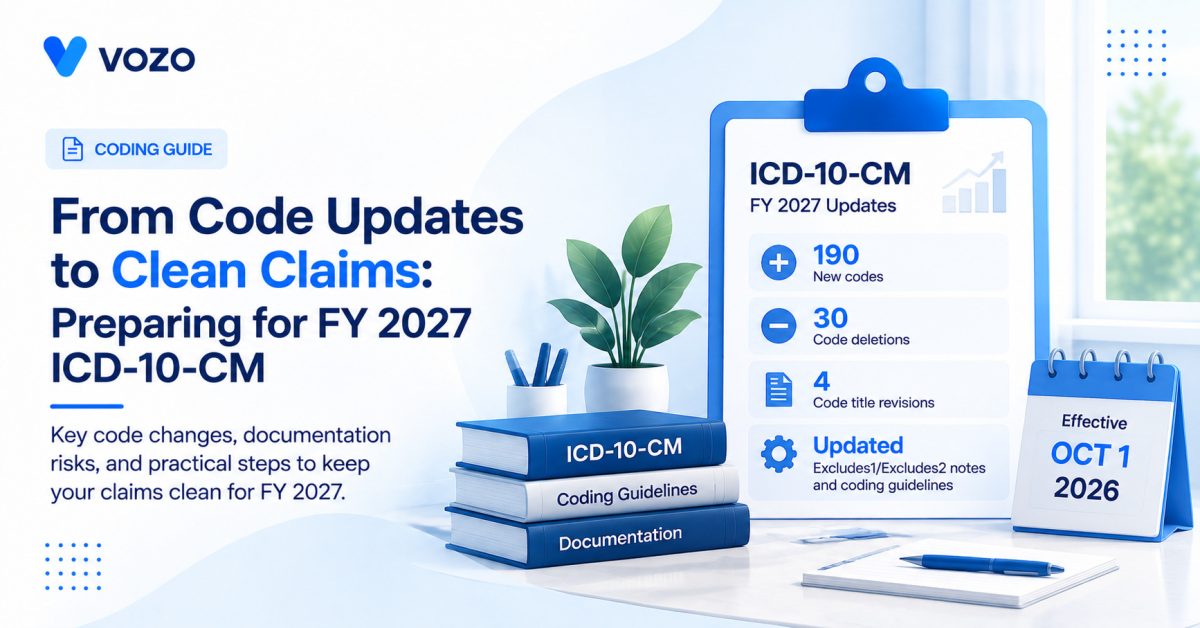
From Code Updates to Clean Claims: Preparing for FY 2027 ICD-10-CM
Annual ICD-10-CM updates can require healthcare organizations to review diagnosis coding, clinical documentation, EHR configuration, and billing workflows.
The FY 2027 ICD-10-CM update adds 190 new diagnosis codes, deletes 30 codes, and revises four code descriptions. It also includes changes to code structure, instructional notes, and the Official Guidelines for Coding and Reporting.
The new code set takes effect October 1, 2026. It applies to patient encounters and inpatient discharges occurring from October 1, 2026, through September 30, 2027, and replaces the April 1, 2026 FY 2026 release.
Behavioral health practices should review how FY 2027 code changes apply to their diagnosis documentation and reporting processes.
Key Takeaways
- The FY 2027 update takes effect October 1, 2026. Practices should verify that their workflows use the correct code set for applicable encounters.
- FY 2027 introduces new Z codes related to personal history of gender transition that may be relevant for some behavioral health records.
- A deleted or nonreportable code may not be valid for reporting and may require correction.
- Practices should review systems and workflows that use ICD-10-CM codes.
- A focused review before October 1 can help practices identify affected codes and workflows.
What Is Changing in the FY 2027 ICD-10-CM Update?
CMS and the CDC’s National Center for Health Statistics publish annual updates to the ICD-10-CM code set. FY 2027 covers diagnoses and patient encounters from October 1, 2026 through September 30, 2027.
Here is the update at a glance.
| Change Type | What It Means for Your Practice | FY 2027 Update |
| New reportable codes | Codes you can now use that did not exist before | 190 |
| Deleted codes | Codes that are no longer valid for applicable FY 2027 encounters or discharges | 30 |
| Revised codes | Same code, updated description | 4 |
CMS and CDC publish the official FY 2027 ICD-10-CM files, including the addendum, code descriptions, and coding guidelines. ICD-10-CM applies to HIPAA-covered entities, not only Medicare and Medicaid providers.
Why Billable Status Matters
A code may remain visible in the ICD-10-CM hierarchy but no longer be reportable on its own. This can occur when ICD-10-CM expands a category with more specific reportable codes.
Practices should review diagnosis selection options to ensure they support valid reportable codes. The diagnosis may look familiar, but it will not provide the specificity required for claim submission.
Which Changes Are Most Relevant to Behavioral Health?
The FY 2027 update adds F64.A, Gender identity disorder, in remission, with the inclusion term “gender dysphoria, in remission (desistance).”
It also expands the personal-history options associated with Z87.890:
| Code | FY 2027 Description |
| F64.A | Gender identity disorder, in remission |
| Z87.8901 | Personal history of social gender transition |
| Z87.8902 | Personal history of medical gender transition |
| Z87.8903 | Personal history of surgical gender transition |
| Z87.8904 | Personal history of intersex surgery |
| Z87.8909 | Personal history of unspecified gender transition |
| Z87.893 | Personal history of gender detransition |
The expanded Z87.890 category provides more specific options for reporting documented personal history related to gender transition.
Code assignment should be based on provider documentation and the FY 2027 Official Guidelines for Coding and Reporting.
What Documentation Should Behavioral Health Practices Review?
Adding codes to the EHR is only part of implementation. More specific codes require documentation that supports the distinction between them.
For behavioral health practices, a documentation review should consider whether clinicians consistently record:
- The diagnosis being evaluated or treated
- Whether the condition is current, historical, or in remission when applicable
- Details needed to support code specificity
- Relevant conditions affecting the encounter
What Happens If a Deleted Code Is Used After October 1?
Code selection follows the applicable encounter or discharge date, not the date the claim is submitted.
For outpatient and professional services, the code set generally follows the date of service. For inpatient facility reporting, FY 2027 codes apply to discharges occurring on or after October 1, 2026.
A deleted code or nonbillable parent code used for an FY 2027 encounter is invalid for that reporting period. An invalid diagnosis code may require correction before a claim can be processed.
Practices should ensure that applicable workflows use valid FY 2027 codes for encounters and discharges beginning October 1, 2026. The safest approach is to make the new codes available and prevent selection of outdated reportable codes before the first October service or discharge is documented.
Practical Steps Before the FY 2027 Update
1. Identify the Codes Your Practice Uses
Start with a diagnosis frequency report covering the previous 12 months. Compare the codes your practice uses with the FY 2027 ICD-10-CM addendum.
This review helps practices focus on codes used in their own documentation and reporting processes. It identifies which deleted, revised, or newly nonbillable codes present a real risk for your practice.
2. Update and Test the Workflow
Review diagnosis libraries, favorites, problem-list options, superbills, templates, order sets, and claim edits to ensure they support valid FY 2027 code selection.
End-date or deactivate deleted codes for FY 2027 selection while retaining historical code availability for prior dates of service, corrections, appeals, and reporting. CMS guidance requires diagnosis-code editing to account for the applicable date of service and effective dates of code changes.
Test representative claims across the EHR, practice management system, clearinghouse, and connected billing tools. Include both pre-October 1 and October 1-or-later dates to verify that the appropriate code set is applied based on the applicable date of service or discharge.
3. Educate Staff and Monitor Early Results
Provide focused education based on the codes your practice uses. Clinicians need to know what documentation has changed, while coders and billers need to understand new code options, reportability, and claim edit behavior.
After implementation, monitor rejections, unprocessable claims, denials, and coding-related edits closely during October and November. Early review can reveal an outdated favorite, template, or payer rule before it affects a larger claim volume.
How the Right EHR Supports Cleaner Claims
Annual code updates can expose gaps between clinical documentation and billing workflows. Connected systems help clinical and billing teams manage information consistently throughout the claim process.
Vozo EHR gives clinical and billing teams visibility into the information supporting each claim and helps teams manage documentation and billing workflows within a connected platform.
If your practice is preparing for the FY 2027 ICD-10-CM transition, see how Vozo EHR connects behavioral health documentation, billing workflows, and claim management in one platform.
Frequently Asked Questions
When does the FY 2027 ICD-10-CM update take effect?
The update takes effect October 1, 2026. FY 2027 codes apply to patient encounters and inpatient discharges from October 1, 2026, through September 30, 2027.
How many ICD-10-CM codes are changing?
The official FY 2027 code-description addendum contains 190 additions, 30 deletions, and four revised descriptions.
What happens if a practice reports a deleted code?
A deleted code is not valid for applicable FY 2027 reporting and should be replaced with an appropriate supported code based on documentation.
Is there a new behavioral-health-related code?
Yes. FY 2027 adds F64.A for gender identity disorder in remission. It also adds more specific personal-history codes for social, medical, and surgical gender transition, intersex surgery, unspecified gender transition, and gender detransition.
Beyond New Codes: Review Coding Guidelines
FY 2027 changes are not limited to new diagnosis codes. Practices should also review updates to the Official Guidelines for Coding and Reporting, including instructions related to code assignment and reporting requirements.
Sources
CMS – ICD-10 Codes https://www.cms.gov/medicare/coding-billing/icd-10-codes
CDC/NCHS – ICD-10-CM Files https://www.cdc.gov/nchs/icd/icd-10-cm/files.html
https://ftp.cdc.gov/pub/health_statistics/nchs/publications/ICD10CM/2027
About the author
Lara Dixit


Lara Dixit is a Senior Business Manager at Vozo Health, specializing in EHR platforms, practice management, billing, and revenue cycle optimization. She helps healthcare providers improve operational efficiency, streamline workflows, and drive sustainable practice growth. At Vozo Health, she focuses on business strategy, healthcare automation, and scalable growth for modern medical practices.