

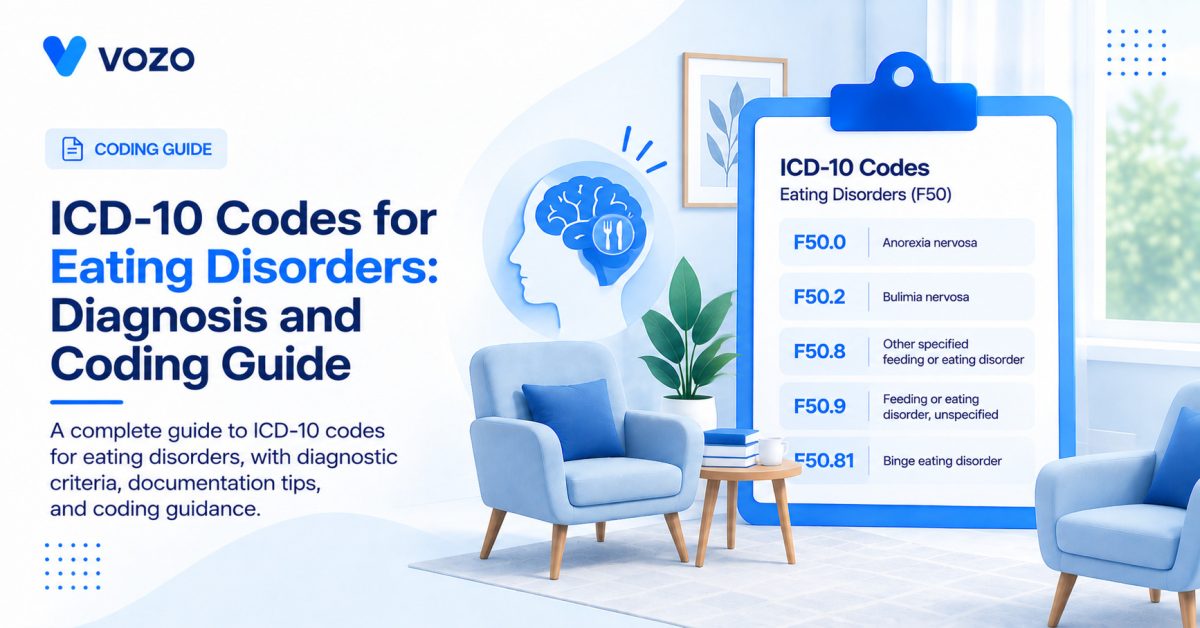
ICD-10 Codes for Eating Disorders: Diagnosis and Coding Guide
Eating disorders require accurate diagnostic documentation and coding to support appropriate treatment, clinical records, and reimbursement.
In ICD-10-CM, eating disorders are classified within the F50 category, which includes specific diagnosis codes for anorexia nervosa, bulimia nervosa, binge eating disorder, ARFID, and other eating disorders.
Understanding the correct eating disorder ICD-10-CM codes helps behavioral health providers maintain accurate documentation, support billing requirements, and reduce coding errors.
What Are Eating Disorders?
Eating disorders are behavioral health conditions involving persistent disturbances in eating behaviors, food intake, and related thoughts or emotions.
Common eating disorders include:
- Anorexia nervosa
- Bulimia nervosa
- Binge eating disorder
- Avoidant-restrictive food intake disorder (ARFID)
- Other specified feeding or eating disorders
These conditions can affect physical health, emotional well-being, and daily functioning, making accurate diagnosis and documentation important for ongoing care.
Common ICD-10 Codes for Eating Disorders
| Eating Disorder | ICD-10-CM Code |
| Anorexia nervosa, unspecified | F50.00 |
| Anorexia nervosa, restricting type | F50.01 |
| Anorexia nervosa, binge eating/purging type | F50.02 |
| Bulimia nervosa | F50.2 |
| Binge eating disorder | F50.81 category (additional digits may apply) |
| Avoidant-restrictive food intake disorder (ARFID) | F50.82 |
| Other eating disorders | F50.89 |
| Eating disorder, unspecified | F50.9 |
Complete ICD-10-CM Eating Disorder Code List
F50.00 – Anorexia Nervosa, Unspecified
This code is used when a patient meets criteria for anorexia nervosa, but the specific subtype is not documented.
F50.01 – Anorexia Nervosa, Restricting Type
Used when weight loss occurs primarily through:
- Restriction of food intake
- Dieting behaviors
- Fasting
- Excessive exercise
F50.02 – Anorexia Nervosa, Binge Eating/Purging Type
Used when anorexia nervosa includes episodes of binge eating or compensatory behaviors such as purging.
F50.2 – Bulimia Nervosa
Bulimia nervosa involves recurring episodes of binge eating followed by compensatory behaviors intended to prevent weight gain.
Providers should document:
- Frequency of binge episodes
- Compensatory behaviors
- Duration of symptoms
- Clinical impact
F50.81 – Binge Eating Disorder
The ICD-10-CM category for binge eating disorder is F50.81. Depending on documentation, additional characters may specify severity or remission status.
Binge eating disorder involves repeated episodes of consuming large amounts of food with a feeling of loss of control, without regular compensatory behaviors.
Documentation should include:
- Binge eating patterns
- Frequency and duration
- Associated distress
- Impact on daily functioning
F50.82 – Avoidant-Restrictive Food Intake Disorder (ARFID)
ARFID involves restrictive eating patterns that are not primarily related to body image concerns.
Documentation may include:
- Food avoidance patterns
- Nutritional impact
- Sensory sensitivities
- Functional limitations
F50.89 – Other Eating Disorders
This code is used for eating disorder presentations that cause significant distress or impairment but do not meet criteria for another specific eating disorder category.
F50.9 – Eating Disorder, Unspecified
The ICD-10 code F50.9 is used when documentation confirms an eating disorder diagnosis, but available information does not support a more specific classification.
DSM-5-TR Diagnosis vs ICD-10-CM Coding
Behavioral health providers often use DSM-5-TR criteria to evaluate and diagnose eating disorders, while ICD-10-CM codes are used for medical documentation and billing purposes.
Maintaining accurate clinical notes is easier with structured mental health EHR software designed for behavioral health practices.
The selected ICD-10-CM code should reflect the provider’s documented diagnosis, clinical assessment, and patient presentation.
Accurate documentation helps ensure the diagnosis code aligns with the patient’s condition and treatment plan.
Common Mistakes When Coding Eating Disorders
Accurate ICD-10-CM coding depends on matching the diagnosis code with complete clinical documentation. Common coding mistakes may create inconsistencies in patient records, billing workflows, and reporting.
1. Using Unspecified Codes When More Detail Is Available
The F50.9 code may be appropriate when documentation is limited. However, providers should use a more specific ICD-10-CM code when the diagnosis, subtype, or clinical presentation is clearly documented.
2. Selecting Codes Without Supporting Documentation
Diagnosis codes should reflect documented symptoms, assessment findings, and the provider’s clinical evaluation. Missing details about eating behaviors, severity, or treatment history may affect code selection.
3. Overlooking Eating Disorder Subtypes
Some eating disorders have specific ICD-10-CM classifications based on clinical presentation. Documenting the subtype, when supported, helps improve coding accuracy.
4. Not Reviewing Annual ICD-10-CM Updates
ICD-10-CM codes are updated periodically. Practices should review current code requirements to ensure documentation and billing workflows remain aligned with the latest standards.
Documentation Tips for Accurate Eating Disorder Coding
Behavioral health providers should consider documenting:
- Specific eating disorder diagnosis
- Eating patterns and behaviors
- Symptom frequency and duration
- Severity indicators
- Associated psychological concerns
- Treatment goals and interventions
- Changes in symptoms over time
Clear documentation supports accurate ICD-10-CM coding and creates a complete clinical record. Behavioral health practices can improve consistency using structured clinical documentation templates within their EHR system.
Support Better Eating Disorder Documentation With Vozo EHR
From diagnosis tracking to progress notes, Vozo EHR helps behavioral health providers maintain structured documentation for complex care needs.
Eating Disorder Coding and Insurance Billing
Accurate ICD-10-CM coding plays an important role in behavioral health billing.
Incorrect or incomplete diagnosis coding may contribute to:
- Claim delays
- Additional documentation requests
- Billing inconsistencies
- Challenges with treatment authorization
Providers should ensure that diagnosis codes match clinical documentation and reflect the current patient condition.
How EHR Systems Support Eating Disorder Documentation
Behavioral health EHR systems can help providers manage eating disorder documentation through:
- Structured psychiatric assessments
- Diagnosis and ICD-10 coding support
- Treatment plan documentation
- Progress note templates
- Secure patient records
- Clinical documentation management
For practices treating eating disorders, organized documentation tools can support consistent record-keeping and reduce documentation burden.
Keep Eating Disorder Documentation Organized With Vozo EHR
Eating disorder care requires detailed assessments, accurate diagnosis tracking, and consistent clinical documentation.
Vozo EHR helps behavioral health practices manage clinical notes, treatment plans, ICD-10 coding, scheduling, and patient records on a single platform designed for mental health professionals.
Whether your practice provides eating disorder treatment, psychotherapy, psychiatry, or other behavioral health services, Vozo EHR helps maintain organized clinical documentation and diagnosis workflows.
Frequently Asked Questions
What is the difference between F50.2 and F50.81 in ICD-10?
F50.2 covers bulimia nervosa, marked by binge eating followed by purging behaviors like vomiting or laxative use. F50.81 covers binge eating disorder, where episodes of overeating occur without regular compensatory purging. The absence of purging is the key distinction between these two code families.
How do coders choose between restricting type and binge eating/purging type anorexia codes?
The choice depends on documented behavior. Restricting type (F50.01) applies when weight loss comes from limiting food intake, fasting, or excessive exercise alone. Binge eating/purging type (F50.02) applies when the patient also engages in recurrent binge eating or purging episodes.
What code shows BMI-based severity for eating disorders?
Some ICD-10-CM eating disorder codes include additional characters to identify severity, remission status, or other clinical details. The required specificity depends on the diagnosis category and current code set.
Is ARFID classified differently from other eating disorders in ICD-10?
Yes. Avoidant/restrictive food intake disorder has its own dedicated code, F50.82, separate from the anorexia and bulimia families. ARFID differs from anorexia and bulimia because restrictive eating is not primarily driven by concerns about body weight or shape.
Do DSM-5 eating disorder diagnoses map directly to ICD-10-CM codes?
DSM-5-TR diagnoses generally correspond to ICD-10-CM codes, but providers must select codes based on the current ICD-10-CM code set and documented clinical information.
Official ICD-10-CM References
CDC National Center for Health Statistics (NCHS) – ICD-10-CM Official Guidelines
https://www.cdc.gov/nchs/icd/index.htm
CMS ICD-10-CM Codes and Guidelines
https://www.cms.gov/medicare/coding-billing/icd-10-codes
American Psychiatric Association – DSM-5-TR Information
https://www.psychiatry.org/psychiatrists/practice/dsm
About the author
Lara Dixit


Lara Dixit is a Senior Business Manager at Vozo Health, specializing in EHR platforms, practice management, billing, and revenue cycle optimization. She helps healthcare providers improve operational efficiency, streamline workflows, and drive sustainable practice growth. At Vozo Health, she focuses on business strategy, healthcare automation, and scalable growth for modern medical practices.