
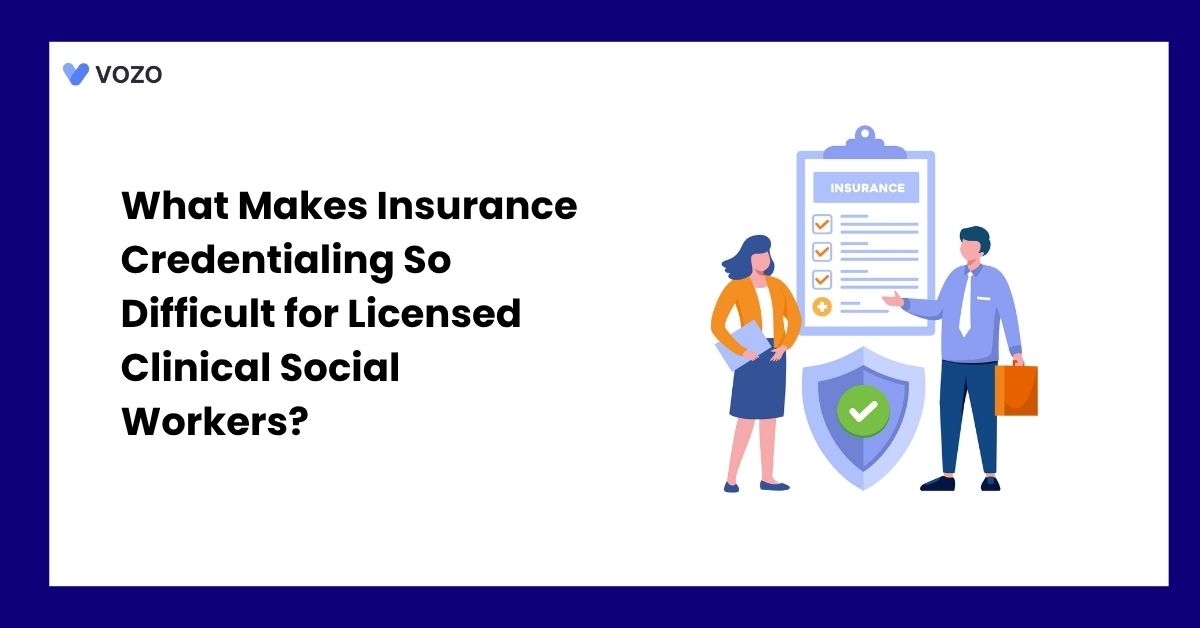
What Makes Insurance Credentialing So Difficult for Licensed Clinical Social Workers?
A licensed clinical social worker can meet every state requirement for independent practice and still be unable to bill an insurance plan.
The problem is not usually the clinician’s qualifications. Joining an insurance network involves several separate steps. The payer reviews the LCSW’s background, decides whether the network is open, issues a contract, and sets up the billing relationship.
The clinician’s information must be consistent everywhere. This includes state licensing records, federal provider databases, DataSpring, Medicare, Medicaid, payer portals, and practice records. Even small errors can cause delays. Examples include an old address, an expired liability policy, an incorrect business name, or missing group affiliation.
Insurance credentialing is difficult because no single system controls every step. Licensing, credentialing, contracting, enrollment, and billing setup happen separately. A delay in one stage can slow the entire process.
What Is Insurance Credentialing for Licensed Clinical Social Workers?
Insurance credentialing is the process a health plan uses to confirm that a licensed clinical social worker meets its professional standards.
It is different from state licensure. A state license determines whether the social worker may legally practice in that jurisdiction. Credentialing determines whether the clinician meets a payer’s requirements.
This process differs from state licensure. A state license allows a social worker to practice legally in a specific area. Credentialing determines if the clinician meets a payer’s requirements.
A payer may examine various documents. These include the LCSW’s license, education, supervised experience, work history, National Provider Identifier, liability coverage, practice locations, and references.
Credentialing confirms that an LCSW meets professional standards. However, it does not automatically place the clinician in a payer network or activate insurance billing.
The National Uniform Claim Committee taxonomy code for a clinical social worker is 1041C0700X. LCSWs should confirm that the correct code appears in payer and federal provider records. An incorrect code may cause manual review or route the application to the wrong team.
Credentialing, Contracting, and Enrollment Are Different
Many providers use the phrase “getting credentialed” to describe the entire insurance onboarding process. In reality, several approvals may be involved.
| Stage | What It Determines |
| Credentialing | Whether the LCSW meets professional standards. |
| Network review | Whether the payer is considering new providers in that specialty and area. |
| Contracting | Which reimbursement rates, products, and contract terms will apply? |
| Enrollment | Whether the provider is entered into the payer’s administrative and claims systems. |
| Group affiliation | Whether the LCSW is connected to the correct practice or group. |
| Billing and claims setup | Whether claims can be processed under the approved billing relationship. |
A provider can finish one stage while another remains incomplete.
For example, credentialing may be approved while the contract is still pending. The contract may then be signed before the clinician is linked to the correct tax ID, location, and insurance products.
Aetna states that credentialing is separate from network contracting. Carelon Behavioral Health needs providers to finish credentialing. They must also get a countersigned contract before treating patients as approved network providers.
This separation is one of the main reasons LCSW insurance credentialing becomes confusing.
Why Is Insurance Credentialing So Difficult for Licensed Clinical Social Workers?
1. State Licenses and Payer Rules Do Not Follow One Standard
Social work licenses are issued by states and territories rather than through one national licensing system. A clinical social worker may hold an LCSW, LICSW, LISW, LCSW-C, or another title, depending on the jurisdiction.
The Association of Social Work Boards (ASWB) confirms that social work license categories and requirements vary by jurisdiction. Social workers usually need permission in their state or territory. This applies even when they offer services online.
A payer application may use “LCSW” as a general provider category, while the clinician’s official state title is different. The payer may then need to confirm whether that license permits independent clinical practice.
The review becomes more difficult when the clinician is licensed in several states or provides telehealth across state lines. A license in one state does not automatically update payer participation in another.
State licensure determines whether the social worker may practice legally. The payer separately decides whether the clinician can join its network and bill under its contract.
2. One Application Includes Several Separate Approval Stages
An LCSW may believe that one department reviews the application from start to finish. That is often not the case.
Network staff may first decide whether the plan needs another clinical social worker. Credentialing, contracting, and enrollment teams may then handle different parts of the application.
Each stage may have its own staff, documents, status, and completion date.
Common situations include:
- The LCSW is credentialed but has not received a final contract.
- The agreement is signed but has not been countersigned.
- The clinician gets approval, but the billing group remains unconnected.
- One product or location is active while another remains pending.
Aetna’s process shows how network review, contracting, credentialing, and system updates may happen at different stages. Other insurers may use a different order.
The exact sequence varies. However, the main problem stays the same: several teams control different parts of the approval.
3. Provider Information Must Match Across Several Systems
An LCSW may need to keep the same information in many systems.
These include state license records, the National Plan and Provider Enumeration System, DataSpring, payer portals, Medicare’s Provider Enrollment, Chain, and Ownership System, Medicaid systems, group rosters, directories, and payment platforms.
These systems do not always exchange updates.
The Centers for Medicare & Medicaid Services warns that an NPI update does not automatically update the provider’s Medicare enrollment record. The clinician must review and update each system separately.
Common mismatches include:
| Information | Example of a Mismatch | Possible Issue |
| Legal name | New surname in NPPES, former surname on license | Additional identity review |
| Practice address | New office on application, old office in NPPES | Application returned for correction |
| Tax name | Business name does not match the W-9 | Contract or payment delay |
| License title | General LCSW title instead of the state title | Manual license review |
| Taxonomy | General social worker code instead of the applicable clinical code | Specialty or application-routing issue |
| Liability insurance | Expired certificate in the provider profile | Credentialing hold |
| Group relationship | LCSW approved individually but not linked to the billing practice | Rejection, denial, or incorrect payment |
Not every mismatch produces the same result. It may delay approval or cause a claim rejection, denial, out-of-network payment, or payment under the wrong provider record.
CMS also requires covered providers to update address changes in NPPES within 30 days of the effective date.
LCSWs should check each system before applying changes. They shouldn’t assume that a change in one portal affects the others.
4. DataSpring Reduces Repeated Work but Does Not Replace Payer Applications
CAQH began operating under the DataSpring brand in 2026. Clinicians continue to use the CAQH Provider Data Portal to maintain and share professional information.
The portal reduces repeated data entry. However, it does not create one national credentialing approval.
The LCSW must keep the profile current and respond to requests shown in the portal. The clinician must also authorize the relevant health plans to access the information.
A current profile supports payer review. It does not mean that:
- The payer’s panel is open.
- The clinician has been accepted.
- The contract is final.
- The group affiliation is active.
- Billing has started.
An application may remain delayed because payer access is missing, a document has expired, or a payer-specific form is incomplete.
5. Behavioral Health Networks and Closed Panels Add Another Barrier
The insurer shown on a patient’s card may not directly manage outpatient behavioral health services.
Another organization may manage credentialing, contracts, authorizations, claims, or provider directories. An LCSW who applies through the medical network may later learn that behavioral health providers use a different process.
Before applying, an LCSW should confirm:
- Who manages behavioral health benefits?
- Is the network accepting clinical social workers?
- Which insurance products are included?
- Is the application for the individual, the group, or both?
- Does each practice location need approval?
- Are Medicare and Medicaid handled separately?
Applying through the wrong channel can waste weeks without producing a valid participation request.
Even a complete application may be declined when the payer’s panel is closed. Insurers may review local provider supply, member demand, geographic access, languages, telehealth availability, and specialty needs before adding clinicians.
Aetna first evaluates whether it needs another provider in the applicant’s area before deciding whether to begin the contracting process.
In a 2025 review of 40 Medicare Advantage plans and 20 Medicaid managed care plans across 10 counties, the U.S. Department of Health and Human Services Office of Inspector General (HHS OIG) found limited behavioral health networks and inactive providers in plan directories.
The study was limited to selected plans and counties, so it should not be treated as a national measurement. However, it shows how a network can appear larger on paper than it is in practice.
6. Individual and Group Enrollment Must Be Connected Correctly
An individual LCSW uses a Type 1 NPI. A separate corporation, group, or other eligible organization may also need a Type 2 NPI. A sole proprietor generally uses only the individual’s Type 1 NPI, so the correct setup depends on the legal and billing structure.
When an LCSW joins a practice, the payer may need to approve both the clinician and the billing relationship.
The individual may be credentialed but still not be linked to the group’s tax identification number (TIN), organizational NPI, contract, service locations, network products, or payment record.
This issue commonly appears when an LCSW changes employers, joins a group, creates a new business entity, changes tax IDs, adds a location, or reassigns Medicare benefits.
Existing payer participation does not always transfer automatically to a new practice or tax ID. The new practice may need a roster update, affiliation request, reassignment, contract amendment, or separate enrollment application before claims can be processed correctly.
7. Medicare and Medicaid Use Separate Enrollment Processes
Commercial payer approval does not automatically enroll an LCSW in Medicare or Medicaid.
For Medicare, a clinical social worker generally must hold a master’s or doctoral degree in social work, complete at least two years of supervised clinical social work, and meet the applicable state licensing or certification requirement. The clinician must then complete Medicare enrollment through PECOS.
Medicaid processes vary by state, provider type, practice structure, and managed care arrangement. An LCSW may need state enrollment, provider screening, a Medicaid provider agreement, managed care credentialing, group affiliation, location approval, and periodic revalidation.
An LCSW may therefore be enrolled with the state but not contracted with the patient’s managed care plan. A managed care plan may also complete its credentialing review while the clinician’s state Medicaid enrollment remains incomplete.
8. Verification, Contracting, and Effective Dates Delay Final Approval
Credentialing organizations may verify licenses, education, work history, liability coverage, sanctions, exclusions, and professional disclosures.
A file may remain incomplete when a license renewal is not visible or a former employer has not responded. Dates that do not match can also delay the review.
Name changes, work gaps, expired documents, and disclosures may require manual review.
These issues do not always mean the clinician is unqualified. They may simply prevent the reviewer from closing the file.
Even after credentialing is approved, the LCSW may still be waiting for:
- Final or countersigned contract
- Group and location approval
- Product enrollment
- Payer system loading
- Written effective date
A directory listing, welcome email, or verbal approval does not always confirm that the billing relationship is active.
Carelon tells providers that credentialing approval and a countersigned contract are required before they treat patients as approved network providers.
Before billing, confirm the rendering NPI, billing NPI, tax ID, group relationship, approved locations, network products, payer ID, and effective date.
Why Credentialing Hits Independent LCSWs Harder
Large health systems may have separate credentialing, contracting, compliance, and billing teams. A solo LCSW may perform the same work while continuing to provide therapy, complete notes, verify benefits, and manage the practice.
Credentialing work also happens before the expected revenue begins. Delays can reduce patient access, interrupt referrals, and place pressure on practice cash flow.
For an independent clinician, a missing document is not a minor administrative issue. It may prevent the practice from accepting insured patients or receiving payment for completed care.
Prioritize Patient Care Over Managing Disconnected Software
Bring clinical notes, appointments, insurance workflows, billing, and communication together with Vozo.
How Long Does LCSW Credentialing Take?
There is no single national credentialing timeline. The total time depends on whether the panel is open, whether the application is complete, how quickly primary sources respond, and how long contracting and payer system loading take.
Some insurers publish their own estimates. Aetna says it will respond within 45 days about participation eligibility and separately notes that credentialing can take approximately 45 days. These estimates are payer-specific and may not include missing-document follow-up, contract completion, group enrollment, or billing setup.
Where Do LCSW Credentialing Applications Usually Get Stuck?
Applications can stall before or after the professional review.
| Stage | Common Delay | Question to Ask |
| Network request | Wrong channel or closed panel | Is the network open for LCSWs in this area? |
| Application review | Missing document or field | Has my application been marked complete? |
| DataSpring access | Missing authorization or outdated profile | Can you access my current profile? |
| Verification | License, name, or work-history mismatch | Which source or item remains pending? |
| Contracting | Agreement not final or countersigned | Is my contract complete? |
| Group enrollment | Provider not linked to the group TIN | Is my NPI active under the correct billing entity? |
| System loading | Product or location missing | Which products and locations are active? |
| Effective date | Participation date not confirmed | What is my written effective date? |
| Medicare or Medicaid | State, PECOS, plan, or reassignment step incomplete | Which government or plan enrollment remains pending? |
The word “pending” is not detailed enough. The LCSW should ask which stage is incomplete, which department owns the next step, and whether the payer needs anything from the clinician.
How Can LCSWs Reduce Credentialing Delays?
Create One Verified Provider Record
Maintain one master record containing legal names, licenses, NPI and taxonomy information, tax details, practice locations, work history, liability coverage, government enrollment, and group relationships.
Use the same spelling, dates, and addresses in every application.
Check Every System Before Applying
Review the state license record, NPPES, DataSpring, PECOS, Medicaid records, liability documents, and group information. Do not assume that changing one system updates the others.
Confirm the Correct Behavioral Health Network
Ask who manages behavioral health benefits and whether the panel is open. Confirm which products, locations, and billing relationships the application covers.
Track Every Approval Stage
Track application completeness, verification, committee review, contracting, group affiliation, enrollment, the effective date, claims setup, electronic funds transfer (EFT), electronic remittance advice (ERA), and directory status separately.
Confirm Activation Before Billing
Obtain the effective date and approved billing relationship in writing.
Confirm that the clinician’s Type 1 NPI is connected to the correct tax ID, group, locations, and products, when applicable, before submitting in-network claims.
LCSW Credentialing Readiness Checklist
| Item | What to verify |
| State license | Active status and exact license title |
| NPI | Correct legal name, address, and applicable taxonomy, including 1041C0700X when appropriate |
| W-9 | Matching legal business name and TIN |
| DataSpring profile | Complete, authorized, and current |
| Liability insurance | Active policy with the correct insured name |
| Work history | Clear dates with explained gaps |
| Practice locations | Every office and telehealth location |
| Group relationship | Correct individual NPI, organizational NPI when applicable, tax identification number, contract, and group affiliation |
| Medicare | PECOS enrollment and reassignment, when applicable |
| Medicaid | State and managed care enrollment, when applicable |
| Contract | Final agreement received and stored |
| Effective date | Written date for each product |
| Claims setup | Electronic data interchange (EDI), EFT, ERA, and payer ID confirmed |
| Ongoing maintenance | License renewals, liability coverage, DataSpring updates, directory reviews, payer recredentialing, and document expiration dates |
| Provider directory | Correct address, telephone number, availability, locations, and network products |
Bottom Line
Insurance credentialing is difficult for licensed clinical social workers because no single organization manages the full process. State licensing, professional verification, network review, contracting, government enrollment, group affiliation, and billing setup must all align before the clinician can bill correctly.
LCSWs cannot prevent every payer delay. However, they can reduce avoidable problems by keeping provider information consistent, confirming the correct network, tracking each approval stage, and waiting for written activation before submitting in-network claims.
Frequently Asked Questions
1. What does insurance credentialing mean for social workers?
Insurance credentialing is the process a health plan uses to verify a social worker’s license, education, supervised experience, work history, professional liability coverage, practice locations, and other qualifications. Credentialing confirms professional eligibility, but it does not automatically create a payer contract or activate in-network billing.
2. What are the steps for insurance credentialing for social workers?
The process usually begins with confirming that the payer’s network is open. The social worker then completes the payer application, updates their DataSpring profile, submits supporting documents, and completes primary-source verification. After approval, contracting, group affiliation, payer enrollment, and billing setup may still be required before claims can be paid.
3. What is the difference between credentialing and contracting for social workers?
Credentialing verifies whether the social worker meets the payer’s professional standards. Contracting establishes the reimbursement rates, insurance products, participation terms, and responsibilities that apply to the provider. An LCSW may complete credentialing but remain out-of-network until the contract is signed, countersigned, and activated by the payer.
4. How long does insurance credentialing take for an LCSW?
There is no single national timeline. Some insurers publish review estimates of about 45 days after receiving the required information, but the complete process may take longer. Network review, missing documents, primary-source verification, contracting, group enrollment, Medicare or Medicaid requirements, and payer system setup can extend the timeline.
5. Can an LCSW bill insurance while credentialing is pending?
An LCSW should not present themselves as an in-network provider until the payer confirms the participation effective date and billing relationship. Services provided before activation may be processed as out-of-network, rejected, denied, or assigned to the patient. The practice should obtain written confirmation before submitting in-network claims.
Support the Work That Comes After Credentialing With Vozo
Credentialing determines whether an LCSW may join an insurance network. The EHR and practice management system support the daily work that follows.
Vozo EHR brings scheduling, intake, telehealth, clinical notes, eligibility checks, billing, and patient communication into one connected workflow. It helps solo LCSWs and behavioral health groups reduce repeated data entry and keep clinical and billing information aligned.
About the author
Lara Dixit


Lara Dixit is a Senior Business Manager at Vozo Health, specializing in EHR platforms, practice management, billing, and revenue cycle optimization. She helps healthcare providers improve operational efficiency, streamline workflows, and drive sustainable practice growth. At Vozo Health, she focuses on business strategy, healthcare automation, and scalable growth for modern medical practices.