


12 Common Mental Health Claim Denials and How Practices Can Prevent Them
A client starts therapy, attends every session, and does the work.
Then the denial arrives.
Now your front desk is calling the payer, your clinician is defending medically necessary care, and your practice is waiting to be paid for services already delivered.
Behavioral health claims face persistent denial pressure. CipherBilling issued behavioral health denial rates of approximately 30%, as opposed to approximately 19% for other medical specialties in 2023.
The good news? Most denials are from familiar issues, such as eligibility denials, missing authorizations, coding inaccuracies, missing documentation and disorganized behavioral health EHR workflows.
The purpose of this guide is to explain why claims for common mental health issues are denied, how this occurs, and what practices can do to avoid these denials in 2026. It also provides a summary of the latest telehealth billing changes, automated utilization review and the status of federal enforcement of mental health parity.
Key Takeaways
- Behavioral health claims are denied more often than medical and surgical claims, largely because every therapy session has to independently justify its own medical necessity.
- Eligibility and authorization issues cause a large share of denials, and both are preventable with a quick verification check before the first session and periodic rechecks after.
- Coding errors are one of the most common preventable denial drivers in 2026, especially telehealth, place of service mismatches and time-based CPT upcoding.
- Payers are increasingly using automated utilization review to flag progress notes that lack measurable symptom severity and functional impairment data.
- MHPAEA parity protections are in a state of flux in 2026. The original 2013 baseline rules remain enforceable, but stricter 2024 final rule provisions are currently seeing limited federal enforcement.
- A written, systematic denial prevention workflow consistently outperforms writing appeals after the fact.
First, Know What Type of Claim Problem You Have
| Claim Status | What It Means | Typical Next Step |
| Rejected | The claim failed front-end submission, format, enrollment, or data validation and was not accepted for adjudication. | Correct the error and resubmit the claim. |
| Denied | The payer adjudicated the claim but did not pay it as submitted. | Review the ERA or EOB and determine whether to submit a corrected claim or an appeal. |
| Pending | The payer has not completed processing because information, records, coordination of benefits, or another action is required. | Provide the requested information and monitor the claim. |
| Underpaid | The claim was paid, but the amount may not match the contract, fee schedule, units, or expected patient responsibility. | Compare the payment with the contract and submit a reconsideration or dispute if necessary. |
Why Mental Health Claims Are Denied More Than Any Other Specialty
Before we get into the list, it helps to understand why behavioral health gets hit so much harder than other specialties.
In most areas of medicine, a diagnosis drives a treatment plan, and individual visits are not heavily scrutinized once that plan is approved. In behavioral health, every single session has to independently justify its own medical necessity.
There is no X-ray or lab value to point to. Only documented symptoms, risk factors, and functional impairment, all of which insurers can question far more easily than they could question a broken bone.
Add payer-specific telehealth rules, plans that route mental health claims to a separate administrator, and increasingly active automated utilization review, and you get a specialty where claim denials are not an occasional annoyance. They are a structural risk to practice revenue.
The encouraging part is that the causes are well documented and highly predictable. Here is the full breakdown.
12 Most Common Mental Health Claim Denials
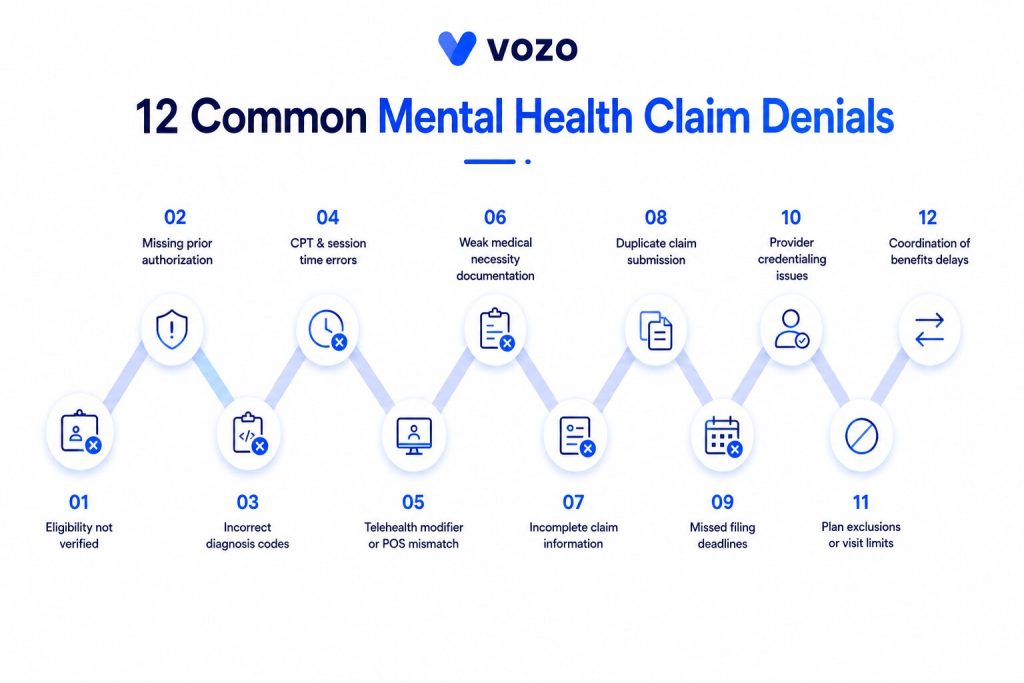
1. Eligibility Not Verified Before the Session
What happens and why: The client’s coverage lapsed, changed plans, or never included the behavioral health benefit you assumed it did. You only find out after the claim bounces.
This usually happens because practices verify eligibility once at intake and never again, even though coverage can change mid-treatment without the client realizing it.
A new employer plan, a lapsed COBRA payment, or a switch during open enrollment can all quietly end coverage you thought was active.
How to prevent it: Check eligibility status before each first appointment and frequently once a month for current clients, particularly during the transition between plan years (usually in January) and during open enrollment.
Most EHR and practice management platforms support automated real-time eligibility checks, so use them. Confirm not just that coverage is active, but that mental health benefits specifically are included, since some employer plans route behavioral health claims to a completely separate administrator.
2. Missing or Invalid Prior Authorization
What happens and why: The payer required prior authorization for the service, level of care, or number of sessions, and none was on file.
Authorization rules vary by payer, plan tier, and even diagnosis, and they can change without much notice. A plan that did not require authorization for outpatient therapy last year might require it this year, particularly for intensive outpatient or partial hospitalization levels of care.
How to prevent it: Build a payer-specific authorization matrix and check it before scheduling, not just before billing. Track authorization expiration dates and approved session counts against actual utilization.
A common and entirely preventable denial occurs when a practice exceeds the approved number of sessions without requesting a timely reauthorization.
3. Diagnosis Code Errors
What happens and why: The claim uses an inactive ICD 10 code, an overly vague unspecified code, or a diagnosis the plan does not cover for mental health services at all.
Every year ICD 10 codes change and the unspecified codes are used far too much as the easy way to intake a patient in a rush. They are also one of the first indicators that utilization reviewers see when flagging for thin clinical justification.
How to prevent it: Code with the highest specificity the clinical picture supports, and verify every code against a current ICD 10 lookup tool before submission. A quick check for active versus retired status can save you a denial entirely.
Remember that a DSM 5 diagnosis alone is not always billable. Some plans require more than a Z code as the primary diagnosis, and certain conditions are excluded from mental health coverage no matter how accurately they are coded.
4. CPT Code and Time-Based Billing Errors
What happens and why: The session gets billed under the wrong time-based code, most often 90837 billed on a session that ran 45 to 50 minutes rather than the required 53 or more. This can trigger an upcoding denial or a post-payment audit and recoupment.
The tradition of the 50-minute therapy hour does not match CPT rules, which use a fixed minute threshold. Rounding up from 50 minutes to bill 90837 is a well-documented pattern that payer review systems are trained to catch.
How to prevent it: Document exact start and stop times, or total minutes, in every note rather than just selecting a code from memory.
Train clinicians on the specific minute thresholds for 90832, 90834, and 90837. Run a monthly internal audit sampling a portion of notes against the codes actually billed. Precise time documentation alone closes one of the most costly denial categories in current billing data.
5. Telehealth Place of Service and Modifier Mismatches
What happens and why: The claim gets denied or underpaid because the place of service code does not match where the patient actually was, or a required modifier is missing entirely.
Place of service 10 means the patient is at home and pays the higher non-facility rate. Place of service 02 means the patient was elsewhere and pays the lower facility rate. The exact dollar difference varies by payer and contract, but it is consistently meaningful enough to affect revenue at scale.
Many commercial payers now require modifier 95 for video sessions and modifier 93 for audio-only sessions. Medicare’s decision not to reimburse the newer telehealth code family also means many practices have to run two parallel coding approaches depending on the payer.
How to prevent it: Build a payer-specific telehealth reference showing which place of service codes, modifiers, and code families each of your top payers accepts. Build it into your claim scrubbing process as a hard stop before submission.
Modifier order matters too. Pricing modifiers generally need to appear before informational modifiers on the claim form, and getting that order wrong can trigger a denial even when every code on the claim is technically correct.
6. Insufficient Documentation of Medical Necessity
What happens and why: After a clinical review, the payer decides the notes do not adequately support the need for treatment, the level of care, or the session frequency, even when the care itself was entirely appropriate.
This has become one of the most consequential denial categories in behavioral health. Payers are increasingly using automated claims analysis to flag notes that lack measurable symptom severity, documented functional impairment, or clear progress toward treatment goals. A single weak progress note can put an entire treatment episode at risk, not just the one session it was written for.
How to prevent it: Standardize every note around a simple structure such as diagnosis, functional impairment, intervention performed, patient response, and plan for next steps.
Structured notes and documentation workflows can help clinicians capture consistent data elements, reduce omissions, and maintain clearer support for coding and audit review. However, every note must still be individualized to the patient, service, intervention, and response.
Use specific terms such as a patient in distress instead of vague terms, and quantify the distress, such as a specific score on a symptom scale and what changed from the last visit.
Using validated outcome measures such as the PHQ-9, GAD-7, or PCL 5 at regular intervals is one of the fastest ways to give a utilization reviewer objective, quantifiable evidence instead of subjective narrative alone.
Catch Billing Errors Before Claims Reach the Payer
Eligibility gaps, missing authorization details, coding mistakes, and incomplete claim data are easier to fix before submission. Vozo connects clinical documentation with billing workflows, so your team can review claims, track payments, and identify issues earlier.
7. Incomplete or Incorrect Claim Forms
What happens and why: A field on the claim form is missing, mismatched, or filled in incorrectly, such as the wrong claims address, an incorrect NPI, or mismatched patient demographics. The claim gets rejected before it is even clinically reviewed.
Most mental health claims use the CMS 1500 form, but some EAPs and separately administered plans require their own proprietary forms.
The claims mailing or electronic payer ID on a client’s insurance card is also frequently outdated for these plans, since mental health claims often route to a different administrator than medical claims.
How to prevent it: Confirm the correct claim form and payer ID directly with the plan rather than assuming the address on the insurance card is correct for behavioral health claims.
Use an EHR with integrated billing or a dedicated claim-scrubbing tool that flags missing demographics, provider details, diagnosis codes, payer information, and other required fields before submission.
8. Duplicate Claim Submissions
What happens and why: A claim is submitted before the original claim has been processed, and the payers’ system recognizes it as a duplicate and prevents and delays it from being paid.
This typically occurs when a claim is submitted when someone is frustrated, is waiting too long to be granted and resubmits it just in case, only to find out the claim was still pending or denied for a correctable reason.
How to prevent it: Never resubmit a denied or slow-moving claim without first correcting the actual issue and confirming the original claim’s status.
If a correction is needed, use the proper corrected claim resubmission code rather than submitting a fresh claim from scratch, since most payers require a specific frequency code to distinguish a correction from a duplicate.
9. Timely Filing Deadline Missed
What happens and why: The claim gets submitted after the payer’s filing deadline, commonly around 90 days from the date of service, though it varies by payer and can be shorter for some in-network plans.
This often happens because claims get stuck in an internal backlog, a staffing transition creates a gap, or a claim bounces for a small fixable error and the correction takes long enough to blow past the deadline.
How to prevent it: Track every payer’s specific timely filing window in your payer matrix rather than assuming a universal number. Build an internal deadline that is tighter than the payer’s, for example, submitting within 30 days of service to leave a buffer for corrections.
If a claim is denied for timely filing, do not assume it is a dead end. Many payers grant exceptions with documented proof of a system error, a coordination of benefits delay, or other good cause circumstances.
10. Provider Licensure or Network Status Issues
What happens and why: The insurance company denies the claim because that payer does not recognize the clinician’s credential or the clinician is not fully licensed or the client’s insurance plan only covers those providers in the network.
Credentialing processes with well-known companies may take months, and an associate can begin working with clients while they are still in the process of credentialing. Some plans also cover only fully licensed providers, which creates a gap for associate-level or pre-licensed clinicians providing supervised care.
How to prevent it: Never schedule a new clinician’s insurance-billed sessions until credentialing confirmation is in hand, and track application status weekly rather than only at submission.
For pre-licensed or associate clinicians, confirm the payer’s specific supervision billing rules in advance. Virtual supervision is acceptable for many payers in 2026, but the supervising provider still needs to meet documented availability standards, and that documentation needs to appear in the note itself.
11. Plan Specific Exclusions and Visit Limits
What happens and why: The service itself, whether a certain level of care, a specific diagnosis, or a session count beyond a plan-imposed cap, simply is not covered under that particular plan.
Some plans still impose visit caps, exclude specific diagnoses, or do not cover intermediate levels of care like intensive outpatient or partial hospitalization the way they cover equivalent medical and surgical levels of care.
How to prevent it: This is where the Mental Health Parity and Addiction Equity Act, known as MHPAEA, becomes your most powerful tool. Guidance published by the National Alliance on Mental Illness explains that MHPAEA requires insurers to apply treatment limitations to behavioral health no more restrictively than comparable medical and surgical benefits. A hard visit cap on therapy with no equivalent cap on physical therapy is a textbook example of a parity issue worth appealing.
There is an important detail for 2026. Reporting on the current regulatory landscape indicates that stricter 2024 MHPAEA final rule provisions, including outcome data and meaningful benefits requirements, are currently seeing limited federal enforcement, while the original 2013 baseline parity rules remain in effect.
In practice, parity-based appeals are still worth pursuing, but they are on firmer ground when built on the 2013 framework and, where applicable, state-level parity laws, some of which go further than federal law. Citing MHPAEA by name in an appeal is still a meaningful step.
12. Coordination of Benefits Delays
What happens and why: The claim sits in a pending status because the payer is waiting on information about a client’s other possible insurance coverage before it will process payment.
Clients with more than one insurance plan, such as a spouse’s plan or dual-eligible Medicare and Medicaid coverage, need to actively confirm which plan is primary, and payers often cannot move forward until that information is on file, sometimes without clearly communicating that to the provider.
How to prevent it: Ask directly during intake whether the client has any other health coverage, and if so, get both plans’ information and their coordination of benefits order confirmed before billing.
When billing a secondary plan, always attach the primary plan’s Explanation of Benefits, since a claim submitted without it is essentially guaranteed to be pending or denied.
Building a Denial Prevention System, Not Just a Checklist
Fixing these 12 issues one at a time helps, but the practices with the lowest denial rates treat prevention as a system rather than a reaction. Three things make the biggest difference.
First, keep a denial tracking log. Categorize every denial by reason code, payer, and root cause, and patterns will emerge fast. You will often find that just three or four recurring issues account for the majority of your denied revenue.
Second, maintain a payer-specific matrix. Authorization rules, timely filing windows, accepted claim forms, and telehealth code requirements differ from payer to payer. A single shared reference document, updated quarterly, prevents staff from relying on memory or guesswork.
Third, use a pre-submission claim scrubber. When selecting a platform, evaluate whether its integrated billing and telehealth capabilities include eligibility checks, claim submission, payment posting, denial tracking, and billing reports rather than basic invoicing alone.
The practices that get this right do not necessarily have simpler cases. They just have far fewer preventable losses on the cases they already have.
Reduce Preventable Denials Before They Affect Cash Flow
Correcting one denied claim may recover one payment. Correcting the workflow behind it can prevent the same problem across future claims.
Vozo’s revenue cycle management solution supports billing, coding, claims, payment tracking, and denial follow-up so your practice can reduce rework and keep revenue moving.
Frequently Asked Questions
1. What is the most common reason mental health claims get denied?
Documentation that does not adequately support medical necessity is currently one of the most consequential denial reasons, closely followed by eligibility and authorization gaps.
Payers are increasingly using automated review to flag notes lacking measurable symptom severity or functional impairment data, so even clinically appropriate care can be denied if the documentation does not quantify it clearly.
2. How long do I have to appeal a denied mental health claim?
It depends on the payer and plan type, but most commercial plans allow at least 180 days from the denial notice to file an internal appeal under ACA requirements.
Medicare and Medicaid have their own specific appeal windows. Always check the denial letter itself for the exact deadline, and request an expedited appeal if the denial affects urgent or ongoing care.
3. What is the difference between place of service 10 and 02 for telehealth billing, and why does it matter for denials?
Place of service 10 indicates the patient received telehealth at home and pays the higher non-facility rate, while place of service 02 indicates the patient was elsewhere, such as a clinic or school, and pays the lower facility rate.
Using the wrong code does not just reduce reimbursement. Payer systems increasingly flag place of service and modifier mismatches as an automatic denial trigger, so getting this right affects both approval and payment amount.
4. Can I bill for a 90837 session if it only lasted 50 minutes?
No. CPT time thresholds are specific: 90834 covers 38 to 52 minutes, and 90837 requires 53 minutes or more. Billing 90837 for a 50-minute session is considered upcoding and is one of the more commonly flagged errors in current payer audits. Document exact session length in every note to support whichever code is billed.
5. How do I prevent denials caused by missing prior authorization?
Verify authorization requirements before scheduling, not just before billing, since requirements vary by payer, plan, and level of care and can change without much notice.
Track approved session counts and authorization expiration dates against actual utilization, and submit reauthorization requests before the current approval runs out rather than after.
About the author
Lara Dixit


Lara Dixit is a Senior Business Manager at Vozo Health, specializing in EHR platforms, practice management, billing, and revenue cycle optimization. She helps healthcare providers improve operational efficiency, streamline workflows, and drive sustainable practice growth. At Vozo Health, she focuses on business strategy, healthcare automation, and scalable growth for modern medical practices.