

How EHR-Driven Patient Registration Reduces Claim Errors by 40%
Healthcare providers lose billions of dollars each year due to claim denials, which are frequently caused by incorrect patient data. However, with the implementation of EHR-driven registration procedures, healthcare providers are lowering claim-related mistakes by up to 40% in several circumstances.
As healthcare systems become more automated, front-end operations like patient intake and registration are crucial to downstream claims performance.
In this blog, you’ll know how EHR-integrated patient registration improves data accuracy, helps payers comply, and simplifies the whole revenue cycle.
The High Cost of Incorrect Patient Registration
Patient registration is the first step of every clinical and billing process. Unfortunately, this is where the majority of data problems begin. Wrong date of birth, misspelled name, or incorrect insurance policy number can lead to rejected claims and delayed payouts.
Front-desk employees using outdated or siloed systems frequently lack real-time access to payer eligibility, demographic validation, and duplicate record warnings.
This fragmented architecture makes it difficult to maintain data integrity and adhere to payer standards, resulting in claim rework, rejections, and revenue loss.
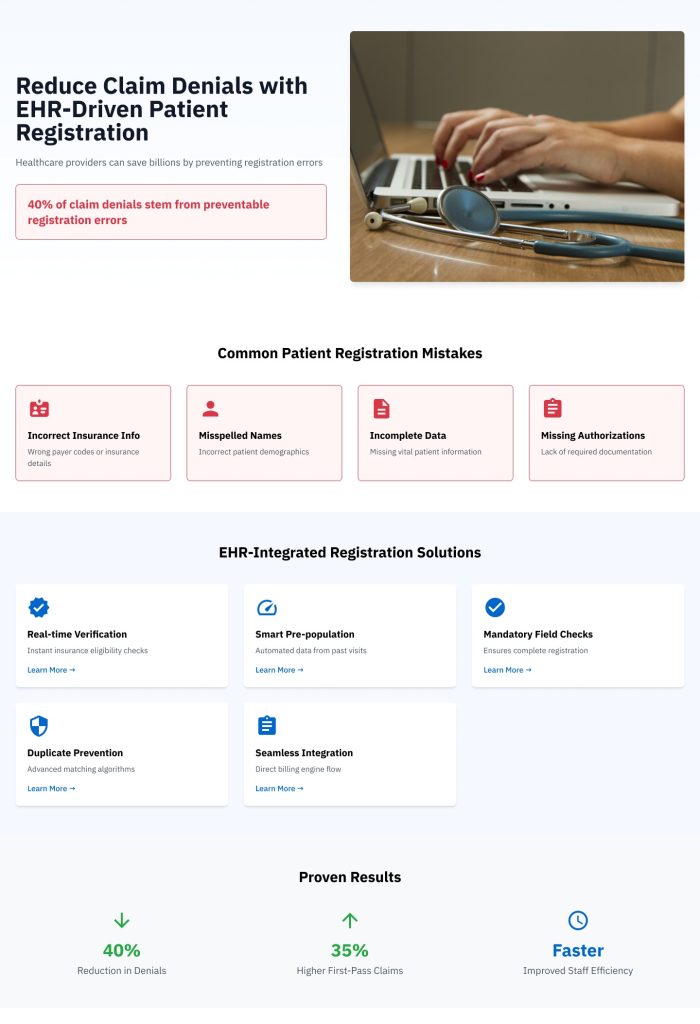
Common registration problems affecting claims include:
- Incorrect insurance identification or payer code
- Misspelled patient names or mismatched DOBs
- Outdated or unconfirmed demographic data
- Missing previous permission data
- Duplicate patient records
How EHR Integration Improves Registration Workflows
When patient registration is integrated into the EHR workflow, data accuracy and operational efficiency improve significantly. With integrated fields, dropdown validations, and API linkages to eligibility systems, EHRs can ensure clean data submission from the start.
Furthermore, EHR-driven registration saves human entry by automatically entering demographic and insurance information from previous visits or other data sources. This reduces typographical mistakes and saves time for both front-office employees and patients.
Benefits of EHR-Integrated Registration
- Real-time insurance eligibility verification
- Automated demographic check against payer rules.
- Unified patient profile for appointments, billing, and clinical records
- Alerts for missing or contradictory data.
- A seamless transition from registration to claim creation.
Related: Top 10 Features to Consider Before Choosing the Patient Portal
Core Features that Reduce Errors
1. Automated Insurance Eligibility Checks
- Verifies insurance coverage in real time during registration.
- Inactive insurance or coverage mismatches are flagged before submitting a claim.
2. Field Validations & Mandatory Data Capture
- Requires important fields such as DOB, policy ID, gender, and address.
- Avoids the filing of incomplete claims.
3. Duplicate Record Prevention
- Uses patient-matching logic to avoid data duplication.
- Ensures integrated records across visits, which improves claim consistency.
4. Pre-populated Demographics
- Retrieves existing patient data from past visits.
- Reduces data entry mistakes and improves registration time.
5. Audit Trails and Change Logs
- Tracks any changes made to registration data.
- Provides openness and responsibility for compliance.
From Accurate Intake to Clean Claims
Accurate patient input has a direct influence on claims quality. Once patient information is validated and saved accurately in EHR-driven processes, it flows effortlessly into the billing module, lowering the likelihood of rework or claim rejection.
Because the claim engine depends on structured data from registration, the danger of mismatch with payer criteria is reduced. As a result, first-pass claim acceptance rates rise while the time-to-payment cycle shortens.
Healthcare institutions that use EHR-based registration have reported:
- 40% fewer registration-related claim denials
- 25-35% increase in first-pass claim acceptance.
- Faster patient check-in times and higher patient satisfaction
Integration of Clearinghouses and Payment Systems
Another benefit of EHR-driven registration is its seamless connection with clearinghouses and payment systems. Many current EHR platforms provide real-time API or HL7 interfaces, enabling fast eligibility checks and demographic validation.
This connection guarantees that any abnormalities, such as plan mismatches or inactive policies, are identified at the time of registration rather than after a claim is filed. This proactive verification minimizes administrative effort while improving payer-provider alignment.
Systems can automatically provide alerts when key payer-specific data is missing, allowing staff to rectify issues in real time before billing begins.
Optimizing Staff Workflow and Compliance
EHR-based registration also provides front-desk and billing staff with tools to make more informed judgments. Role-based workflows, user-friendly interfaces, and built-in reminders assist employees through the intake process, ensuring that no crucial data item is missed.
Standardized data gathering enhances documentation for audits and regulatory needs, which benefits compliance. By implementing best practices at the intake stage, healthcare businesses may avoid payer audits, HIPAA compliance, and interoperability obligations.
Key compliance benefits include:
- Accurate patient identity matching and minimizing duplicate records.
- Improved tracking of permission and authorization documents.
- Time-stamped data entry records for audit trails.
- Complying with CMS and payer-specific documentation standards.
Vozo Patient Portal Solution
Vozo patient portal software provides a comprehensive solution to help healthcare providers achieve clinical, financial, and operational excellence through a powerful patient portal.
Our exceptional Patient Portal Software will allow:
- Have complete access to patients’ medical records digitally
- Our cost-effective subscription plan helps healthcare practices at all levels.
- The Vozo patient portal can effortlessly be integrated and implemented with any EHR system to increase productivity.
- Vozo’s Patient Portal respects users’ privacy and safeguards health-related records and personal information.
- 24/7 availability to support you with your needs and requirements.
- By understanding your unique needs for your specialty healthcare practice, we will customize Vozo’s patient portal for a seamless workflow.
Patients can request appointments, access health records and lab results, and even pay bills online with the help of a patient portal, which creates a personal touch with you always.
Leverage the Vozo Patient Portal for Better Healthcare Solutions.
About the author
Lara Dixit


Lara Dixit is a Senior Business Manager at Vozo Health, specializing in EHR platforms, practice management, billing, and revenue cycle optimization. She helps healthcare providers improve operational efficiency, streamline workflows, and drive sustainable practice growth. At Vozo Health, she focuses on business strategy, healthcare automation, and scalable growth for modern medical practices.