


What Are BIRP Notes? How to Write Them Step by Step
If you have ever stared at a blank progress note, wondering how much detail is enough, you already know the problem. Write too little and the note is not useful to the next clinician. Write too much, and documentation can take longer than the session itself.
BIRP notes provide a practical structure for creating clear and focused mental health progress notes. The format of this session includes four sections: Behavior, Intervention, Response, and Plan. It is frequently used by therapists, counselors, social workers, and substance use counselors.
It does something many formats only do halfway. It asks you to connect what happened in the room to how the client responded, instead of just listing both.
This guide explains what BIRP notes are, how to write BIRP notes step by step, and how the format compares with DAP, SOAP, and GIRP. It also includes practical BIRP note examples, a reusable template, and common mistakes to avoid when writing therapy and counseling progress notes.
Key Takeaways
- BIRP notes organize documentation into Behavior, Intervention, Response, and Plan.
- BIRP progress notes make the relationship between the clinician’s intervention and the client’s response easier to understand.
- Strong mental health progress notes connect the session to an existing treatment goal rather than documenting symptoms in isolation.
- Effective therapy progress notes use specific, neutral language instead of vague phrases such as “client did well.”
- The BIRP format can support clear documentation, but it does not automatically meet every payer, state, or organizational requirement.
What Are BIRP Notes?
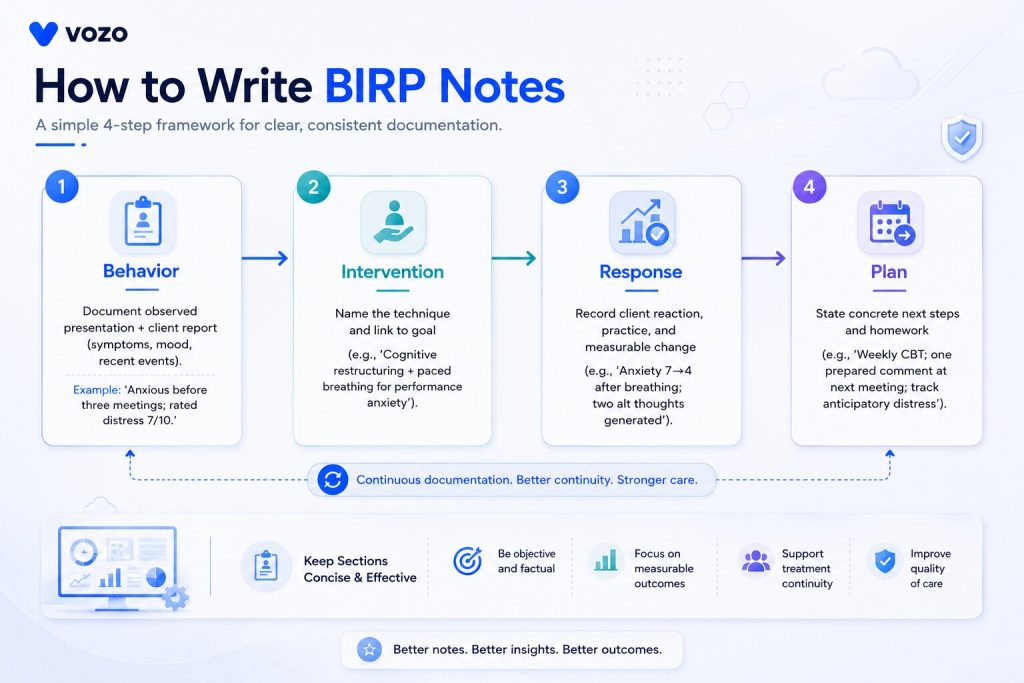
BIRP progress notes are structured clinical records organized into four sections: Behavior, Intervention, Response, and Plan. The format helps clinicians document what occurred during the encounter, the treatment provided, how the client responded, and the next steps in care.
- Behavior – What did the clinician see and hear?
- Intervention – What did the clinician actually do?
- Response – How did the client react to it?
- Plan – What happens next?
When clinicians ask what BIRP notes are, the simplest answer is that they are a structured form of mental health progress notes designed to make the intervention and treatment response clearly visible.
Where BIRP Notes Are Used?
BIRP notes may be used to organize therapy and counseling progress notes in settings such as:
- Outpatient therapy and counseling practices
- Community mental health centers
- Substance use disorder treatment programs
- Case management and care coordination
- Individual, family, group, and telehealth sessions
One thing worth clearing up early: BIRP is a documentation structure, not a billing rule. Using the four headings correctly does not, by itself, satisfy every payer, state, or licensing board requirement. CMS emphasizes the importance of complete, accurate, and timely documentation for each patient encounter.
Why the Format Matters for Documentation and Billing?
In a BIRP note, Intervention and Response sit right next to each other. That pairing helps a reviewer see the skilled service provided, the client’s response to it, and whether continued care still looks appropriate.
Intervention and Response are not the only things a reviewer checks. Audits also look at diagnosis, treatment plan alignment, and risk information.
Clinicians billing Medicare should also review current CMS guidance on outpatient psychiatric care documentation, coverage, and billing requirements.
But a clear Intervention-to-Response pairing makes that review easier. That is part of why some behavioral health organizations favor BIRP. No insurer requires this exact format, and plenty of compliant notes use other structures.
The treatment plan connection
A BIRP note can read like an isolated session unless it ties back to something ongoing. When writing the Intervention section, connect the technique to a clear treatment goal rather than documenting the activity alone.
Compare these two lines:
“Used cognitive restructuring.” This describes an activity with no context.
“Used cognitive restructuring to address the goal of reducing workplace avoidance.” This shows goal-directed care.
Naming the goal takes only a few extra words. It is one of the easiest ways to strengthen a BIRP note.
Progress Notes vs. Psychotherapy Notes
These two terms get confused often.
Progress notes, including BIRP notes, are part of the clinical record. They can be shared for treatment, payment, and healthcare operations under applicable privacy rules.
HIPAA does not always require separate patient authorization for this. Some records, like certain substance use disorder information, carry extra protections.
The official HIPAA definition of psychotherapy notes covers notes recorded by a mental health professional that document or analyze counseling conversations and are maintained separately from the rest of the medical record.
The legal line is about that separation, not how personal the note feels. A properly written BIRP note is a progress note, not a psychotherapy note as it belongs in the chart.
How to Write BIRP Notes Step by Step
Learning how to write BIRP notes begins with understanding the purpose of each section. Behavior establishes the client’s presentation, Intervention records the clinical action, Response shows what happened because of that action, and Plan defines the next step.
Step 1: Document the Behavior
This section combines what the client told you with what you actually observed. Think of it as two streams feeding into one paragraph:
Client-reported information: symptoms, recent events, sleep, stressors, progress since the last visit
Clinician observations: mood, affect, speech, engagement, relevant mental status findings
Weak: “Client was anxious and had a rough week.”
Stronger: “Client reported anxiety before three work meetings this week, rating distress 7/10, and described avoiding two of them. The client appeared alert, spoke rapidly, and tapped their foot throughout the session. Denied current suicidal or homicidal ideation.”
The first version confirms that anxiety came up. The second gives a future reader something they can actually verify or build on.
Step 2: Describe the Intervention
This is where you name the specific thing you did and tie it back to what you just described in Behavior. A few words worth watching for in your own notes: “discussed,” “explored,” “provided support.” None of these count as interventions on their own. They need a method attached.
Weak: “Reviewed coping skills with the client.”
Stronger: “Used cognitive restructuring to examine the automatic thought ‘my coworkers think I’m incompetent,’ addressing the treatment goal of reducing avoidance at work, then guided the client through a paced-breathing exercise.”
When appropriate, name the treatment goal the intervention was addressing. This shows the session was part of a plan, not a standalone activity.
If you bill by time or CPT code, this section should also match the service billed. A fifty-minute psychotherapy claim needs an Intervention section that reads as if fifty minutes had happened, not one short sentence.
Step 3: Record the Response
Out of all four sections, this is the one clinicians shortchange most often. It should document how the client reacted to the specific intervention just named:
What did they say?
What did they demonstrate, practice, or attempt?
Did they resist, hesitate, or decline?
Weak: “Client responded well to the intervention.”
Stronger: “Client generated two balanced alternative thoughts with moderate prompting. After the breathing exercise, the client rated anxiety at 4/10, down from 7/10 at the start of the session, and agreed the technique felt usable before future meetings.”
A quick gut check: If the Response section just restates what you did, you have written Intervention twice and Response zero times. A limited or negative response is still worth documenting. It explains why the next session may need a different approach.
Step 4: Build a Plan That Says Something Specific
The Plan should name a concrete next action, not just confirm that treatment will continue.
Weak: “Continue therapy next week.”
Stronger: “Continue weekly CBT for performance anxiety. Clients will contribute one prepared comment during the next team meeting and record anticipatory distress and automatic thoughts. Review the exposure outcome at the next session.”
Stop Rebuilding Notes Every Session
Save hours of documentation time with built-in BIRP, DAP, and GIRP templates that automatically connect to each client’s treatment plan. Keep interventions and responses aligned with treatment goals, reduce administrative work, and prevent pending notes from piling up.
Complete BIRP Notes Example
The following section provides one of several possible BIRP notes examples for an adult receiving outpatient therapy.
Scenario
Adult outpatient client receiving weekly CBT for social anxiety affecting workplace participation. No acute safety concern identified.
Behavior
Takes in reported anticipatory anxiety before two workplace meetings this week, but does not talk after preparing comments. Rated them 8/10 before and said they feared they would be regarded as incompetent if they got it wrong at work. Denied current suicidal or homicidal ideation.
Intervention
Used Socratic questioning and cognitive restructuring to examine supporting and contradictory evidence for the client’s catastrophic prediction, addressing the treatment goal of reducing workplace avoidance. Guided client through a brief role-play of offering one comment in a meeting.
Response
Client identified two balanced alternative thoughts and completed the role-play with moderate hesitation. Distress decreased to 4/10 by the end of the exercise. Client agreed the rehearsal felt more manageable than anticipated.
Plan
Continue weekly CBT with graded exposure. Client will contribute one prepared comment at the next team meeting and log anticipatory distress, automatic thoughts, and the outcome. Review the exposure record and consider advancing the hierarchy at the next session.
BIRP Progress Notes Example for a Group Telehealth Session
Scenario: Adult process group for stress and coping skills, held via telehealth, six of seven members present.
- Behavior: Client joined on time from home. Reported feeling “overwhelmed most days this week” at check-in. Engaged when peers spoke but did not share until prompted.
- Intervention: Facilitator led a discussion on identifying stress triggers, addressing the client’s goal of building coping skills. Used reflective prompts to draw the client into the discussion.
- Response: Client named two triggers, work deadlines and lack of sleep, and one coping strategy already in use. Participation increased after the prompt. No safety concerns disclosed.
- Plan: Continue weekly telehealth group. Clients will track daily stress triggers and bring observations to the next session.
Simple Template for BIRP Progress Notes
Clinicians can adapt this template for individual therapy progress notes, group sessions, case management, or counseling progress notes.
Behavior: client report + clinician observation. Intervention: technique used + treatment goal it addressed. Response: client’s reaction + progress or resistance. Plan: next concrete action + homework or next session focus.
Common BIRP Note Mistakes
While BIRP notes provide a clear structure for behavioral health documentation, they can become ineffective if they lack clarity and detail, or contain redundant information and a lack of treatment connection. The following are typical errors that clinicians should avoid:
1. Using subjective or unclear language
Terms such as “difficult,” “unmotivated,” or “doing better” do not explain what occurred during the session. Use objective descriptions of what the client reported, demonstrated, or declined.
2. Not tying interventions to treatment goals
An intervention should be connected to a symptom, functional need, or treatment goal. Briefly describe why the technique is an appropriate component of the client’s care plan.
3. Providing little detail about the client’s response
Statements such as “client was receptive” do not show whether the intervention was effective. Document what the client practiced, understood, reported, or struggled to complete.
4. Repeating the same wording across multiple sessions
Templates can improve efficiency, but copied language may make notes appear generic. Update each note to reflect the client’s current behavior, treatment response, and next steps.
5. Unfamiliar abbreviations
Terms that are shortened but not commonly understood can be confusing to other providers. Use standard terminology in behavioral health, or use the full term if clarification is required.
6. Confidential information is not included
Progress notes should include information that helps with treatment, safety, coordination, and other valid clinical needs. Do not record personal information that is not relevant to the service offered.
Being aware of these errors can help the clinician to write BIRPs that are more accurate, more useful for treatment planning and continuity of care, and clearer.
BIRP vs. DAP vs. SOAP vs. GIRP
Different mental health progress notes organize the same clinical information in different ways. The best format depends on the setting, treatment model, team workflow, and documentation requirements.
| Format | Sections | Best fit |
| BIRP Notes | Behavior, Intervention, Response, Plan | Settings where the link between technique and client reaction needs to be explicit, such as community mental health and substance use treatment |
| DAP Notes | Data, Assessment, Plan | Outpatient practices that want a more compact note, combining observation and data into one section |
| SOAPNotes | Subjective, Objective, Assessment, Plan | Medically integrated settings that need a clear split between reported and observed findings |
| GIRPNotes | Goal, Intervention, Response, Plan | Programs that want each note to open with the specific treatment goal addressed, rather than client behavior |
The difference is what opens the note: BIRP starts with observed behavior, while GIRP starts with the treatment goal itself. Some programs blend the two by opening with behavior and naming the goal inside the Intervention section, which is the approach used in the examples above.
Explore the differences among the common behavioral health clinical notes before choosing a format for your practice.
Bring Structured Documentation Into One Workflow
A behavioral health EHR can make BIRP progress notes easier to complete by connecting documentation templates with treatment plans, appointments, outcome measures, and follow-up tasks.
- Customizable note templates built around BIRP, DAP, GIRP, or SOAP
- Treatment plans are connected directly to notes, so goal progress stays visible over time
- Pending-note reminders that help keep documentation from piling up
Vozo EHR for therapists, which connects structured templates, treatment-plan tracking, scheduling, and follow-up workflows for behavioral health practices.
Clinicians can use the system to create more consistent therapy progress notes while retaining control over the final documentation.
Frequently Asked Questions
1. What are BIRP Notes in therapy?
In therapy, a BIRP note documents four things: the client’s behavior at the start of the session, the specific intervention the therapist used, how the client responded to it, and the plan for what happens next. The format is common in outpatient therapy, group therapy, and substance use counseling settings.
2. How to Write an Effective BIRP Note?
An effective BIRP note pairs each intervention with the client’s actual response, uses specific observable language in Behavior, and ends with a Plan naming a concrete next step. Avoid vague phrases like the client did well. Reference the treatment goal when possible to show the session supported an individualized plan.
3. BIRP Notes vs. SOAP Notes: Which Format Should You Use?
BIRP works well when you want the connection between intervention and client response to stand out, common in community mental health and substance use treatment.
SOAP Notes fit medically integrated settings that need subjective and objective findings kept separate. Neither format is required by law, so the right choice depends on your setting.
4. How long should a BIRP note be?
There is no fixed word count for a BIRP note. A routine session may need only a few sentences in each section. Sessions involving risk, a treatment change, or a notable shift in functioning usually need more detail to explain what happened and why.
5. Can BIRP notes be used for group therapy?
Yes. The clinician can document the group intervention while recording each client’s individual behavior, participation, response, and plan. Some organizations require a general group note along with a separate progress note for each participant.
About the author
Lara Dixit


Lara Dixit is a Senior Business Manager at Vozo Health, specializing in EHR platforms, practice management, billing, and revenue cycle optimization. She helps healthcare providers improve operational efficiency, streamline workflows, and drive sustainable practice growth. At Vozo Health, she focuses on business strategy, healthcare automation, and scalable growth for modern medical practices.