
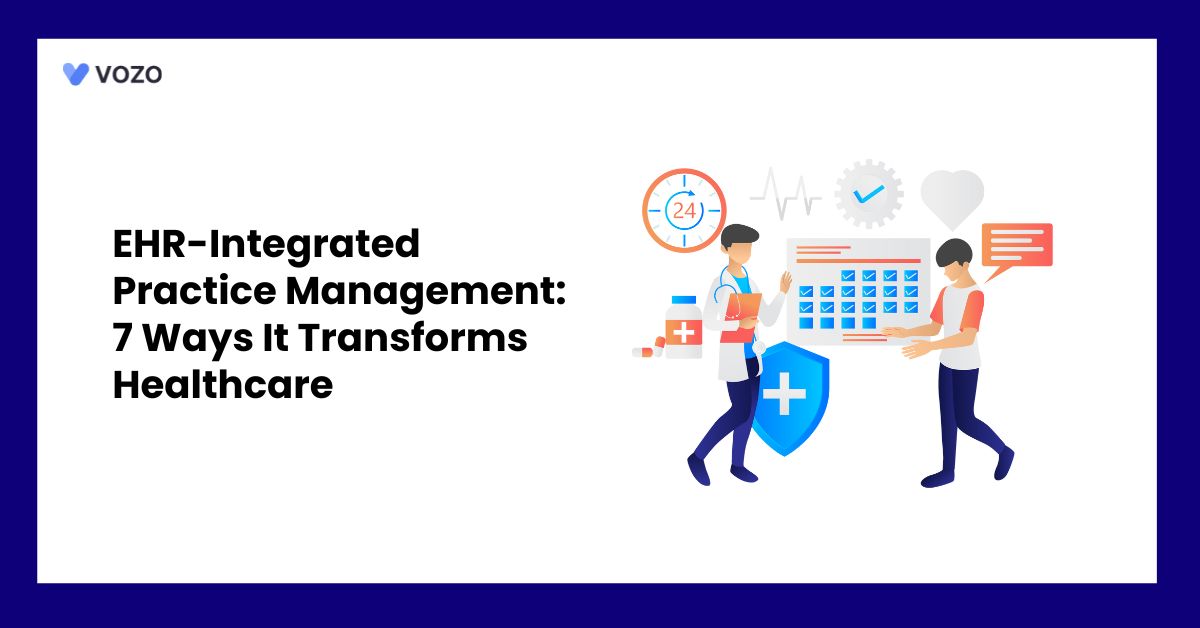
EHR-Integrated Practice Management: 7 Ways It Transforms Healthcare
Healthcare is changing at a fast rate, necessitating higher efficiency, better patient outcomes, and better financial health for medical practices. The main feature of this change is the smooth combination of EHR and practice management systems.
EHR-integrated practice management is now a necessity that has been completely transforming the manner in which medical offices are being conducted.
Integrating both the clinical information that a person recorded in an EHR and the administrative and financial capabilities of a PM system, practices eliminate data silos and form a unified, intelligent operational environment. A shift towards systems of the past is a solution to the next stage of performance in modern healthcare.
In this blog, you’ll know the 7 important ways that EHR-integrated practice management systems are changing healthcare delivery.
7 Ways EHR-Integrated Practice Management Transforms Healthcare
1. Clinical Improvement with Integrated Workflow
The drastic workflow improvement is one of the direct advantages of an integrated system. By having clinical and administrative data on the same platform, a single time-consuming step of data entry, which is a common source of error, is eliminated. The staff do not have to manually move the patient demographics, insurance information, or procedure codes across systems.
The result of this streamlining is the improvement of clinical efficiency. A note by a physician or an order obtained by a physician is immediately connected to the billing system, and it makes sure that there is accuracy and accelerates the process of capturing charges.
Automation of EHR practices addresses duplication of duties such as appointment reminders and patient initial examinations, leaving clinical staff to attend to patients instead of documentation.
This will lead to the patient flow being less stressful, the administrative burnout will also be minimized, and the ability of the practice to cope with the patient volume will also increase.
2. Increased Revenue Cycle Management
Any healthcare practice is dependent on financial stability. EHR-integrated practice management systems are integrated to improve the whole revenue cycle process, patient registration, and final payment. The fact that clinical documentation is directly linked with billing makes coding more precise and uniform.
The major features are automated checking of eligibility, real-time coding recommendations according to documentation made by the physician, and automatic submission of claims.
This decreases claims denials and rejections that are usually occasioned by disjointed data. The quicker take on claims, cleaner payments, and even quicker payments lead to a healthier bottom line of the practice.
3. Health Information Interchange and Availability
The final health care data integration tool is a unified platform. It places the entire information of patients, such as the clinical history, lab tests, medication history, imaging history, and financial report, into one complete and detailed electronic chart.
This one source of truth makes sure that all care team members, front desk all the way to the physician, and the billing specialist all have access to the up-to-date and correct information.
Being able to immediately see the full medical and financial history of a patient increases the quality of the standard of diagnosing a specific patient, patient safety, such as built-in drug interaction warnings, and speed of care provision, particularly in complex or emergent cases.
4. Increasing Patient Engagement Resources and Experience
The healthcare consumers in the modern world need convenience and transparency. Integrated systems are a good source of strong tools of patient engagement that fulfill these expectations and help motivate the patient to become an active participant in their health journey.
- Make and accept appointments via the internet.
- Get their laboratory tests and medical documents.
- Payment of bills is safe and convenient.
- Share with their carers through secure messaging.
This online convenience enhances patient satisfaction, decreases administrative calls, and makes patients more informed. This is important in following up on treatment plans and the ultimate health outcomes.
Related: A Complete Guide To Healthcare Practice Management In 2025
5. Interoperability in Healthcare
The implementation of EHR and PM systems in one practice is a significant move towards wider interoperability. Integrated platforms are in a better position to share and receive information safely with external providers, hospitals, and laboratories through established health information exchange protocols such as FHIR.
Better data sharing enables really coordinated care. A complete, unified record of a patient can be continuously trailed when there is a patient referral to a specialist, or when the patient is transferred out of inpatient care back to their primary care physician.
Such a communication level in practice avoids the occurrence of redundancy in tests, minimizes the probability of medical errors, and provides the patient with a seamless, high-quality experience throughout the healthcare ecosystem.
6. Improved Data Protection and Compliance
Working with sensitive patient information will encompass high security and compliance with complicated laws such as HIPAA.
EHR-integrated practice management systems are integrated, which means that the key security measures are centralized, and it is simpler to control access, introduce encryption, and have detailed audit trails.
One system will ensure that both administrative and clinical information is safeguarded by a single high-level security system, which lessens exposure to risk by having many different systems.
Compliance tools are built in and include automatic updates on the coding standards (ICD-10, CPT), which keep the practice on the correct side of the financial and regulatory requirements.
7. Data-Driven Decision Making
A business intelligence system that operates on an EHR-integrated practice management system is potent. The integration of clinical, operational, and financial data will enable the system to produce detailed reports and dashboards that will provide incomparable information about the health of the practice.
Real-time analysis of key performance indicators can be performed by administrators and providers and includes:
- Volume and waiting time for patients.
- Professor’s productivity and activity.
- Denials and revenue trends.
- Outcome of patients undergoing particular procedures.
This evidence-based method enables practices to identify bottlenecks, allocate resources in a more efficient way, and make strategic decisions that influence not only the growth of clinical efficiency but also financial growth as well.
Vozo All-In-One Cloud EHR for Healthcare Practices
From managing and organizing patient health records digitally to reducing medical errors, it significantly empowers providers to improve healthcare quality.
If you are searching for the best EHR system for your healthcare practice, Vozo EHR can be your go-to choice. Our comprehensive EHR solution lets you focus more on patient care while carrying all the burdens and simplifying them.
- Vozo Cloud EHR’s cost-effective cloud subscription benefits all levels of practice.
- Our feature-rich EHR helps you rectify mistakes efficiently and speed up the process.
- Vozo Specialty EHR aligns with the needs and requirements of specialty practices.
- Our expert technical team is available 24/7 to cover any needs that may arise.
- Our EHR System continues to scale as your healthcare practice grows, improving the user experience.
The Vozo Customized EHR solution benefits your healthcare practice by:
- Streamlining the administrative process
- Improving workflow efficiency
- Reducing proneness to errors
- Managing all the patients’ records in one place
- Offers greater efficiency and cost savings across the board
- Our specialty-specific tools, such as scheduling, patient portals, lab integration, cloud hosting, and more, meet the specific needs and requirements of your healthcare practice.
“Embrace Vozo EHR to reduce your burdens and enhance patient care”.
About the author
Lara Dixit


Lara Dixit is a Senior Business Manager at Vozo Health, specializing in EHR platforms, practice management, billing, and revenue cycle optimization. She helps healthcare providers improve operational efficiency, streamline workflows, and drive sustainable practice growth. At Vozo Health, she focuses on business strategy, healthcare automation, and scalable growth for modern medical practices.