


What Is the Difference Between a Behavioral Health EHR and a General Medical EHR?
A behavioral health EHR is built for therapy, psychiatry, and substance use care. It supports repeat visits, treatment plans, progress notes, and sensitive records. A general medical EHR is built for exams, lab orders, medicines, procedures, and referrals. The right choice depends on the care your team provides.
You can be a therapist, psychiatrist, or addiction treatment professional. If you can, you may be thinking, will the same family doctor EHR be good for me too?
Both systems do record-keeping, schedule visits, and support billing.
The difference is in the daily work.
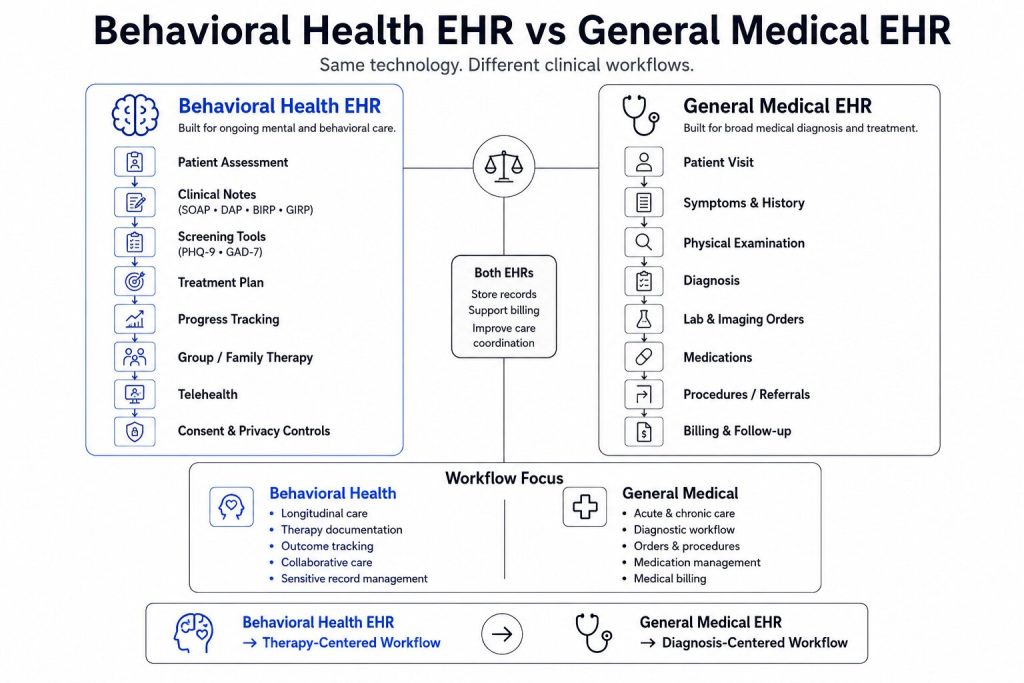
A general medical EHR is usually built around medical visits. A behavioral health EHR is usually built around therapy sessions, care goals, and progress over time. That gap can affect notes, billing, privacy, telehealth, and data sharing.
What Is a Behavioral Health EHR?
A behavioral health EHR is a digital clinical and practice-management system designed for mental health, psychiatric, and substance use treatment settings. It can store charts, manage visits, support claims, and help teams share care details. Its main value is that the workflow fits behavioral health services.
Common features may include:
- SOAP, DAP, BIRP, and GIRP note forms
- PHQ-9 and GAD-7 screening tools
- Treatment plans with clear goals and review dates
- Progress tracking across many visits
- Group and family therapy notes
- Telehealth for repeat sessions
- Role-based access and audit logs
- Consent tools for sensitive records
What Is a General Medical EHR?
A general medical EHR is designed for physical health care, covering primary care, specialty medicine, hospitals, and urgent care. It handles a wide range of visits, including physical exams, lab orders, imaging referrals, prescriptions, and procedures.
General medical documentation usually emphasizes symptoms, findings, diagnoses, orders, medications, procedures, and follow-up care.
These systems often focus on:
- Symptoms and health history
- Exam findings
- Diagnoses
- Medicines
- Lab and imaging orders
- Procedures
- Referrals
- E/M and procedure billing
Many general EHRs connect well with labs, pharmacies, imaging centers, and hospitals. Some also support mental health care through extra forms or modules.
Behavioral Health EHR vs General Medical EHR: Core Differences
The primary difference between the two is that one is workflow-oriented. General medical EHRs typically focus on medical encounters, orders, procedures, and diagnosis results, whereas behavioral health EHRs focus on regular sessions, treatment goals and objectives, interventions, and progress over time.
| Area | Behavioral Health EHR | General Medical EHR |
| Notes | Therapy notes linked to goals and progress | Medical notes linked to findings, diagnoses, and orders |
| Visits | Repeat sessions over time | Exams, tests, procedures, and follow-up visits |
| Care plans | Goals, actions, review dates, and outcomes | Medicines, orders, referrals, and care plans |
| Billing | Time-based therapy and psychiatry workflows | E/M, procedures, labs, imaging, and hospital workflows |
| Clinical tools | PHQ-9, GAD-7, MSE, risk tools, and outcomes | Vitals, exam findings, lab results, and screenings |
| Privacy | Extra focus on sensitive notes and Part 2 when it applies | HIPAA-wide controls, with extra privacy tools in some systems |
| Telehealth | Often built for repeat therapy and psychiatry visits | Usually one of several visit types |
| Data sharing | May link with hospitals, HIEs, labs, and pharmacies | Often has strong hospital, lab, pharmacy, and referral links |
Documentation: Why the Note Format Actually Matters
Many general medical EHR templates emphasize symptoms, exam findings, diagnoses, orders, medications, procedures, and follow-up care.
- Chief complaint
- History
- Exam findings
- Assessment
- Plan
Behavioral health documentation must connect the session content, clinical intervention, patient response, risk status, and next steps to the active treatment plan.
Common behavioral health formats include:
- SOAP – Subjective, Objective, Assessment, Plan
- DAP – Data, Assessment, Plan
- BIRP – Behavior, Intervention, Response, Plan
- GIRP – Goal, Intervention, Response, Plan
Example of a BIRP note:
- Behavior: Client reported increased work-related anxiety and sleep difficulty.
- Intervention: Used cognitive restructuring to address catastrophic thinking.
- Response: Client identified and reframed two distorted thoughts.
- Plan: Continue weekly CBT and complete a thought log.
Payers do not require one note style for every case. But the note should support the service, the care plan, the time spent when needed, the patient response, and the need for more care.
Privacy and Sensitive Records
Both types of EHRs must protect patient data. Mental health systems may need extra controls for sensitive notes and substance use records.
Psychotherapy notes are not the same as normal progress notes. They are separate notes about a counseling conversation. HIPAA gives them added protection.
Normal progress notes may include:
- Diagnosis
- Medicines
- Session time
- Symptoms
- Care plans
- Progress
- Outlook
Some substance use records may also fall under 42 CFR Part 2. This rule applies only when the program and records meet its scope.
The updated Part 2 rule became required on February 16, 2026. In many cases, one consent can cover future treatment, payment, and healthcare operations. Some SUD counseling notes and legal uses still need separate consent.
When you compare systems, look for:
- Role-based access
- Separate consent steps
- Access and sharing logs
- Audit reports
- Incident records
- Easy data export
- Support for state privacy rules
A mental health EHR may make these tasks easier. A general or hospital EHR may offer similar tools through extra settings or modules.
Does Your EHR Fit the Way Your Practice Works?
See how a behavioral health-focused system can simplify documentation, track treatment progress, support time-based billing, and reduce the need for manual workarounds.
Billing: Time-Based Psychotherapy vs Medical E/M Workflows
General medical billing frequently relies on E/M and procedure codes. Behavioral health uses several billing models, but individual psychotherapy provides a clear example of why specialty workflow support matters.
| Code | Service | Time or billing basis |
| 90832 | Individual psychotherapy | 16–37 minutes |
| 90834 | Individual psychotherapy | 38–52 minutes |
| 90837 | Individual psychotherapy | 53 minutes or more |
Behavioral health billing also includes diagnostic evaluations, psychiatric E/M services, psychotherapy, family and group therapy, testing, and care-management services. But individual psychotherapy codes are a prime case in point of the importance of structured time documentation.
Example: A documented 50-minute psychotherapy session falls under 90834, not 90837. Reporting 90837 would not match the recorded duration and could lead to a denial, repayment request, or audit finding.
Interoperability and Data Sharing
Large hospital and general medical EHR platforms often provide mature connections to laboratories, pharmacies, imaging systems, referral networks, and HIEs.
Behavioral health interoperability adoption has historically been lower. An April 2026 ASTP/ONC brief based on 2024 survey data found that 68% of surveyed substance use and mental health facilities used only EHRs, 25% combined EHRs with paper records, and 19% actively participated in an HIE.
These findings describe sector-level adoption. They do not mean every behavioral health EHR has limited interoperability.
When comparing platforms, verify support for:
- HL7 interfaces & FHIR APIs
- HIE participation
- Pharmacy and e-prescribing connections
- Laboratory orders and results
- Referral exchange
- Patient matching
- Data import and export
- Consent enforcement
- Role-based access and audit logging
Can a General Medical EHR Be Used for Behavioral Health?
Yes. A general medical EHR can be utilized for behavioral health, particularly a mental health service that is part of a medical group. Special templates may be required; tools for treatment plans, outcome measures, psychotherapy documentation, workflows, and controls for sensitive records may be needed.
A purpose-built system is often more practical when behavioral health is the organization’s main service line.
Which Type Fits Each Setting?
A Behavioral Health EHR May Be a Better Fit For:
- Solo therapists
- Counseling groups
- Psychiatric practices
- Community mental health centers
- Substance use treatment programs
A general medical EHR may fit:
- Primary care practices
- Multispecialty groups
- Hospitals and health systems
- Urgent care centers
- Ambulatory surgery organizations
- Organizations where behavioral health is one service within a broader medical model
A connected or hybrid approach may work best for:
- Hospitals with inpatient or outpatient psychiatric departments
- Integrated physical and behavioral healthcare organizations
- Health systems operating Part 2 programs
- Networks using a specialty behavioral health platform alongside an enterprise EHR
For a hybrid approach, interfaces and APIs need to carry the same access, consent, disclosure, and auditing abilities that would be applied to a traditional on-premises system while still supporting the necessary flow of clinical information between systems.
Questions to Ask Before Choosing an EHR
- Does it support our note forms?
- Can it track goals and progress?
- Can it record session time?
- Does it support Part 2 when needed?
- Can it separate psychotherapy notes?
- Can it connect with labs, pharmacies, hospitals, and HIEs?
- Can we export all clinical and billing data?
- Which features cost extra?
Which EHR Is the Right Fit for Your Practice?
Choose based on the work your team does each day.
If you are mainly involved in therapy, psychiatry, repeat visits, care plans, patient progress tracking, a behavioral health EHR might be a more suitable solution.
A general medical EHR might be more suitable if the mental health service is a part of a broader medical service and if the hospital, lab, pharmacy, and referral links are more important.
The best EHR should fit your care model. Your staff should not have to change good clinical work to match the software.
Vozo Behavioral Health EHR: Built for How Therapy Actually Works
If you want an EHR built around behavioral health, not adapted to fit it, Vozo Behavioral Health EHR is worth a look. Our platform is made for therapists, psychiatrists, and addiction treatment providers. You won’t have to reshape a general medical template just to write a therapy note.
Vozo Behavioral Health EHR automates the workflow and facilitates therapy and psychiatric care by providing behavioral health documentation, screening tools, treatment planning, group-session management, telehealth, billing, and configurable access controls.
See how Vozo supports behavioral health documentation, scheduling, telehealth, billing, and connected practice workflows.
Frequently Asked Questions
1. Are There Specific Features in a Behavioral Health EHR?
Yes. They all contain forms for therapy notes, care plans, repeat visits, outcome scores, telehealth, and group sessions, billing tools, and role-based access. Some systems also support consent and sharing rules for records covered by 42 CFR Part 2. Features vary by vendor.
2. Who Uses Behavioral Health EHRs?
These systems are used by therapists, psychologists, psychiatrists, psychiatric nurse practitioners, counselors, social workers, case managers, and substance use care teams. They are also used in group practices, community mental health centers, residential programs, and integrated care groups.
3. How Do Behavioral Health EHRs Support Treatment?
Behavioral health EHRs support treatment by connecting assessments, diagnoses, treatment goals, interventions, progress notes, outcome measures, and follow-up plans in one longitudinal record.
Clinicians can review changes over time, coordinate care, update treatment plans, and document whether services remain medically necessary and aligned with the patient’s current needs.
4. Which EHR Features Are Essential for Tracking Behavioral Health Treatment Progress?
Progress tracking components include treatment goals that can be measured, plan review at regularly scheduled intervals, progress notes, documentation, standardized evaluation, trends, tracking interventions, medication history, attendance at appointments, and outcome dashboards.
The EHR should also illustrate whether symptoms, functioning, and the response to treatment improve over time, and be able to establish a clear audit trail of plan changes.
About the author
Lara Dixit


Lara Dixit is a Senior Business Manager at Vozo Health, specializing in EHR platforms, practice management, billing, and revenue cycle optimization. She helps healthcare providers improve operational efficiency, streamline workflows, and drive sustainable practice growth. At Vozo Health, she focuses on business strategy, healthcare automation, and scalable growth for modern medical practices.