

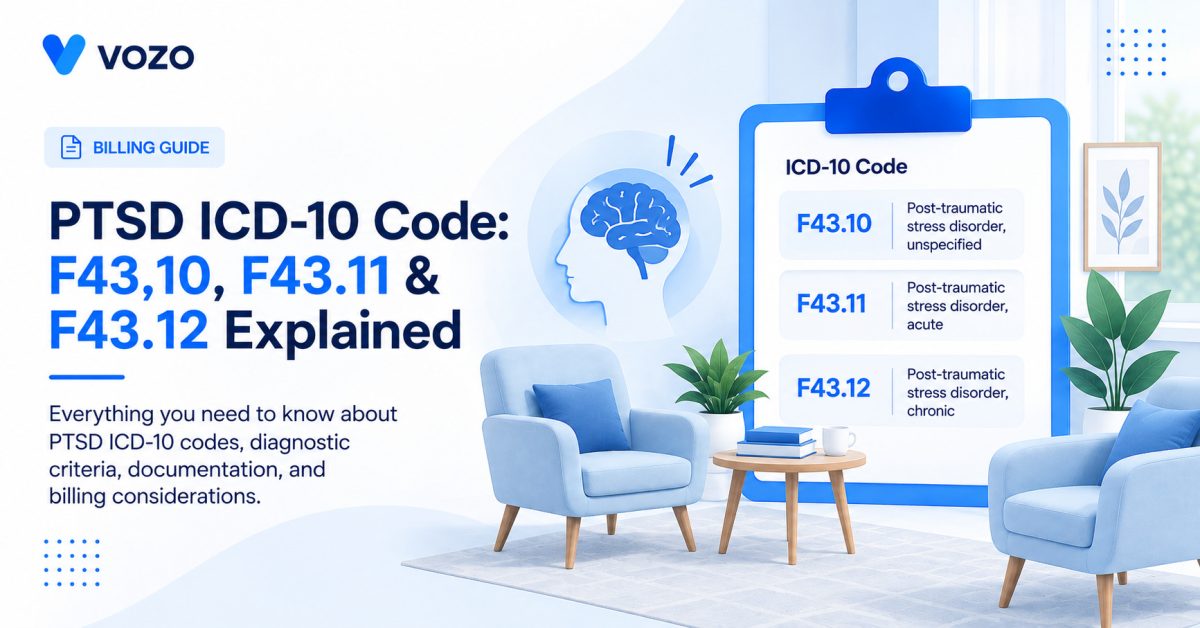
PTSD ICD-10 Codes: F43.10, F43.11 & F43.12 Explained
PTSD coding looks simple until you have to choose between F43.10, F43.11, and F43.12. The diagnosis may be clinically clear, but the code must still match what is documented in the chart. That is where questions about symptom duration, acute versus chronic status, delayed presentation, and related diagnoses can create confusion.
For U.S. claims, PTSD is reported under the F43.1 category in ICD-10-CM, with more specific codes used for unspecified, acute, or chronic PTSD. At the same time, DSM-5-TR uses a different framework for diagnosing PTSD and no longer uses acute and chronic specifiers the way older DSM editions did.
This guide explains what each PTSD ICD-10-CM code means, how current diagnostic criteria fit in, and what clinicians should document for accurate coding.
Key Takeaways
- F43.1 is the ICD-10-CM category for PTSD. A more specific code, such as F43.10, F43.11, or F43.12, is reported on the claim.
- The reportable PTSD codes are F43.10 for unspecified PTSD, F43.11 for acute PTSD, and F43.12 for chronic PTSD.
- Under DSM-5-TR, PTSD symptoms must persist for more than one month. During the first month after trauma, acute stress disorder may be considered when its diagnostic criteria are met.
- Clear documentation of the traumatic event, symptom history, duration, functional impact, and diagnosis supports accurate PTSD coding and billing.
What Is the ICD-10 Code for PTSD?
Post-traumatic stress disorder sits under F43.1 in ICD-10-CM. This code lives inside the F43 block, which covers reactions to severe stress and adjustment disorders.
F43.1 is a category code rather than a complete reportable diagnosis code.
For reporting, the diagnosis must be coded to one of the more specific PTSD codes: F43.10, F43.11, or F43.12.
What Are the PTSD Subcodes: F43.10, F43.11, and F43.12?
Here is the quick answer table most people are looking for.
| Code | ICD-10-CM Description | Documentation |
| F43.10 | PTSD, unspecified | PTSD documented without acute or chronic status |
| F43.11 | PTSD, acute | Provider documents acute PTSD |
| F43.12 | PTSD, chronic | Provider documents chronic PTSD |
All three are billable. Depending on the reason for the encounter and documented conditions being treated, one of these PTSD codes may be reported as the first-listed diagnosis in an outpatient claim.
PTSD requires symptoms to persist for more than one month. DSM-5-TR acute stress disorder applies during the period from three days through one month after trauma. When clinically significant symptoms persist beyond one month, the patient should be evaluated for PTSD.
PTSD may also have a delayed presentation. DSM-5-TR recognizes PTSD with delayed expression when the full diagnostic criteria are not met until at least six months after the traumatic event.
When the provider documents PTSD without specifying acute or chronic status, F43.10 represents PTSD, unspecified.
What Are the Diagnostic Criteria Behind These Codes?
A PTSD diagnosis is based on more than exposure to a traumatic event. DSM-5-TR requires a qualifying trauma, specific symptom patterns, sufficient duration, and clinically significant distress or impairment.
The main diagnostic elements include:
- Exposure to qualifying trauma – The person directly experienced or witnessed actual or threatened death, serious injury, or sexual violence; learned about a qualifying event involving a close relative or friend; or experienced repeated or extreme exposure to traumatic details, usually through professional duties.
- Intrusion symptoms – These may include unwanted memories, nightmares, flashbacks, or strong emotional or physical reactions to reminders of the trauma.
- Avoidance – The person avoids trauma-related thoughts, feelings, conversations, people, places, or situations.
- Negative changes in cognition and mood – Symptoms may include persistent negative beliefs, guilt, emotional detachment, reduced interest in activities, difficulty experiencing positive emotions, or trouble recalling parts of the event.
- Changes in arousal and reactivity – These can include irritability, hypervigilance, sleep problems, difficulty concentrating, reckless behavior, or an exaggerated startle response.
- Duration – Symptoms must persist for more than one month.
- Functional impact – Symptoms must cause clinically significant distress or interfere with work, relationships, daily activities, or other important areas of functioning.
- Exclusion – The symptoms should not be better explained by medication, substance use, or another medical condition.
Direct physical injury is not required; qualifying exposure can also occur through witnessing, certain events involving a close relative or friend, or repeated professional exposure to traumatic details.
How Is PTSD Different From Acute Stress Disorder and Adjustment Disorder?
Two related diagnoses get confused with PTSD often enough that they deserve their own comparison.
DSM-5-TR uses Acute Stress Disorder, which can be diagnosed from three days through one month after trauma. If trauma-related symptoms continue beyond one month, the clinician should assess whether the full diagnostic criteria for PTSD are met.
Adjustment disorder also follows an identifiable stressor, but it does not require the specific qualifying traumatic exposure or the full PTSD symptom pattern. Its presentation may include depressed mood, anxiety, behavioral disturbance, or a combination of these symptoms. When PTSD criteria are met, adjustment disorder should not be used simply as a less severe alternative.
Getting this differential right at intake saves rework later. When significant trauma-related symptoms persist beyond the first month, reassessment is appropriate to determine whether the patient now meets PTSD criteria.
How Does ICD-10-CM Compare to DSM-5-TR for PTSD?
These two systems do different jobs, and it helps to keep that straight.
DSM-5-TR provides the current DSM diagnostic criteria clinicians use when assessing PTSD. It lays out the detailed symptom criteria a clinician works through during assessment.
ICD-10-CM is the U.S. diagnosis classification and coding system used for healthcare reporting and claims.
DSM-5-TR and ICD-10-CM serve related but different purposes. One important difference is that DSM-5-TR no longer uses acute and chronic PTSD specifiers, while ICD-10-CM continues to include separate acute and chronic PTSD codes.
What Documentation Supports Accurate PTSD Coding?
For therapists, psychiatrists, and other behavioral health providers, a few specific details in the note support accurate diagnosis selection, coding, and continuity of care.
- The qualifying traumatic event, documented briefly and factually.
- Approximate symptom onset and duration, including whether symptoms have persisted for more than one month.
- Intrusion symptoms.
- Avoidance symptoms.
- Negative changes in cognition and mood.
- Changes in arousal and reactivity.
- How symptoms affect work, relationships, daily functioning, or other important areas.
- Any separately diagnosed co-occurring mental health or substance use conditions relevant to treatment.
Make PTSD Documentation Easier to Track
Keep symptom history, diagnosis, treatment notes, and billing details connected in one place. See how Vozo EHR supports a more organized documentation workflow for behavioral health practices.
What Are Common PTSD Coding Mistakes to Avoid?
Several documentation and coding issues can reduce diagnostic specificity or create avoidable billing problems.
- Billing F43.1 directly instead of dropping to a subcode.
- Using F43.10 when the provider has documented a more specific acute or chronic PTSD diagnosis.
- Failing to document symptom onset and duration when they are clinically relevant to diagnosis and treatment.
- Failing to document the clinical findings supporting PTSD when acute stress disorder or adjustment disorder is also being considered.
Keep PTSD Documentation Connected to Billing
Accurate PTSD coding starts with what is captured during the clinical encounter. When assessment details, diagnosis documentation, treatment plans, progress notes, and billing live in separate workflows, important information can easily be missed or entered twice.
Vozo EHR helps behavioral health practices keep clinical documentation and billing information connected within a single system.
Providers can document symptom history, treatment progress, diagnoses, and co-occurring conditions while giving billing teams access to the information they need for cleaner workflows.
Failing to document the clinical findings supporting PTSD when acute stress disorder or adjustment disorder is also being considered.
Frequently Asked Questions
What ICD-10 code should I use for PTSD?
PTSD is coded under the F43.1 category in ICD-10-CM. The reportable codes are F43.10 for PTSD, unspecified, F43.11 for acute PTSD, and F43.12 for chronic PTSD. The code selected should match the diagnosis documented in the patient’s clinical record.
When should I use F43.10 for PTSD?
F43.10 is used when PTSD is documented but the record does not specify acute or chronic status. Providers should avoid selecting a more specific PTSD code unless the clinical documentation supports that diagnosis.
What is the difference between F43.11 and F43.12?
F43.11 represents acute PTSD and F43.12 represents chronic PTSD in ICD-10-CM. Current DSM-5-TR no longer uses the older acute and chronic duration specifiers, so providers should document the clinical diagnosis clearly rather than choosing a code based only on how many months symptoms have been present.
Can I diagnose PTSD if symptoms have lasted less than one month?
Under DSM-5-TR, PTSD requires symptoms to persist for more than one month. During the first month after a traumatic event, providers may need to evaluate whether the patient meets criteria for acute stress disorder or another appropriate diagnosis.
Can I code PTSD with anxiety, depression, or substance use disorder?
Yes. PTSD can occur alongside depression, anxiety disorders, substance use disorders, and other conditions commonly treated in mental health practices. When a co-occurring condition is separately diagnosed, clinically addressed, and relevant to the encounter, it may also be reported with its appropriate ICD-10-CM code.
Coding year note: ICD-10-CM codes and guidelines are updated periodically. This article should be checked against the ICD-10-CM code set applicable to the date of service. The FY2026 code set applies through September 30, 2026, and the FY2027 code set applies from October 1, 2026, through September 30, 2027.
Sources
Centers for Medicare and Medicaid Services: ICD-10-CM Official Code Files, FY2026 https://www.cms.gov/medicare/coding-billing/icd-10-codes
National Center for Health Statistics: ICD-10-CM Classification, Chapter 5: Mental, Behavioral and Neurodevelopmental Disorders https://www.cdc.gov/nchs/icd/icd-10-cm.htm
World Health Organization: International Statistical Classification of Diseases and Related Health Problems, 10th Revision https://icd.who.int/browse10/2019/en
About the author
Lara Dixit


Lara Dixit is a Senior Business Manager at Vozo Health, specializing in EHR platforms, practice management, billing, and revenue cycle optimization. She helps healthcare providers improve operational efficiency, streamline workflows, and drive sustainable practice growth. At Vozo Health, she focuses on business strategy, healthcare automation, and scalable growth for modern medical practices.