

ICD-10 Codes for Substance Use Disorders: Diagnosis and Coding Guide
A behavioral health clinic submits a claim for a patient with opioid use disorder. The claim gets denied. The reason: the code listed didn’t match the documented severity in the chart notes.
This happens more often than it should. Substance use disorder coding involves more layers than most other behavioral health diagnoses. An incorrect diagnosis code, missing documentation, or mismatch between the code and clinical notes can contribute to claim delays, denials, or additional review.
This guide walks through the F10-F19 code range, how to select the right code, and where coders most often go wrong.
Key Takeaways
- ICD-10 codes for substance use disorders fall under the F10-F19 range, organized by substance type.
- Accurate coding affects claim approval, reimbursement timelines, and treatment documentation.
- Providers must document substance type, severity, and any co-occurring conditions to support the code.
- Documentation should also reflect current clinical status, including remission or substance-related complications when applicable.
- Common errors include mismatched severity codes and missing remission specifiers.
What Are Substance Use Disorders?
Substance use disorders (SUDs) are behavioral health conditions involving the problematic use of alcohol or other substances that leads to significant impairment, distress, or difficulty controlling use.
Substance use disorders may affect a person’s:
- Physical health
- Mental health
- Relationships
- Daily functioning
- Work or social activities
Common substance use disorders include:
- Alcohol use disorder
- Opioid use disorder
- Cannabis use disorder
- Stimulant use disorder
- Sedative, hypnotic, or anxiolytic use disorder
- Multiple substance use disorders
In ICD-10-CM, substance-related disorders are primarily classified under the F10–F19 categories, depending on the substance involved and the documented clinical condition.
What Is the ICD-10 Code Range for Substance Use Disorders?
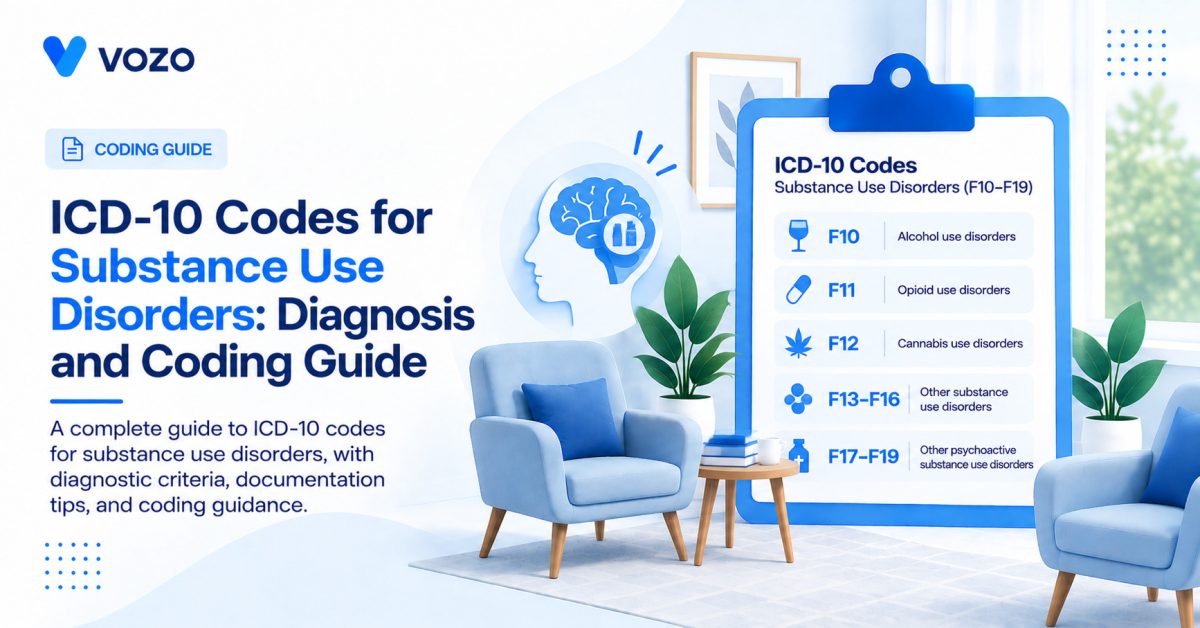
Substance use disorders fall under F10 through F19 in the ICD-10-CM manual. Each three-digit category covers one substance class.
| ICD-10 Category | Substance Type |
| F10 | Alcohol-related disorders |
| F11 | Opioid-related disorders |
| F12 | Cannabis-related disorders |
| F13 | Sedative, hypnotic, or anxiolytic-related disorders |
| F14 | Cocaine-related disorders |
| F15 | Other stimulant-related disorders |
| F16 | Hallucinogen-related disorders |
| F17 | Nicotine-related disorders |
| F18 | Other psychoactive substance-related disorders |
| F19 | Multiple substance-related disorders |
Each category contains more specific codes based on the documented condition, such as substance use, dependence, intoxication, withdrawal, remission, or substance-induced disorders.
What Are the Most Common ICD-10 Codes by Substance?
Alcohol, opioid, and cannabis codes make up the bulk of everyday behavioral health billing.
ICD-10-CM terminology may include terms such as abuse and dependence, while behavioral health providers often use the broader clinical term substance use disorder based on DSM-5 diagnostic criteria.
- Alcohol (F10): F10.10 (abuse, uncomplicated), F10.20 (dependence, uncomplicated), F10.90 (use, unspecified, uncomplicated). Additional codes apply for intoxication, withdrawal, and alcohol-induced mood or anxiety disorders.
- Opioids (F11): F11.10 (abuse, uncomplicated), F11.20 (dependence, uncomplicated), F11.90 (use, unspecified, uncomplicated).
- Cannabis (F12): F12.10 (abuse, uncomplicated), F12.20 (dependence, uncomplicated), F12.90 (use, unspecified, uncomplicated).
- Sedatives, hypnotics, or anxiolytics (F13): Covers sedative and anxiolytic medication-related disorders.
- Cocaine (F14) and other stimulants (F15): Cover cocaine and stimulant-related conditions, including methamphetamine use.
- Multiple substances (F19): Used when more than one substance contributes to the diagnosis.
How Do Severity Specifiers Work in These Codes?
Behavioral health providers often determine severity using clinical assessment criteria, while ICD-10-CM coding is used to represent the documented diagnosis for healthcare reporting and billing.
Providers may document:
- Mild
- Moderate
- Severe
The ICD-10-CM code selected should align with the documented diagnosis and applicable coding guidelines. Severity information from clinical assessment helps support accurate diagnosis selection.
How Do I Select the Right Code for a Patient?
Selecting a code means matching the clinical documentation to three details.
- Identify the substance involved. Alcohol, opioids, cannabis, stimulants, or multiple substances each point to a different category.
- Document the clinical condition. Note whether the record supports use, abuse, dependence, intoxication, or withdrawal.
- Capture severity and recovery status. Mild, moderate, or severe status, along with early or sustained remission, should match the treatment plan.
Example: A provider documents opioid use disorder with a separate diagnosis of PTSD. The opioid-related ICD-10-CM code should reflect the documented opioid condition, while PTSD should be separately documented and coded based on the clinical assessment.
The code should reflect the opioid-related condition, with PTSD documented and coded separately.
Keep Substance Use Disorder Documentation and Coding Connected
Reduce coding gaps with behavioral health workflows that connect assessments, notes, diagnoses, and billing documentation.
What if My Patient Has a Co-Occurring Mental Health Condition?
Many patients in substance use treatment also carry a diagnosis like depression, anxiety, PTSD, bipolar disorder, or ADHD.
Each condition should be documented and coded separately unless a specific combination code exists, like alcohol dependence with withdrawal. A patient in opioid use disorder treatment who also has PTSD needs both conditions reflected in the clinical record.
Substance use can also contribute to conditions that require their own code, including substance-induced depressive disorder, substance-induced anxiety disorder, substance-induced psychotic disorder, and substance-induced sleep disorder. Documentation should identify the relationship between the substance use and the resulting condition.
ICD-10 Codes for Substance Use Disorder Remission
Substance use disorder status can change throughout treatment. A patient who was previously diagnosed with an active substance use disorder may later meet criteria for remission based on their clinical progress.
ICD-10-CM coding may include remission status when supported by provider documentation, such as:
- Early remission – The patient has met criteria for remission for a shorter period following active substance use disorder.
- Sustained remission – The patient has maintained remission for a longer period based on clinical assessment.
Remission coding may apply across substance categories, including alcohol use disorder, opioid use disorder, and other substance-related diagnoses, when supported by documentation.
When documenting remission, providers should ensure the diagnosis reflects the patient’s current clinical status rather than relying on the original diagnosis alone.
For example, a patient receiving treatment for opioid use disorder may move from active treatment to remission status over time. The clinical documentation should be updated to reflect this change when appropriate.
Accurate remission documentation helps maintain consistency between:
Clinical assessment → Diagnosis → Treatment plan → ICD-10-CM coding
What Are the Most Common Coding Mistakes?
A few errors show up repeatedly across substance use disorder claims.
- Using unspecified codes when documentation supports more detail. Unspecified codes are appropriate when information is limited, but a more specific code should be used when the chart supports it.
- Missing withdrawal or intoxication details. Diagnoses may need additional documentation when a patient experiences withdrawal, intoxication, or substance-induced conditions.
- Diagnosis not matching clinical notes. The code should align with initial assessments, progress notes, treatment plans, and clinical evaluations.
- Not updating the diagnosis during treatment. Status changes, like a move toward remission, need to be reflected in the next code submitted.
Substance Use Disorder Documentation Checklist
Before finalizing documentation, providers should verify:
- Correct substance category is selected
- Diagnosis matches clinical assessment
- Substance type and clinical condition are documented
- Severity is documented when applicable
- Withdrawal or intoxication status is captured when relevant
- Remission status is documented when applicable
- Progress notes support the selected ICD-10 code
- Co-occurring conditions are documented separately when clinically appropriate
How Behavioral Health EHR Supports Substance Use Documentation
Substance use treatment requires consistent documentation across assessments, progress notes, treatment plans, and billing processes.
A behavioral health EHR can help practices manage:
- Diagnosis documentation
- Clinical assessments
- Treatment plans
- Progress notes
- Patient records
- Billing-related workflows
By keeping clinical information organized, providers can spend less time managing documentation requirements and more time focusing on patient care.
Turn Substance Use Disorder Coding Into a Repeatable Process
Manual ICD-10 lookups slow down documentation and increase the chance of a mismatched code.
Vozo EHR is built for behavioral health workflows, including substance use disorder documentation and coding.
- Built-in code search: Look up relevant F10-F19 diagnosis codes directly inside the chart.
- Template-linked coding: Progress note templates map to matching diagnosis codes automatically
- Claims scrubbing: Flags mismatched severity or missing specifiers before submission
- Audit-ready notes: Documentation structure supports the code selected, reducing denial risk
Start your free trial and see how Vozo EHR keeps substance use disorder documentation and coding aligned from intake through discharge.
Frequently Asked Questions
1. What ICD-10 code should I use for substance use disorder?
The correct ICD-10-CM code depends on the substance involved, the documented diagnosis, and the patient’s current clinical status. Substance-related disorders are classified under F10-F19 categories, with additional codes based on conditions such as dependence, intoxication, withdrawal, or remission.
2. Why was my substance use disorder claim denied even though the diagnosis was correct?
Claims may require additional review when the diagnosis code does not match the clinical documentation. Common issues include missing severity details, incorrect substance categories, outdated remission status, or differences between progress notes and submitted codes.
3. Can I code substance use disorder with PTSD, depression, or ADHD?
Yes. When multiple behavioral health conditions are clinically diagnosed, each condition should be documented separately and coded according to the provider’s assessment. Co-occurring conditions are common in substance use treatment.
4. How do I code substance use disorder when a patient is in remission?
Remission coding depends on the substance category and documented clinical status. Providers should update the diagnosis when a patient’s condition changes from active disorder to early or sustained remission.
5. What documentation is needed to support a substance use disorder ICD-10 code?
Documentation should include the substance involved, diagnosis, clinical assessment, severity when applicable, treatment status, and related conditions such as withdrawal, intoxication, remission, or co-occurring mental health diagnoses.
Sources
American Psychiatric Association. Diagnostic and Statistical Manual of Mental Disorders, Fifth Edition (DSM-5)
Centers for Medicare & Medicaid Services. ICD-10-CM Official Guidelines for Coding and Reporting https://www.cms.gov/medicare/coding-billing/icd-10-codes
Substance Abuse and Mental Health Services Administration. Substance Use Disorder Treatment Resources
About the author
Lara Dixit


Lara Dixit is a Senior Business Manager at Vozo Health, specializing in EHR platforms, practice management, billing, and revenue cycle optimization. She helps healthcare providers improve operational efficiency, streamline workflows, and drive sustainable practice growth. At Vozo Health, she focuses on business strategy, healthcare automation, and scalable growth for modern medical practices.