

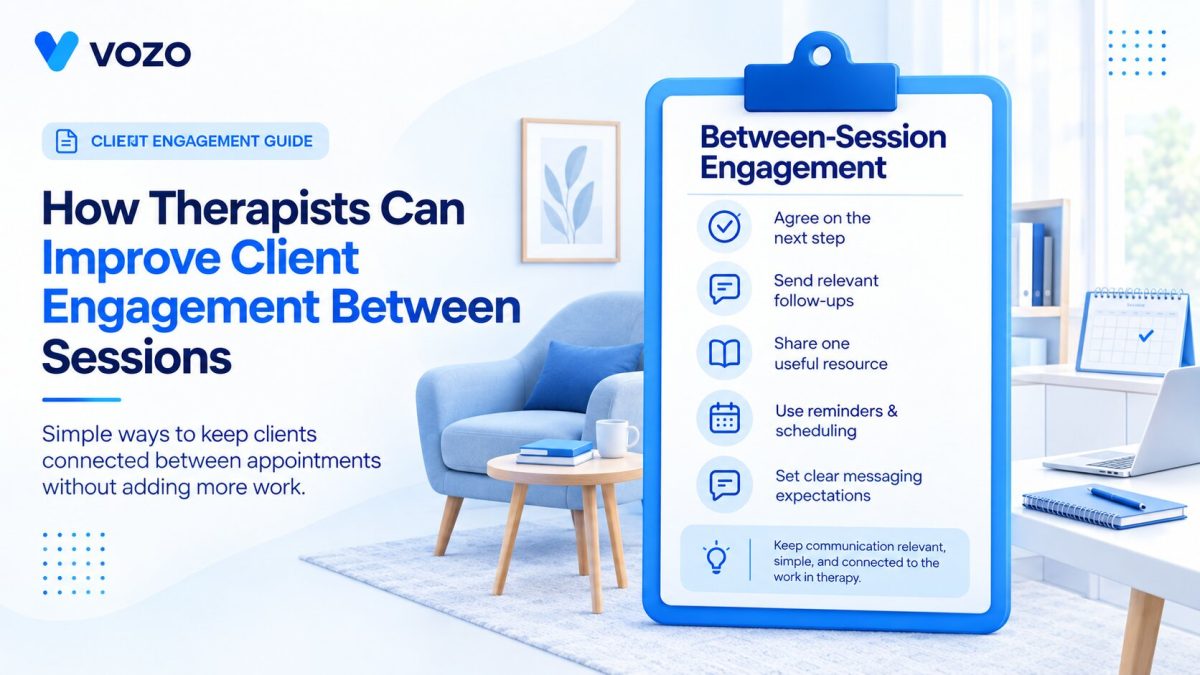
How to Improve Client Engagement Between Therapy Sessions
A lot of the work discussed in therapy can continue after the client leaves the appointment. They try something they talked about with the therapist, think more about a topic that came up, or notice how it affects them during the week.
Therapists can help keep that connection going without checking with clients all the time. Sometimes a short message or a resource is enough. In other cases, it may be better to simply agree on something the client can pay attention to before the next visit.
For busy practices, the challenge is making time for these small tasks without adding more work to the therapist’s day. Simple ways of handling follow-ups help keep clients connected between appointments without creating another administrative burden.
What Is Client Engagement Between Therapy Sessions?
Client engagement does not stop when the appointment ends. It can include practicing something discussed in therapy, paying attention to certain patterns, working toward treatment goals, or bringing up something that happened during the week at the next session.
Someone working through anxiety might write down situations that trigger anxious thoughts. A client dealing with sleep problems might keep a record of their sleep. Another person may practice a technique discussed in therapy and talk about how it went at the next appointment.
Activities between sessions are used in different forms of psychotherapy. The American Psychological Association describes examples such as practicing skills, keeping records, reading, and completing other activities outside the session, depending on the therapy approach and the client’s situation.
The important part is choosing something that makes sense for the treatment rather than giving every client the same assignment.
Why Does Engagement Between Sessions Matter?
Clients continue to experience challenges, relationships, and daily situations after a therapy session ends. The time between appointments can help them practice a technique, notice patterns, or reflect on something discussed in therapy.
Evidence from psychotherapy research indicates that explaining the purpose of between-session activities and involving clients in planning them can support engagement. Much of this research focuses on CBT, so these findings may not apply equally to every type of psychotherapy.
The activity should fit the client’s treatment goals and what feels realistic for them.
1. Talk About the Next Step Before the Session Ends
Near the end of the session, ask the client if there is anything they want to try or pay attention to before coming back.
It could be as simple as noticing how they react in a certain situation or trying out something discussed during the appointment.
For instance, a client working on boundaries might notice the next time they agree to something they do not actually want to do.
There is no need to turn it into a formal homework assignment. A small point to think about during the week can be enough.
2. Send a Follow-Up Message When It Adds Something
Not every session needs a follow-up message.
There are times when one makes sense. The therapist may have mentioned a resource during the appointment, the client may have asked for a worksheet, or there may be something they agreed to work on during the week.
A short message can be enough:
Here is the breathing exercise we discussed today. You can refer back to it when you notice the physical signs of anxiety we talked about
The client already knows why the resource was sent. There is no need to turn a simple follow-up into another lengthy conversation.
3. Choose Resources Cautiously
Clients can become quickly overwhelmed when they receive too much information.
A therapist might have a lot of useful articles, worksheets, or educational materials available. Sending all of them at once does not necessarily make them more useful.
A resource that fits the current conversation is usually easier to put into practice.
For example, a therapist talking with a client about sleep patterns might share a sleep tracking worksheet. A client working on a particular coping technique might receive information that explains or reinforces that technique. The material should complement the therapy rather than take its place.
4. Make Scheduling And Reminders Less Hassle
Some engagement problems are surprisingly ordinary.
A client may intend to book their next appointment and forget. They may have difficulty finding a suitable time or overlook a reminder among other messages.
Online scheduling and appointment reminders can take some of that friction out of the process. The Office of the National Coordinator for Health Information Technology notes that EHRs can support patient participation through features such as electronic appointment scheduling, follow-up information, reminders, communication, and patient portals.
For staff, automated reminders can also reduce the number of routine messages that have to be sent manually. That can be useful when a practice is handling appointments for many clients.
Simplify the Work Between Appointments
Messages, appointment updates, and reminders are all part of running a busy practice. Vozo EHR brings these everyday tasks together so they are easier to manage.
5. Give Clients a Consistent Place to Communicate
A patient portal gives clients a familiar place to interact with the practice. Depending on the platform, they may be able to communicate with the practice, access information, request appointments, or handle other routine tasks.
ONC notes that patient portals can provide an avenue for communication and follow-up information, while EHR systems can support electronic appointment scheduling.
For the practice, keeping those interactions within the EHR can be easier to manage than having conversations spread across personal email, phone calls, and different messaging tools.
Messaging still needs boundaries. Clients should know when messages are checked, which questions belong in the portal, and when they can expect a response.
Under HIPAA, covered healthcare providers may communicate electronically with patients, including by email, when reasonable safeguards are used. For remote communication technologies used in telehealth, HHS recommends explaining to patients when and how they will be contacted and what communication method will be used.
6. Tie Between Session Activities to the Work in Therapy
Clients may be more willing to try something between sessions when they understand the reason behind it.
For example, if a client is working on self-confidence, the therapist might ask them to write down one situation where they handled something better than they expected. The activity can be as simple as long as it relates to the work being done in therapy.
7. Find Out What Works For The Client
Some clients like having something to look back on after a session. Others would rather leave with a plan and work through it during the week.
A quick conversation about their preference can make follow-ups easier. Send something when it is useful, and avoid adding extra messages when they are not needed.
8. Set Expectations Around Messaging
A practice can avoid a lot of confusion by explaining its communication rules upfront.
Clients should know:
- Which method to use for routine questions
- When messages are usually reviewed
- How long a response may take
- What information should not be sent through messaging
- What to do when they need urgent or emergency assistance
These details also help protect the therapist’s time. A portal or messaging system should not create an expectation that the therapist is available around the clock.
Clear expectations can also help clients understand how and when they will be contacted and what communication method the practice uses. HHS recommends providing patients with information about when and how they will be contacted when remote communication technologies are used.
Common Mistakes That Can Get In The Way
Sending Too Many Messages
A steady stream of notifications can become annoying rather than helpful. Before sending something, ask whether the client actually needs it.
Sharing Too Many Resources
Ten links can be harder to use than one relevant worksheet. Give clients somewhere sensible to start.
Handling Every Reminder Manually
Appointment reminders, scheduling messages, and other routine tasks can take up staff time. Automation can take some of those repetitive jobs off their list.
Expecting Clients to Remember Everything
People forget details, especially when several topics come up during a session. A short reminder or resource can give them something to look back at.
Treating Communication as The Same Thing as Engagement
A client does not need to message their therapist several times a week to be involved in treatment. Someone who is quietly practicing a skill or paying attention to patterns in their daily life may be just as engaged.
How Technology Can Support Client Engagement
The right technology can take care of some of the work that happens around the therapy session.
Some EHRs include scheduling, patient records, clinical documentation, messaging, and patient portal functions in the same system. ONC identifies EHR-based communication, electronic scheduling, reminders, follow-up information, and patient portals as ways health IT can support patient participation.
Appointment reminders can help clients keep upcoming visits on their radar. Messaging and portal tools can give the practice one place to handle routine communication.
The technology itself is only part of the picture. The clinical relationship still depends on the therapist and client. The software simply handles some of the work around it.
Make Session Engagement Easier With Vozo EHR
Vozo EHR brings scheduling, documentation, a patient portal, and secure messaging together in one system. Its patient portal supports online appointment requests, while clinical notes can be managed within the EHR workflow.
With these tools in one place, therapists and staff can keep appointments, clinical documentation, patient information, and routine communication organized without relying on multiple systems.
Managing these everyday tasks through a connected workflow can make it easier for practices to stay in touch with clients while keeping administrative work manageable.
Explore Vozo EHR to organize client communication, appointments, and practice management in one place.
Frequently Asked Questions
How can an EHR support client engagement in therapy?
An EHR system can support client engagement by making communication and follow-up easier. Therapists may use a patient portal, secure messages, appointment reminders, or online scheduling to handle routine interactions without relying on separate tools for each task.
Why is client engagement important in therapy?
Client engagement keeps the client involved in the work happening in therapy. They can share what they are experiencing, try things discussed during sessions, and bring their experiences back to the next appointment. This also gives the therapist a better sense of what the client is dealing with between sessions.
How can therapists use digital tools to enhance client engagement?
Some of the work between sessions can be handled through digital tools. Therapists can use secure messaging to share something discussed in therapy, patient portals for communication, and online scheduling or reminders for appointments.
What are some effective strategies for increasing client engagement?
Start by talking with the client about what feels realistic for them between sessions. It could be trying something from the appointment, keeping track of a pattern, or bringing a question to the next visit. A simple plan that fits their situation is easier to work with.
What features should therapists look for in client management software?
For therapists, a client management platform with scheduling, reminders, secure messaging, a patient portal, and clinical documentation can make communication between sessions easier to manage. Vozo EHR includes these tools in one system, giving practices a way to handle routine client communication alongside appointments and clinical records.
About the author
Lara Dixit


Lara Dixit is a Senior Business Manager at Vozo Health, specializing in EHR platforms, practice management, billing, and revenue cycle optimization. She helps healthcare providers improve operational efficiency, streamline workflows, and drive sustainable practice growth. At Vozo Health, she focuses on business strategy, healthcare automation, and scalable growth for modern medical practices.