

How Do Insurance Auditors Review SOAP Notes for Medical Necessity?
Imagine you treated a patient exactly the way any good clinician would. You listened, you examined, you made a smart call, and the patient got better. Then, months later, a denial letter shows up saying the service was not medically necessary.
That moment is confusing and honestly a little insulting. You know you did the right thing, so why did the paperwork say otherwise?
Here is the truth nobody explains. Insurance auditors are not judging how good of a clinician you are.
They are judging how well your SOAP notes prove it. Most claims do not fail because the care was wrong. They fail because the note never showed the thinking behind the care.
This guide walks through what auditors look for in a SOAP note, how the review process works from start to finish, and what has changed in 2026 that makes documentation matter more than ever.
What Is Medical Necessity in SOAP Notes?
Medical necessity in SOAP notes means the documentation clearly shows why the patient needed that specific service on that specific date. It is not enough to say the treatment was helpful. The note must connect the patient’s symptoms, condition, clinical findings, diagnosis, and care plan.
Each SOAP section should support that story.
The Subjective section explains the patient’s concern, the Objective section shows relevant findings, the Assessment explains the provider’s clinical reasoning, and the Plan shows the next step. When these parts do not connect, the service may look unsupported during an insurance audit.
What Are Insurance Auditors Actually Trying to Verify?
Every SOAP note review is trying to answer three questions:
- Did the service happen the way it was documented?
- Was it necessary based on the patient’s condition at that time?
- Does the billed code match what the documentation supports?
If any one of these fails, the claim can be denied, downcoded, or pulled back through recoupment, even when the treatment helped the patient.
How Auditors Connect SOAP Notes to Medical Necessity
Auditors do not review SOAP sections as separate boxes. They look for a chain of evidence. The Subjective section should explain the patient’s problem.
The objective section should support or clarify that problem. Assessment should explain the provider’s reasoning. The Plan should show why the next step is medically appropriate.
This is the medical necessity chain:
- Patient complaint
- Clinical finding
- Diagnosis or working impression
- Functional impact or risk
- Skilled intervention
- Patient response
- Next step
What Auditors Check vs What Providers Often Miss
| What Auditors Check | What Providers Often Miss |
| Does the SOAP note support the billed CPT or HCPCS code? | Time, complexity, intervention detail, or service level justification |
| Does the ICD-10 diagnosis match the patient’s current condition? | Current symptoms, severity, and functional impact |
| Does the Assessment explain clinical reasoning? | Why the provider chose that diagnosis or care path |
| Does the Plan follow logically from the Assessment? | Rationale for tests, referrals, treatment frequency, or continued care |
| Is the note individualized for that date of service? | Copied-forward text, repeated templates, and vague statements |
| Does the note prove medical necessity? | The clear link between symptoms, findings, intervention, and next step |
What Do Auditors Look for in Each Section of a SOAP Note?
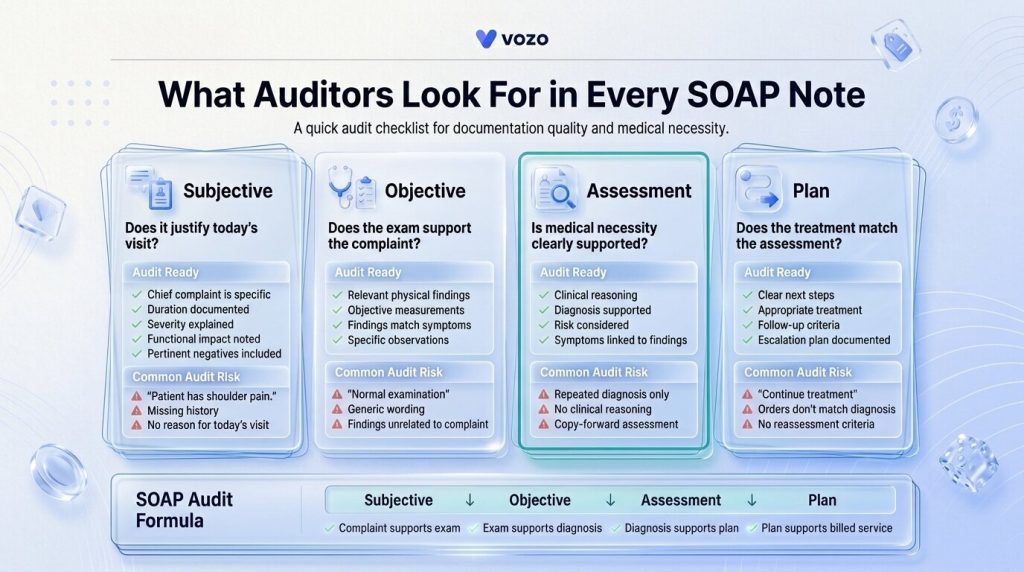
Subjective: Does It Justify the Visit?
Auditors review the level of service charged against the complaint and history to determine if it is accurate. A note which merely states the patient came in for a checkup provides the auditor with no criteria to assess, because it does not indicate severity, duration or the reason for the visit today.
What holds up under review includes specific symptoms, how long they have lasted, what makes them better or worse, and pertinent negatives, meaning the things the patient does not have.
Pertinent negatives matter because they show you considered other possibilities rather than jumping straight to a conclusion.
Weak example:
The patient reports shoulder pain.
Audit-ready example:
The patient reports right shoulder pain for 3 weeks, worse with overhead movement, dressing, and lifting objects above shoulder level. Pain has not improved with rest and over-the-counter medication.
Why this works:
This version shows duration, severity, functional impact, and why the visit was needed today.
Objective: Does the Exam Match the Complaint?
This is where auditors start cross-referencing. If the Subjective section describes shoulder pain but the exam only covers vital signs and a general well-appearing note, that gap stands out immediately. Findings need to correspond directly to the complaint and be specific rather than generic.
Phrases like normal or within normal limits are among the most commonly flagged shortcuts, since they tell an auditor nothing about what was actually examined.
Weak example:
Shoulder exam normal.
Audit-ready example:
Right shoulder active range of motion limited with abduction above 90 degrees. Tenderness noted over the lateral shoulder. Pain reproduced with resisted external rotation. No visible swelling or deformity.
Why this works:
This version gives specific observable findings that match the complaint instead of using generic exam language.
Assessment: This Is Where Medical Necessity Is Won or Lost
The Assessment is the most important component of almost all audits. It shows medical decision-making, the reasoning that links symptoms and findings with a diagnosis and a course of action.
Auditors check for a diagnostic conclusion that’s clearly stated, evidence of weighing severity and risk, and a logical connection between evidence gathered and the decision reached.
An Assessment that repeats a diagnosis without providing any new reasoning, such as continuing to meet criteria for the same condition, is in effect a copy even if it is not literally.
Weak example:
Shoulder pain. Continue treatment.
Audit-ready example:
Findings are consistent with suspected rotator cuff tendinopathy. Persistent pain, reduced range of motion, and difficulty with overhead activity support the need for continued skilled evaluation and treatment.
Why this works:
This version connects symptoms, exam findings, diagnosis, functional limitation, and continued medical necessity.
Plan: Does It Match the Assessment and the Bill?
The Plan has to follow logically from the Assessment. This sounds obvious, but mismatches between the two are among the most common triggers for a denial.
An Assessment of sinusitis followed by a Plan to order an MRI of the lower spine is the kind of contradiction that jumps off the page for a reviewer and raises immediate questions about necessity.
The Plan also needs to show forward motion. If the patient is not improving, “continue treatment” is not enough. The note should explain what will change, why care should continue, and how progress will be reassessed.
Weak example:
Order imaging. Follow up.
Audit-ready example:
Start conservative management with physical therapy referral, activity modification, and NSAID use as appropriate. If pain and limited range of motion persist after 4–6 weeks, consider imaging to evaluate for structural injury.
Why this works:
This version shows why the plan fits the assessment and explains when a higher-cost service may become necessary.
How Auditors Review Behavioral Health SOAP Notes
When auditing a behavioral health SOAP note, the auditors will check for the same medical necessity chain: diagnosis, symptoms, functional impairment, intervention, patient response, and plan. The note should include: the reason for the therapy, the clinical method used, the patient’s response to the therapy, and the rationale for the need for ongoing care.
Weak example:
Discussed anxiety. Patient improvement. Continue therapy.
Audit-ready example:
The patient experiences 2 panic attacks this week and continues to avoid driving alone. Used CBT-based grounding/exposure planning. The patient identified 3 triggers and agreed to one brief driving session before the next session.
Why this works:
This version connects symptoms, functional impairment, clinical intervention, patient response, and the next treatment step.
Turn SOAP Notes Into Stronger Audit Evidence
Vozo helps clinicians create clearer SOAP notes by organizing complaints, findings, assessments, and plans in one structured workflow, so documentation is easier to review before the claim goes out.
How Does the Audit Process Actually Work?
1. Claims data flags the chart – Payers may use billing patterns, code frequency, peer comparison, high-cost services, or documentation trends to identify charts for review.
2. The payer sends a record request – The provider may receive an Additional Documentation Request, payer audit letter, or medical record request.
3. The reviewer compares the claim to the note – The reviewer checks whether the documentation supports the CPT/HCPCS code, ICD-10 diagnosis, service level, time, medical necessity, and plan.
4. The payer issues a decision – The result may be payment approval, denial, downcoding, refund request, or post-payment recoupment.
5. The provider may appeal – Appeals usually depend heavily on whether the original documentation clearly supports the service.
CMS states that medical review requires the review of records to ensure proper coverage, coding, billing and medical necessity. CMS also states that documentation for E/M should be used to support the CPT, HCPCS and ICD-10-CM coding reported on the claim.
What Red Flags Are Auditors Trained to Spot?
| Weak Phrase | Why It Fails | Better Documentation |
| Patient doing better | No measurable progress | Patient reports pain reduced from 8/10 to 5/10 and can now lift light objects below shoulder height |
| Continue treatment | No reason for continued care | Continue therapy twice weekly due to persistent ROM limitation and difficulty with dressing |
| WNL | Too generic | Shoulder abduction limited to 90 degrees with pain at end range |
| Supportive therapy provided | Does not describe intervention | Used CBT reframing to address catastrophic thinking related to panic symptoms |
| Follow up as needed | No clear plan | Follow up in 2 weeks to reassess pain, ROM, and response to conservative treatment |
What Has Changed in Insurance Audit Risk for 2026?
Documentation patterns, risk adjustment accuracy and the ability of the note to support the billed service are all areas payers are taking a closer look at in 2026. This will increase audit risk for providers, as they are more likely to use generic diagnostic language and to copy notes forward.
The biggest change is not that notes need to be longer. They need to be more specific. SOAP notes should clearly show the patient’s current condition, the provider’s medical decision-making, and why the service was necessary for that date of care.
A Practical Audit Readiness Checklist
Use this list before a claim goes out, not after a denial arrives.
- Does the Subjective section explain why the patient is here today, with real specifics rather than a repeated complaint?
- Does the Objective exam address the relevant systems with actual findings instead of a phrase like within normal limits?
- Does the Assessment show new clinical reasoning rather than a restated diagnosis?
- Does the Plan follow logically from the Assessment and change when the patient is not improving?
- If an expensive service was ordered, is the reasoning behind it documented clearly?
- Is the note signed, dated, and completed near the time of the visit?
- If anything was corrected later, is the amendment clearly labeled, leaving the original entry untouched?
Reviewing several charts per provider each month against this list costs far less than responding to a record request months from now.
The Bottom Line
Insurance auditors are not grading your medicine; they are grading your evidence. A SOAP note that clearly shows what you found, why it mattered, and what you decided because of it is much easier to defend during a review, regardless of specialty, payer, or changing documentation expectations.
Write every note as though someone who was never in the room needs to understand your reasoning from the page alone, because sooner or later, someone will be reading it exactly that way.
Frequently Asked Questions
1. How do insurance auditors review SOAP notes?
Insurance auditors review SOAP notes by comparing the billed claim against the medical record. They check whether the note supports the diagnosis, CPT or HCPCS code, medical necessity, treatment plan, clinical findings, provider decision-making, patient response, and time billed when applicable.
2. What do insurance auditors look for in SOAP notes?
Auditors search for a logical link between the patient’s complaint, objective findings, patient’s diagnosis, patient’s treatment decision and patient’s plan. They also determine if the note was written for just that date of service, signed, filled out, and is substantive enough to warrant the level of care being billed.
3. What are the key elements insurance auditors review in SOAP notes?
The elements include chief complaint, pertinent history, objective findings, clinical evaluation, diagnosis recommendations, medical decision, plan of care, patient’s response, service length (if applicable) and documentation of codes and claims consistent with billed codes (CPT, HCPCS, ICD-10).
4. How can providers prepare SOAP notes to pass insurance audits smoothly?
Providers may have the ability to produce more robust SOAP notes, with the reason for the visit, current symptoms, pertinent findings, clinical reasoning, intervention, patient reaction, and next step. Vague phrases, not copying from the previous note, missing time and plans that do not match the assessment should be avoided.
5. What SOAP note documentation standards matter for insurance audits?
SOAP documentation for insurance audits should be clear, complete, timely, signed, and dated. Every note must include medical necessity, the relationship between the diagnosis and the care rendered and, importantly, why the service was the correct service for this patient.
6. What are the best practices for insurance auditors reviewing SOAP notes?
Best practices involve looking to see if documentation backs up the claim, reviewing the Assessment and Plan for clinical reasoning, comparing the note to the CPT and ICD-10 codes, looking for copied forward language, and confirming that the service was medically necessary on that date of care.
About the author
Lara Dixit


Lara Dixit is a Senior Business Manager at Vozo Health, specializing in EHR platforms, practice management, billing, and revenue cycle optimization. She helps healthcare providers improve operational efficiency, streamline workflows, and drive sustainable practice growth. At Vozo Health, she focuses on business strategy, healthcare automation, and scalable growth for modern medical practices.