

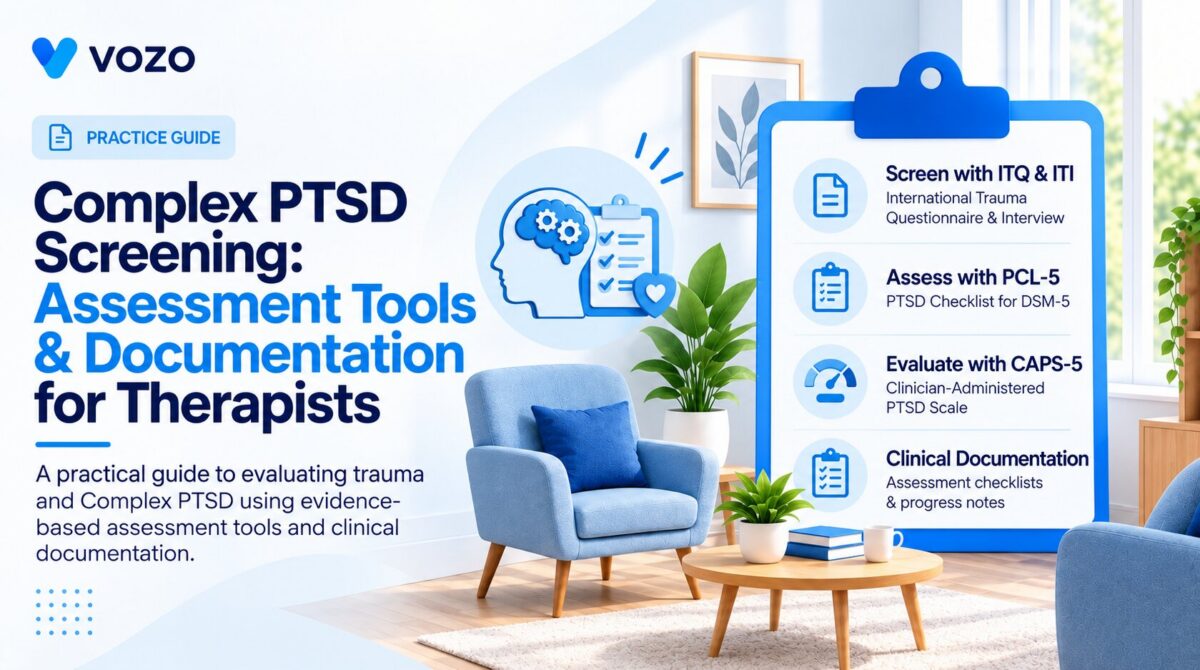
Complex PTSD Screening: Assessment Tools and Documentation for Therapists
A client reports nightmares and avoids anything that reminds them of the trauma. They feel on edge all day. But in session, they keep saying things like “I’m the problem” and “people always leave.”
A PTSD measure such as the PCL-5 can help assess PTSD symptoms, but it does not assess the complete set of disturbances in self-organization associated with ICD-11 CPTSD.
That gap is why complex post-traumatic stress disorder (CPTSD) needs its own assessment. Alongside core PTSD symptoms, therapists look at emotions, self-image, and relationships.
This guide covers the main screening tools, what to do after a positive screen, and how to write it all up.
Key Takeaways
- ICD-11 CPTSD includes core PTSD symptoms plus disturbances in self-organization involving emotional regulation, self-concept, and relationships.
- The International Trauma Questionnaire (ITQ) is an 18-item self-report measure that supports provisional ICD-11 PTSD and CPTSD classification.
- The International Trauma Interview (ITI) is a semi-structured clinician-administered assessment for ICD-11 PTSD and CPTSD.
- The PCL-5 and CAPS-5 assess DSM-5 PTSD. Neither independently establishes an ICD-11 CPTSD diagnosis.
- A positive CPTSD screen requires further clinical evaluation, including symptom history, functional impairment, and differential diagnosis.
- Clinical documentation should connect assessment findings with their interpretation, diagnostic uncertainty, and the next steps in care.
What Is Complex PTSD?
Complex post-traumatic stress disorder (CPTSD) is a trauma-related condition recognized in the ICD-11. It includes the core symptoms of PTSD along with persistent difficulties managing emotions, maintaining a stable sense of self, and forming close relationships.
According to the VA National Center for PTSD, ICD-11 CPTSD involves two groups of symptoms.
The PTSD part has three groups of symptoms:
- Re-experiencing: Reliving traumatic events through flashbacks, trauma-related nightmares, or vivid memories experienced as happening again in the present.
- Avoidance: Avoiding thoughts, memories, activities, people, or situations associated with the trauma.
- Sense of current threat: Persistent hypervigilance or exaggerated startle responses, even when immediate danger is absent.
The second part is called disturbances in self-organization (DSO):
- Emotional dysregulation: Difficulty managing intense emotions or experiencing emotional numbness.
- Negative self-concept: Persistent feelings of worthlessness, failure, or shame.
- Relationship difficulties: Feeling disconnected from others or struggling to maintain emotional closeness.
For an ICD-11 CPTSD diagnosis, symptoms must follow exposure to an extremely threatening or horrific event or series of events and cause significant impairment in daily functioning.
Therapists can review the clinical criteria for CPTSD and related assessment considerations to better understand how the diagnosis differs from PTSD.
Although CPTSD is often associated with prolonged or repeated interpersonal trauma, a specific trauma pattern is not required.
CPTSD can also share symptoms with depression, borderline personality disorder (BPD), and other mental health conditions. These conditions may co-occur, making differential assessment important.
Under ICD-11, PTSD and CPTSD are distinct diagnostic classifications rather than diagnoses assigned together. The DSM-5-TR does not recognize CPTSD as a separate diagnosis, so therapists should follow the diagnostic framework applicable to their practice.
Which Assessment Tools Can Therapists Use?
These four tools serve different purposes. The ITQ and ITI assess ICD-11 PTSD and CPTSD, while the PCL-5 and CAPS-5 assess DSM-5 PTSD.
International Trauma Questionnaire (ITQ)
The ITQ is an 18-item self-report form. It covers the three PTSD groups, the three DSO domains, and the effect on daily life. The scoring instructions help identify a provisional PTSD or CPTSD classification. Follow the official criteria rather than relying on a total score alone.
The client’s responses can help identify symptoms and concerns to explore during the next clinical conversation.
International Trauma Interview (ITI)
The ITI covers the same ICD-11 conditions as the ITQ, but a clinician runs it. You ask the questions, probe vague answers, and rate symptoms and impairment yourself. It takes longer.
It also requires training, so read the official guidance before you use it.
PTSD Checklist for DSM-5 (PCL-5)
The PCL-5 is a 20-item self-report measure used to screen for PTSD, support provisional assessment, and monitor symptom changes during treatment.
The PCL-5 does not assess the complete ICD-11 DSO symptom domains or establish an ICD-11 CPTSD classification.
A high score alone cannot tell you whether CPTSD criteria are met. If CPTSD is suspected, consider the ITQ or, where an appropriately trained assessor is available, the ITI.
CAPS-5
The CAPS-5 is a structured interview for DSM-5 PTSD. It looks at symptoms, duration, distress, and impairment. Like the PCL-5, it won’t give you a CPTSD answer on its own.
Keep Clinical Documentation Connected
Keep screening results and clinical notes organized in one place. Connect follow-up plans and support ongoing client progress with Vozo EHR.
What Should Therapists Do After a Positive Screen?
Start by talking it through. Ask which symptoms hit hardest, how long they’ve been there, and what makes them worse. If CPTSD seems possible, ask about emotions, self-image, and relationships too.
Then consider other explanations and co-occurring conditions. Some symptoms may overlap with depression, anxiety, or BPD, so assess the client’s overall presentation rather than relying on a screening score alone.
Depending on what you find, your next step might be the ITQ, a trained administration of the ITI, or a broader clinical evaluation.
Explain what the results do and do not indicate, discuss any remaining uncertainty, and agree on the next steps with the client.
What Should You Document During CPTSD Assessment?
Good clinical documentation links screening results to your clinical findings and decisions. Include:
- Reason for assessment: What prompted screening.
- Tool used: Name, version, date, and language.
- Results: Scores and key responses.
- Clinical findings: Symptoms, how long they’ve lasted, and the effect on work, relationships, or daily life.
- Interpretation: What the results suggest, their limits, and other possible explanations.
- Plan: More assessment, treatment planning, referrals, or reassessment.
Quote the client when their words make the picture clearer. Leave out graphic details you don’t need, and follow your privacy policies.
How Can an EHR Help With CPTSD Assessment Documentation?
CPTSD assessment requires therapists to document more than screening results. They need to record reported symptoms, clinical findings, functional impairment, and decisions about further assessment or treatment.
A behavioral health EHR can help practices:
- Record screening results: Keep assessment scores and relevant responses with clinical notes.
- Document clinical findings: Connect reported symptoms with their impact on daily functioning.
- Track assessment decisions: Record interpretations, limitations, and recommended next steps.
- Maintain consistent notes: Keep assessment records organized across therapy sessions.
Vozo EHR outcome measures feature offers standardized assessments, automated scoring, and progress tracking. Its published product information lists the PCL-5.
Check whether the specific ITQ or ITI version you need is available before incorporating it into your workflow.
Frequently Asked Questions
1. What assessments can therapists use to evaluate complex PTSD symptoms?
The International Trauma Questionnaire (ITQ) is a self-report measure designed to assess ICD-11 PTSD and complex PTSD (CPTSD). The International Trauma Interview (ITI) provides a clinician-led assessment. The PCL-5 and CAPS-5 assess DSM-5 PTSD symptoms but do not evaluate the complete ICD-11 CPTSD criteria. The appropriate tool depends on the clinical purpose and diagnostic framework.
2. Where can therapists find reliable complex PTSD screening questionnaires?
Therapists can consult the World Health Organization’s ICD-11 clinical guidance and the VA National Center for PTSD for information about the ITQ, ITI, PCL-5, and CAPS-5. Always review the official questionnaire, scoring instructions, and administration requirements before using a measure in clinical practice.
3. How can therapists document complex PTSD symptoms effectively in therapy sessions?
Document the reason for assessment, the tool used, scores, reported symptoms, and their impact on daily functioning. Include your clinical interpretation, relevant alternative explanations, assessment limitations, and follow-up plan. Record the client’s own words when they clarify the findings, while avoiding unnecessary sensitive details.
4. Can a screening questionnaire confirm complex PTSD?
No. A screening questionnaire such as the ITQ can identify a provisional CPTSD classification when scored according to its criteria, but it does not replace a comprehensive clinical assessment. Therapists should consider the client’s history, symptoms, functional impairment, and possible co-occurring conditions before reaching a diagnostic conclusion.
5. How often should therapists repeat complex PTSD assessments?
The timing depends on the client’s needs, treatment goals, and clinical progress. Therapists may repeat an appropriate measure at planned intervals or when significant changes in symptoms occur. Using the same measure consistently can help track changes over time, alongside clinical observations and the client’s reported experiences.
Official Sources
VA National Center for PTSD. International Trauma Questionnaire (ITQ). https://www.ptsd.va.gov/professional/assessment/adult-sr/itq.asp
VA National Center for PTSD. International Trauma Interview (ITI). https://www.ptsd.va.gov/professional/assessment/adult-int/iti.asp
VA National Center for PTSD. PTSD Checklist for DSM-5 (PCL-5). https://www.ptsd.va.gov/professional/assessment/adult-sr/ptsd-checklist.asp
VA National Center for PTSD. Clinician-Administered PTSD Scale for DSM-5 (CAPS-5). https://www.ptsd.va.gov/professional/assessment/adult-int/caps.asp
About the author
Lara Dixit


Lara Dixit is a Senior Business Manager at Vozo Health, specializing in EHR platforms, practice management, billing, and revenue cycle optimization. She helps healthcare providers improve operational efficiency, streamline workflows, and drive sustainable practice growth. At Vozo Health, she focuses on business strategy, healthcare automation, and scalable growth for modern medical practices.