

Smarter Documentation: The Role of AI Voice Assistants in Modern Healthcare
Clinical recording is more important during a patient-provider conversation. From diagnosis to compensation, documentation is the foundation of patient care. However, traditional methods like manual typing, click-heavy EHR interfaces, and post-visit note entry frequently result in physician burnout, mistakes, and inefficiencies.
As technology progresses, AI-powered voice assistants are emerging as a game changer in clinical documentation. In this blog, you’ll learn how AI voice assistants help in clinical documentation.
Challenges in Traditional Documentation
Physicians spend a large amount of time on administrative activities. A research article states that clinicians devote approximately two hours to EHRs and desk work for every hour spent providing direct patient care. This has far-reaching consequences, ranging from physician tiredness to decreased patient satisfaction and income leakage.
Furthermore, data entry mistakes, documentation delays, and poor note quality are typical when practitioners are pressed for time. While scribes and transcribing services provide some respite, they raise privacy issues and increase prices.
Traditional documentation has several issues, including:
- Time-consuming manual entry.
- High cognitive workload and burnout
- Documentation mistakes and discrepancies.
- Delayed chart closure impacts billing cycles.
These difficulties highlight the compelling need for smarter, quicker, and more intuitive solutions.
The Growth of AI Voice Assistants in Healthcare
AI voice assistants use speech recognition, natural language processing, and machine learning to automate clinical reporting. These systems, which allow doctors to talk normally during or after patient appointments, record and intelligently arrange clinical notes in real time.
Companies like Amazon Transcribe, DeepScribe are leading the way. These systems have progressed from simple dictation software to context-aware assistants that interact with EHRs, comprehend medical terminology, and learn from user behavior over time.
- Real-time, organized documentation
- Reduced cognitive burden
- Improved provider-patient face time
- Enhanced note quality and compliance
Cloud computing and AI model developments have made these technologies more precise, scalable, and secure.
Who Uses AI Voice Assistants?
The use of AI voice assistants is no longer limited to tech-savvy early adopters. Today, big health systems, ambulatory offices, and even rural clinics are looking into these solutions to increase workflow efficiency.
According to a HIMSS poll from 2024, approximately 40% of healthcare providers have deployed or plan to implement AI-based documentation solutions within the next year. The increase is especially obvious in disciplines such as internal medicine, family practice, and radiology, which have significant paperwork loads.
- Primary care physicians are accelerating SOAP note creation.
- Radiologists report their observations using speech.
- Emergency departments reduce post-shift charting time
- Mental health providers are taking extensive session notes.
Acceptance depends on usability, compliance, and seamless connection with current systems.
Related: How AI Scribes Can Cut Documentation Time by 50%
Accuracy and Clinical Reliability
A valid issue with AI voice assistants is accuracy. In therapeutic settings, even minor misinterpretations might have major implications. Modern algorithms are rigorously trained on medical datasets and constantly updated to increase speech-to-text accuracy.
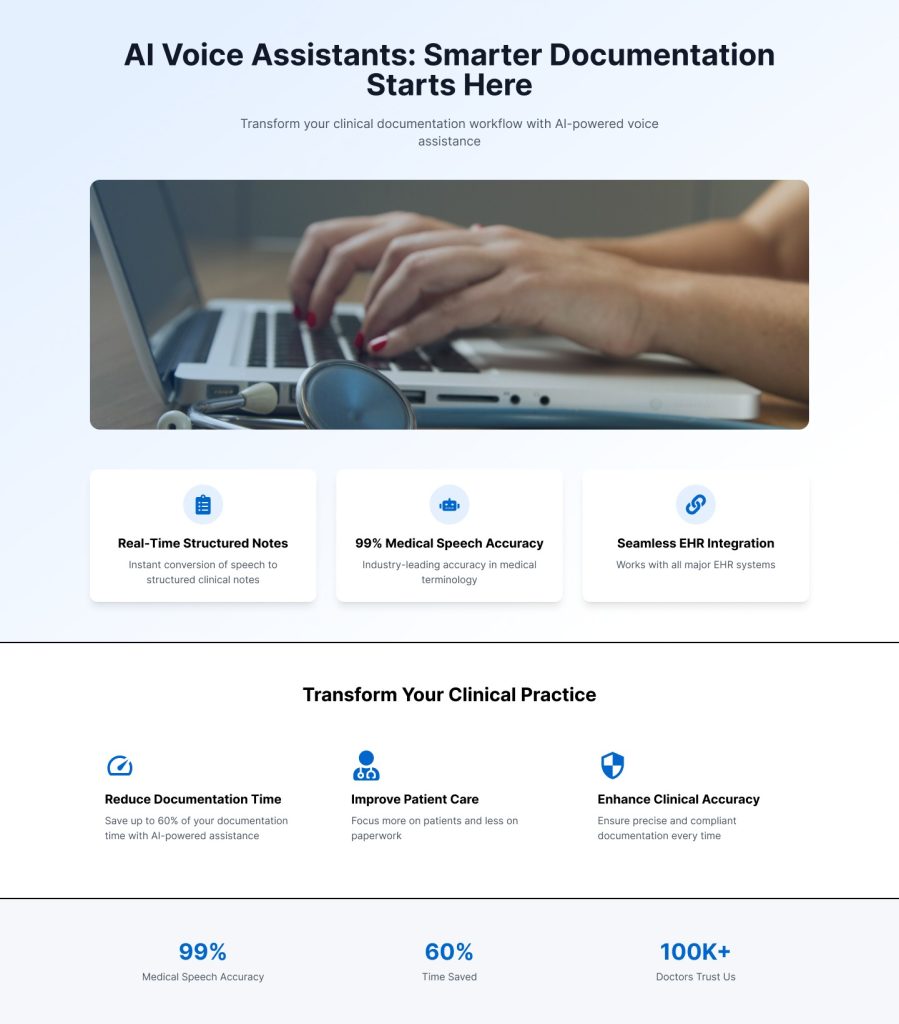
Nuance claims over 99% accuracy in medical voice recognition, but younger players employ AI to learn from provider preferences and context, improving output reliability with each encounter.
Despite their potential, these systems continue to confront obstacles.
- Accents and Speech Variability
- Background noise in crowded situations.
- Contextual misreading, such as homonyms
To address this, suppliers frequently include capabilities like real-time correction recommendations, confidence grading, and human-in-the-loop validation for key documentation. As a result, clinical trust in AI speech technology is rapidly rising.
Integration with EHR Systems
The capacity to easily interact with EHR systems is another element boosting adoption. Most top-tier AI speech tools are designed to integrate with popular EHR systems like OpenEMR, Epic. Integration enables physicians to complete documentation immediately in the patient record, without switching between screens or platforms.
- Enter structured data into the EHR areas.
- Activate orders or referrals using voice commands.
- Summarize and organize notes into SOAP or H&P parts.
- Get essential patient data in real time.
It enables practitioners to be more productive while adhering to regulatory requirements and ensuring documentation is comprehensive.
AI Voice Assistants vs Human Scribes
While human scribes are still used in many organizations, AI voice assistants provide a more scalable and cost-effective solution. Human scribes can cost thousands of dollars each month, necessitate onboarding, and present privacy problems due to PHI disclosure.
- 24/7 availability, lower operational costs.
- There are no HIPAA compliance problems if properly encrypted.
- Continuous performance improvement via machine learning.
Human scribes, on the other hand, continue to excel in complicated judgment and dealing with challenging or unstructured relationships. A hybrid strategy, in which AI performs regular documentation and scribes handle exceptions, may develop as a more balanced method in the future years.
Barriers to Wider Adoption
Despite the promise, not all providers are racing to implement AI voice assistants.
- Initial Cost – Licensing and installation might be costly.
- Learning Curve – Clinicians may require time to modify processes.
- Data Security – Ensuring HIPAA and GDPR compliance is not negotiable.
- IT Infrastructure – Older systems might not support newer AI techniques.
Not all voice assistants are made equally. Some are very broad and lack a medical specialty, while others are difficult to scale across huge businesses.
To overcome these limitations, you need:
- Vendor Training and Support
- Pilot initiatives will demonstrate ROI
- Stakeholder engagement: from IT to doctors
Vozo Cloud EHR for your Healthcare Practices
From managing and organizing patient health records digitally to reducing medical errors, it significantly empowers providers to improve healthcare quality.
If you are searching for the best EHR system for your healthcare practice, Vozo EHR can be your go-to choice. Our comprehensive EHR solution lets you focus more on patient care while carrying all the burdens and simplifying them.
- Vozo Cloud EHR’s cost-effective cloud subscription benefits all levels of practice.
- Our feature-rich EHR helps you rectify mistakes efficiently and speed up the process.
- Vozo Specialty EHR resonates with specialty practice needs and requirements.
- Our expert technical team gets you covered 24/7 if any needs arise.
- Our EHR System continues to scale as your healthcare practice grows to improve the user experience.
The Vozo Customized EHR solution benefits your healthcare practice by:
- Streamlining the administrative process
- Improving workflow efficiency
- Reducing proneness to errors
- Managing all the patients’ records in one place
- Offers greater efficiency and cost savings across the board.
Our specialty-specific tools, like scheduling, patient portals, lab integration, cloud hosting, and more, meet your healthcare practice’s specific needs and requirements.
“Embrace Vozo EHR to reduce your burdens and enhance patient care.”
About the author
Lara Dixit


Lara Dixit is a Senior Business Manager at Vozo Health, specializing in EHR platforms, practice management, billing, and revenue cycle optimization. She helps healthcare providers improve operational efficiency, streamline workflows, and drive sustainable practice growth. At Vozo Health, she focuses on business strategy, healthcare automation, and scalable growth for modern medical practices.