
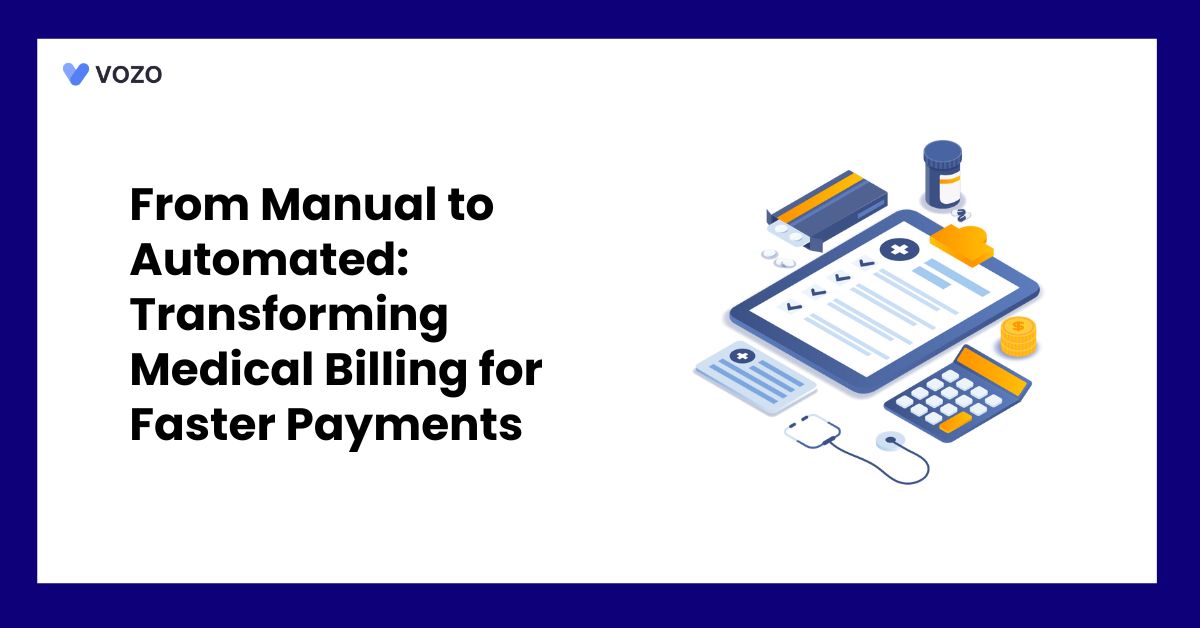
From Manual to Automated: Transforming Medical Billing for Faster Payments
Healthcare organizations are under growing pressure to decrease costs, expedite revenue cycles, and comply with shifting laws. Medical billing is the vital link between treatment given and payment received and is central to these difficulties.
Billing has traditionally been labor-intensive and error-prone, requiring manual data entry, code review, and time-consuming follow-up. However, with developments in AI, robotic process automation, and analytics, the healthcare sector is on the point of a major shift.
In this blog, you’ll learn how automation is changing medical billing today, the benefits and drawbacks of developing technologies, and the implementation of best practices.
The Condition of Medical Billing Today
Many companies still rely on manual procedures for claim submission, coding, and denial management, even after making large investments in EHR and practice management systems.
- Data entry, such as transcription errors, results in coding inconsistencies and claim denials.
- Employees are forced to switch between interfaces due to a lack of smooth interaction between payer portals, billing platforms, and EHRs.
- Industry data indicates that denial rates range from 5 to 10% and that appeals need a great deal of manual investigation.
- Although there is a great need for qualified coders and billing specialists, many practices, particularly smaller or rural ones, find it difficult to recruit and keep talent.
Key Automation Technologies for Medical Billing
1. Robotic Process Automation
RPA employs bots to replace human operations on legacy systems, including browsing displays, transferring data, and performing rule-based tasks.
- Obtain patient demographics and charge information from EHRs.
- Fill out invoicing and claim forms in practice management software.
- Monitor payer portals for claim status updates.
- Create uniform refusal letters for minor coding adjustments.
Organizations may minimize manual burden by up to 60% by assigning repetitive tasks to bots. This also speeds up claim submission and improves data integrity.
2. AI & Machine Learning
AI algorithms may examine previous claim and rejection data to identify high-risk claims before submission.
- Natural language processing algorithms assess clinical data and recommend the most correct CPT, ICD-10, and HCPCS codes.
- Staff can take action before submission by using predictive analytics to find claims that are likely to be rejected, such as those with low medical necessity ratings or missing modifications.
- AI can detect appealable denials, write appeal letters, and offer supporting material.
3. Intelligent Document Processing
IDP systems collect important data items like date of service, diagnosis, and procedure information from unstructured documents, such as test results, referral letters, and doctor notes, and classify them using OCR and AI.
- Charge capture using paper or scanned forms
- Prior authorization workflows
- Pre-billing review of patient records
Organizations that use IDP have experienced up to a 75% decrease in manual chart review time.
4. API-Driven Integrations
Real-time data exchange between EHRs, clearinghouses, payers, and patient portals is made possible via API-driven integrations seen in modern billing platforms.
- At scheduling or check-in, patients may receive instant eligibility checks that verify their coverage and copayments.
- Automated polling of payer systems for adjudication outcomes and remittance advice.
- Patient billing is seamless, with patient responsibility amounts posted to online portals and payment channels promptly upon adjudication.
APIs reduce data silos, decrease redundancy, and increase openness for both providers and patients.
Related: A Provider’s Guide to Solving Medical Billing Issues with Integrated Payment Solution
Benefits of Automated Medical Billing
1. Accelerated Revenue Cycle
Automating data capture, code assignment, and claim filing can minimize days in accounts receivable by 20-40%. Faster cash flow increases financial stability and allows for investing in care delivery.
2. Enhanced Accuracy and Compliance
Automation significantly reduces human error rates. AI-powered code validation aligns with CPT and ICD-10 requirements, lowering compliance risk and audits/fines.
3. Reduced Operational Costs
Delegating basic activities to bots and AI allows billing personnel to focus on difficult rejections, patient questions, and value-added initiatives. This change can lower FTE manpower by up to 30%, resulting in significant payroll savings.
4. Improved Patient Experience
Patient satisfaction and collection rates improve when patient statements are transparent, timely, and easy to pay for online. Automated eligibility checks also help to prevent surprise billing situations.
Implementation Best Practices
Adopting automation in medical billing involves careful planning and change management.
1. Perform a Detailed Process Audit
Map current workflows from start to finish, discovering inefficiencies, error hotspots, and integration gaps.
2. Define Specific Goals and KPIs
Set targets like reducing denial rates by X%, cutting days-in-AR by Y days, and monitoring progress using dashboards.
3. Select a Phased Rollout
Begin with a pilot in a single department or claim type, such as outpatient treatments, tweak bots/models, and then extend across specialties.
4. Preserve Data Security and Governance
To protect PHI both in transit and at rest, use encryption, audit trails, and role-based access limits.
5. Train and Engage Staff
Iterating on automation logic requires early billing team participation, practical training with new technology, and feedback loops.
6. Collaborate with Skilled Vendors
Select IT providers with proven interoperability skills, healthcare experience, and robust support models.
Addressing Potential Challenges
While the potential of automation is appealing, businesses must navigate.
- Data Quality Issues – AI and RPA work best with clean, organized data. Invest in data hygiene and standardization initiatives.
- Technology Integration Challenges – Legacy systems without current APIs may necessitate specialized adapters or middleware. Budget properly and schedule integration sprints.
- Regulatory Evolution – Billing regulations, code sets, and payer requirements are continually updated. Ensure that suppliers update AI models and process rules on a timely basis.
Related: How Practices Are Cutting AR Days with Smarter Claim and Payment Workflows
Vozo EHR Integrated with Medical Billing
Medical billing is a complex healthcare operation that requires efficiency and precision. Delayed payments, claim denials, and manual errors can slow your revenue cycle and affect cash flow.
With Vozo’s Cloud EHR solution, you get an integrated medical billing system that simplifies your billing process and enhances real-time claim tracking to improve payment turnaround.
How Vozo EHR Transforms Medical Billing:
- Streamline billing workflows and reduce administrative workload.
- Instantly identifies and corrects coding errors before claim submission.
- Speeds up claim verification with automated payer communication.
- Ensures compliance with built-in coding checks and regulatory updates.
- Offers real-time analytics and reporting for better decision-making.
- Minimizes delays by automating claims processing and payments.
- Reduces billing disputes with accurate, transparent invoicing.
Vozo EHR’s seamless integration with medical billing empowers healthcare providers to reduce errors, prevent delays, and optimize revenue cycles, all while focusing on delivering better patient care.
About the author
Lara Dixit


Lara Dixit is a Senior Business Manager at Vozo Health, specializing in EHR platforms, practice management, billing, and revenue cycle optimization. She helps healthcare providers improve operational efficiency, streamline workflows, and drive sustainable practice growth. At Vozo Health, she focuses on business strategy, healthcare automation, and scalable growth for modern medical practices.