

10 Best Strategies To Improve Patient Engagement In Primary Care
Improving patient engagement in primary care helps in clinical results while also increasing satisfaction, loyalty, and overall practice efficiency. Most of the patients are more likely to follow treatment recommendations, use preventative treatments, and live healthier lifestyles.
In this blog, you’ll learn the 10 evidence-based techniques for primary care practices to promote patient satisfaction and participation.
1. Utilize Patient Portals and Mobile Apps
Patients may now access their health information, schedule appointments, and communicate securely using digital technologies, making interaction easier.
How To Implement
- Choose a correct portal/app that works flawlessly with your EHR and provides easy navigation.
- During visits, staff show crucial features like reading lab results and obtaining refills. Provides written step-by-step instructions and quick-start videos.
- Incentives can be used to encourage portal usage, such as minor savings on co-pays for healthy living.
- Track metrics, including log-ins, message exchanges, and feature popularity, to detect adoption gaps and customize efforts.
2. Implement Shared Decision-Making
When patients deliberately choose therapies that accord with their beliefs, they are more likely to follow through.
How To Implement
- Make decisions that provide brochures, films, or interactive tools that explain the alternatives, risks, and advantages in simple terms.
- Clinicians can improve their communication abilities through workshops on risk communication, motivational interviewing, and plain language explanations.
- In document preferences, enter patient values like a desire to avoid hospital stays into the EHR so that other team members may respect them.
3. Offer Personalized Health Education
Patients respond more strongly to information that is specifically tailored to them, which gives them the confidence to take certain measures.
How To Implement
- Divide your population into categories according to risk factors, age, or chronic illnesses.
- Make videos, pamphlets, or newsletters that focus on the primary issues facing each group, such as a series on diabetic self-management.
- Use several channels and send SMS reminders, email links to instructional modules, and place posters in waiting areas.
- Assess comprehension during visits, and ask patients to “teach back” essential aspects to verify they comprehend and can apply the advice.
Related: The Ultimate Patient Portal Checklist: What Every Healthcare Practice Needs
4. Utilize Proactive Outreach and Reminders
Patients sometimes forget to schedule preventative tests or follow-ups for chronic conditions.
How To Implement
- Implement your EHR so that it reminds patients by phone, text message, or email about pending or overdue bloodwork, vaccinations, and visits.
- Reminders and custom messages like “Jane, time for your wellness checkup” are perceived as patient-friendly and kind.
- Save staff time by enabling two-way communication to allow patients to confirm or reschedule directly immediately by SMS or portal message.
5. Enhance In-Office Experience
A friendly, efficient visit encourages patients to return and remain involved.
How To Implement
- Streamline check-in by using tablets or kiosks for digital forms to cut wait times and ensure accurate information.
- Improve the environment with comfortable sitting, free WiFi, and health publications. Consider including relaxing design elements such as plants or artwork.
- Train front-desk staff to welcome patients with empathy and a warm demeanor, setting the tone for their overall experience.
6. Foster Care Team Collaboration
When physicians, nurses, care managers, and pharmacists collaborate, patients receive better coordinated and comprehensive treatment.
How To Implement
- Conduct regular meetings to evaluate high-risk patients, report changes, and organize outreach.
- Assign care managers to contact complex patients, pharmacists to perform medication reconciliation, and nurses to educate.
- Shared care plans and maintain a live record within the EHR, which can be viewed and modified by all team members, including the patient.
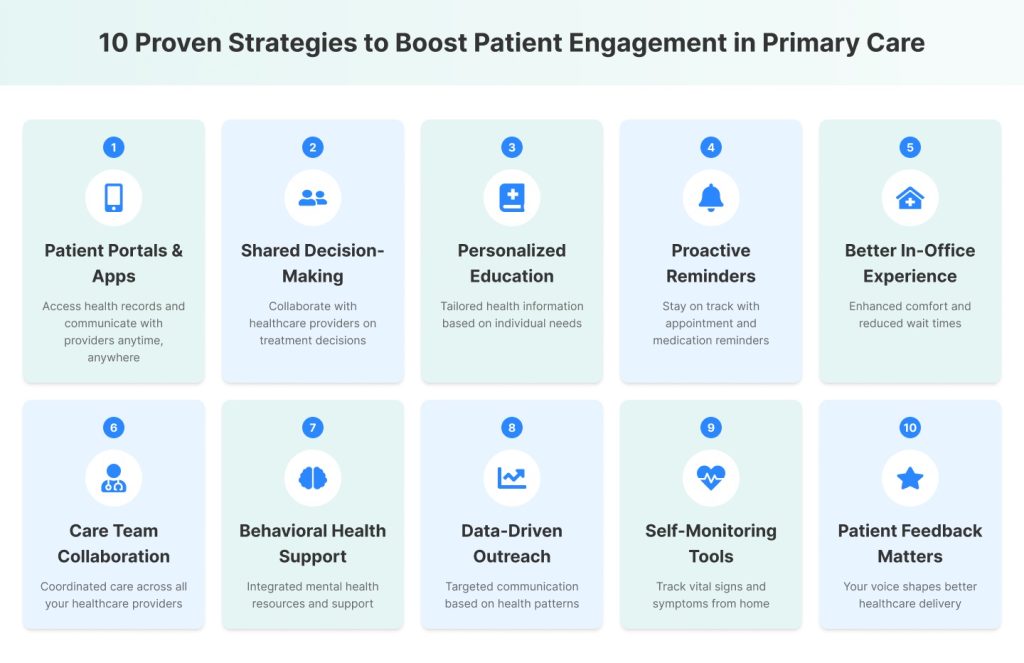
7. Incorporate Behavioral Health Support
Both emotional and mental well-being have a direct correlation with physical health and treatment participation.
How To Implement
- Provide on-site counseling by incorporating mental health providers within the clinic in order to provide seamless transitions.
- Screen frequently with brief standardized instruments such as PHQ-9 for depression, and follow up on good results.
- Offer group programs such as stress-management courses, smoking cessation groups, and chronic pain self-management sessions.
8. Use Data to Identify and Close Gaps
Data analytics helps to identify which patients are disengaged or at risk, allowing for tailored interventions.
How To Implement
- Run registry reports to identify patients with uncontrolled hypertension or skipped diabetes care procedures.
- Prioritize outreach to patients at high risk of problems or non-adherence.
- Track performance measures such as no-show rates, portal utilization, and preventive screening completion to assess progress over time.
9. Empower Through Self-Monitoring
Home monitoring devices, such as blood pressure cuffs, glucometers, and wearable fitness trackers, empower patients to take control of their health.
How To Implement
- Provide devices on loan or at a reasonable cost to patients who cannot otherwise afford them.
- Integrate readings and send data from home devices to the EHR or patient portal for real-time analysis.
- During visits, discuss trends and reinforce positive behavior. Celebrate accomplishments to increase motivation.
10. Seek and Act on Patient Feedback
Direct input allows you to understand engagement barriers and demonstrates to patients that their voices are important.
How To Implement
- Use brief, focused questionnaires such as Net Promoter Score and CAHPS after each visit or quarterly.
- Patient advisory councils gather a broad group of patients quarterly to examine practice initiatives and or changes.
- When you make a change based on feedback, such as expanded hours or enhanced messaging, publicize it through a newsletter or portal announcement.
Related: Top 10 Features to Consider Before Choosing the Patient Portal
Vozo Patient Portal Solution
Vozo patient portal software provides a comprehensive solution to help healthcare providers achieve clinical, financial, and operational excellence through a powerful patient portal.
Our exceptional Patient Portal Software will allow:
- Have complete access to patients’ medical records digitally
- Our cost-effective subscription plan helps healthcare practices at all levels.
- The Vozo patient portal can effortlessly be integrated and implemented with any EHR system to increase productivity.
- Vozo’s Patient Portal respects users’ privacy and safeguards health-related records and personal information.
- 24/7 availability to support you with your needs and requirements.
- By understanding your unique needs for your specialty healthcare practice, we will customize Vozo’s patient portal for a seamless workflow.
Patients can request appointments, access health records, and lab results, and even pay bills online with the help of a patient portal, which creates a personal touch with you always.
Leverage the Vozo Patient Portal for Better Healthcare Solutions.
About the author
Lara Dixit


Lara Dixit is a Senior Business Manager at Vozo Health, specializing in EHR platforms, practice management, billing, and revenue cycle optimization. She helps healthcare providers improve operational efficiency, streamline workflows, and drive sustainable practice growth. At Vozo Health, she focuses on business strategy, healthcare automation, and scalable growth for modern medical practices.