

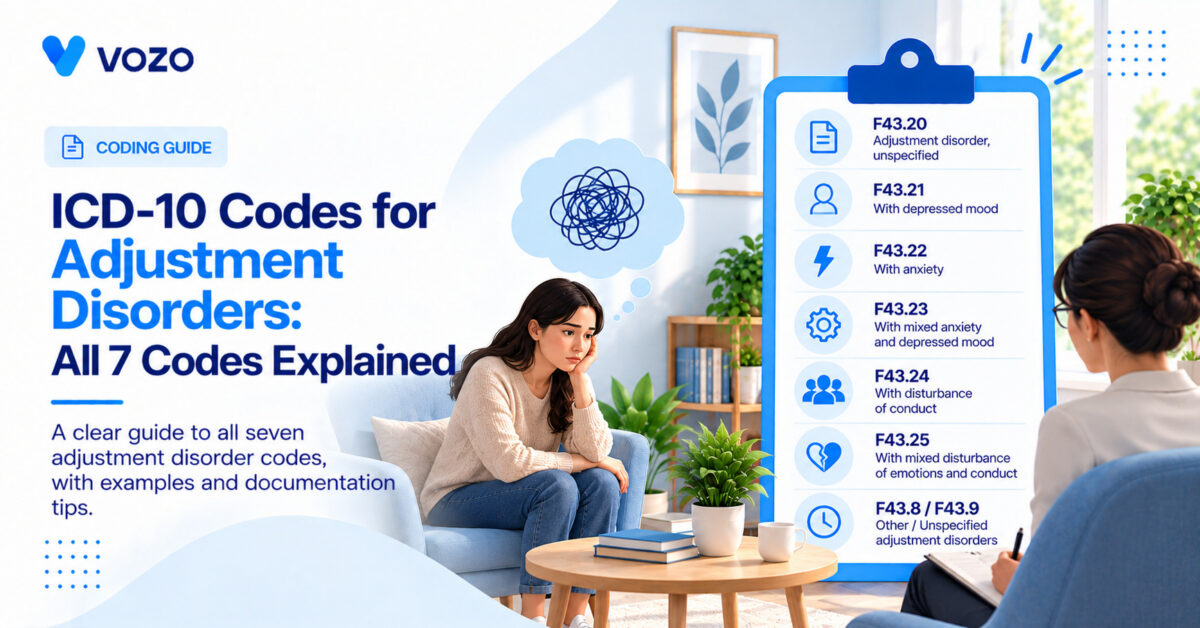
ICD-10 Codes for Adjustment Disorders: All 7 Codes Explained
The ICD-10-CM codes for adjustment disorders fall under F43.2, with seven specific diagnosis codes ranging from F43.20 to F43.29.
These codes identify different clinical presentations, including anxiety, depressed mood, conduct disturbances, and mixed symptoms. As with other ICD-10 codes for common mental health conditions, the correct code depends on the clinician’s documented diagnosis and supporting clinical documentation.
What Are the ICD-10 Codes for Adjustment Disorders?
F43.2 is not billable. For claims reporting, select one of the seven specific codes supported by the documented diagnosis.
Complete Adjustment Disorder ICD-10 Code List
| ICD-10 Code | Official Description | Billable |
| F43.20 | Adjustment disorder, unspecified | Yes |
| F43.21 | Adjustment disorder with depressed mood | Yes |
| F43.22 | Adjustment disorder with anxiety | Yes |
| F43.23 | Adjustment disorder with mixed anxiety and depressed mood | Yes |
| F43.24 | Adjustment disorder with disturbance of conduct | Yes |
| F43.25 | Adjustment disorder with mixed disturbance of emotions and conduct | Yes |
| F43.29 | Adjustment disorder with other symptoms | Yes |
These seven codes are included in the FY2027 ICD-10-CM classification, effective October 1, 2026, through September 30, 2027.
Understanding the Seven Adjustment Disorder ICD-10 Codes
F43.20 – Adjustment Disorder, Unspecified
F43.20 applies when adjustment disorder has been diagnosed, but the clinician has not specified a subtype.
Example: A patient experiences emotional distress and difficulty functioning after relocating. The clinician documents adjustment disorder without identifying a particular subtype.
F43.21 – Adjustment Disorder With Depressed Mood
F43.21 identifies adjustment disorder in which depressed mood is the specified presentation. Symptoms may include sadness, tearfulness, and hopelessness.
Example: Following a divorce, a patient develops persistent sadness and difficulty managing daily responsibilities. The clinician diagnoses adjustment disorder with depressed mood.
F43.22 – Adjustment Disorder With Anxiety
F43.22 identifies adjustment disorder with anxiety. Patients may experience significant worry, nervousness, tension, or difficulty concentrating in response to an identifiable stressor.
Example: After an unexpected job loss, a patient develops persistent financial worries and difficulty sleeping. Clinical assessment establishes the anxiety subtype.
F43.23 – Adjustment Disorder With Mixed Anxiety and Depressed Mood
F43.23 applies when both anxiety and depressed mood characterize the diagnosed adjustment disorder.
Example: Following a relationship separation, a patient experiences persistent worry, sadness, tearfulness, and difficulty completing daily activities. Both emotional presentations are documented in the diagnosis.
F43.24 – Adjustment Disorder With Disturbance of Conduct
F43.24 identifies adjustment disorder involving a disturbance of conduct, such as aggression or significant rule-breaking behavior associated with a stressor.
Example: Following a family disruption, an adolescent becomes aggressive and repeatedly violates school rules. Clinical evaluation establishes the conduct-disturbance subtype.
F43.25 – Adjustment Disorder With Mixed Disturbance of Emotions and Conduct
F43.25 identifies adjustment disorder involving both emotional symptoms and behavioral disturbances.
Example: After parental separation, an adolescent experiences persistent sadness, anxiety, aggression, and repeated school absences. Both emotional and conduct disturbances are documented.
The distinction from F43.23 is the documented disturbance of conduct.
F43.29 – Adjustment Disorder With Other Symptoms
F43.29 applies when the clinician documents an adjustment disorder presentation that does not fit the named subtypes.
Unlike F43.20, which is used when the subtype is unspecified, F43.29 requires a documented other-symptoms presentation.
How to Select the Correct Adjustment Disorder ICD-10 Code
Code selection should follow the clinician’s established diagnosis rather than a coder’s independent interpretation of symptoms.
Before assigning an adjustment disorder code:
- Confirm the diagnosis: Verify that the clinician has established adjustment disorder after clinical assessment.
- Identify the subtype: Review whether the diagnosis specifies anxiety, depressed mood, conduct disturbance, mixed symptoms, or another presentation.
- Match the code: Select the most specific ICD-10-CM code supported by the documentation.
- Clarify documentation: Query the clinician when the subtype is ambiguous, conflicting, or inadequately documented.
For related diagnoses, see our ICD-10 codes for common mental health conditions
Spending Too Much Time on Clinical Notes?
Keep diagnosis details, progress notes, and patient records organized with Vozo’s behavioral health EHR.
Diagnostic Criteria Relevant to Adjustment Disorder Coding
Under DSM-5-TR criteria, adjustment disorder involves clinically significant emotional or behavioral symptoms associated with an identifiable stressor.
The assessment considers:
- Stressor: Symptoms develop in response to an identifiable stressful event or circumstance.
- Onset: Symptoms begin within three months of the stressor’s onset.
- Clinical significance: Symptoms cause distress disproportionate to the stressor, considering cultural and contextual factors, or significant impairment in daily functioning.
- Differential diagnosis: Symptoms are not better explained by another mental disorder, an exacerbation of an existing condition, or an expected bereavement response.
- Duration: Symptoms do not persist beyond six months after the stressor or its consequences have ended.
Symptoms may continue beyond six months when the stressor or its consequences remain ongoing.
Documentation Requirements for Adjustment Disorder ICD-10 Codes
| Documentation Element | What to Record |
| Identifiable stressor | Event or circumstance associated with symptoms |
| Symptom onset | When symptoms began in relation to the stressor |
| Presenting symptoms | Anxiety, depressed mood, conduct changes, or other relevant findings |
| Functional impact | Effects on work, school, relationships, or daily functioning |
| Clinical assessment | Findings supporting the diagnosis and consideration of alternative disorders |
| Diagnosis and subtype | Specific adjustment disorder diagnosis established by the clinician |
Example of Adjustment Disorder Clinical Documentation
Presenting concern: Patient reports persistent worry, sadness, and difficulty concentrating following an unexpected job loss six weeks earlier.
Clinical findings: Symptoms began after the job loss, cause significant functional impairment, and support an adjustment disorder diagnosis following clinical evaluation.
Diagnosis: Adjustment disorder with mixed anxiety and depressed mood.
ICD-10-CM code: F43.23.
Common Mistakes When Coding Adjustment Disorders
1. Coding an Unconfirmed Diagnosis
Under the ICD-10-CM coding guidelines, uncertain outpatient diagnoses should not be reported as established conditions. If adjustment disorder remains under evaluation, code the documented symptoms or other appropriate reasons for the encounter instead.
2. Overlooking Changes in the Documented Diagnosis
When reassessment results in a revised adjustment disorder diagnosis, update subsequent code assignments to reflect the clinician’s current documentation.
Consistent progress tracking can help clinicians identify changes that warrant diagnostic reassessment.
3. Assuming a Billable Code Guarantees Reimbursement
A valid ICD-10-CM code does not guarantee claim approval. Payers may evaluate medical necessity, covered services, provider eligibility, and documentation before determining reimbursement.
Simplify Adjustment Disorder Documentation With Vozo
Managing clinical notes, diagnosis changes, and billing across patient visits can take time away from care.
Vozo EHR brings documentation, customizable therapy templates, scheduling, and billing into one platform.
Want to see how Vozo fits your documentation workflow?
Frequently Asked Questions
1. Can adjustment disorder and major depressive disorder be coded together?
Adjustment disorder should not be used to explain symptoms that are better accounted for by major depressive disorder. If separate conditions are documented, the clinician must determine whether each diagnosis is independently supported and whether reporting both is appropriate.
2. Is there a separate ICD-10-CM code for chronic adjustment disorder?
No. ICD-10-CM does not provide a separate chronic adjustment disorder code within F43.2. The clinician should document the current presentation and select the appropriate subtype code.
3. Can adjustment disorder and PTSD use the same ICD-10-CM code?
No. Adjustment disorders are classified under F43.2, while PTSD falls under F43.1 and its more specific codes. Their diagnostic requirements differ, so the assigned code must reflect the clinician’s documented diagnosis.
4. What is the difference between adjustment disorder and acute stress disorder in ICD-10-CM?
Adjustment disorders are classified under F43.2, with specific codes from F43.20 to F43.29. Acute stress reaction is classified under F43.0. Clinically, acute stress disorder follows exposure to a qualifying traumatic event and has a different symptom pattern and duration. The code should reflect the clinician’s documented diagnosis.
5. Can adjustment disorder be reported as a secondary diagnosis?
Yes, when adjustment disorder is separately documented, clinically relevant to the encounter, and meets the applicable reporting criteria. The sequencing of diagnoses depends on the reason for the encounter and the relevant coding guidelines.
References
CMS – ICD-10-CM Code Files, FY2027
CMS – FY2027 ICD-10-CM Official Guidelines for Coding and Reporting
AAPC – F43.2 Adjustment Disorders
Merck Manual Professional Edition – Adjustment Disorders
About the author
Lara Dixit


Lara Dixit is a Senior Business Manager at Vozo Health, specializing in EHR platforms, practice management, billing, and revenue cycle optimization. She helps healthcare providers improve operational efficiency, streamline workflows, and drive sustainable practice growth. At Vozo Health, she focuses on business strategy, healthcare automation, and scalable growth for modern medical practices.