

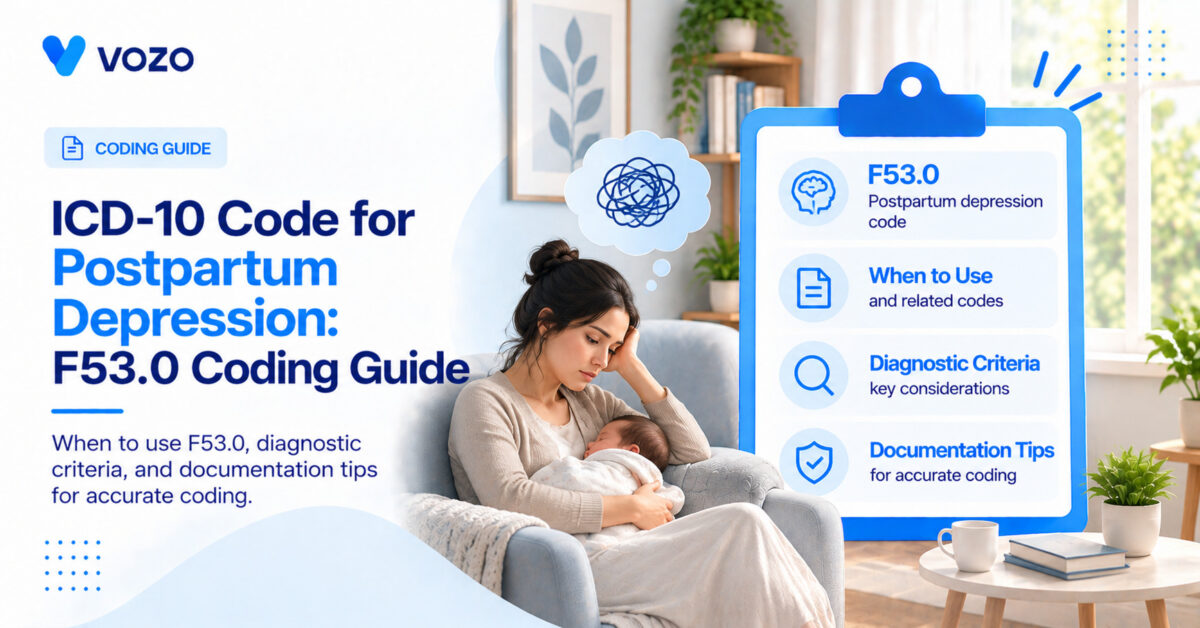
ICD-10 Code for Postpartum Depression: F53.0 Coding Guide
The ICD-10-CM code for postpartum depression is F53.0, a billable diagnosis code for documented postpartum or postnatal depression.
Accurate coding requires a documented clinical diagnosis supported by relevant assessment findings, which behavioral health practices must record clearly.
What Is the ICD-10-CM Code for Postpartum Depression?
F53.0 is the ICD-10-CM diagnosis code for postpartum depression. It belongs to category F53, which covers certain mental and behavioral disorders associated with the puerperium.
| Detail | Value |
| ICD-10-CM code | F53.0 |
| Description | Postpartum depression |
| Billable | Yes |
| Includes | Postpartum depression NOS; postnatal depression NOS |
| Code set | FY 2027 |
What Is Postpartum Depression?
Postpartum depression is a depressive condition that develops after childbirth. Symptoms may include persistent sadness, loss of interest, fatigue, sleep disturbances, difficulty concentrating, and impaired daily functioning. Unlike temporary postpartum blues, postpartum depression involves more persistent symptoms that warrant clinical evaluation.
When Should Clinicians Use ICD-10 Code F53.0?
F53.0 is used when a healthcare provider establishes and documents postpartum or postnatal depression.
Before assigning the code, confirm:
- Diagnosis: The provider documents postpartum depression, not just symptoms or screening findings.
- Clinical relationship: The documentation supports the relationship to childbirth.
- Coding requirements: Applicable exclusions, other diagnoses, and obstetric coding rules have been reviewed.
Does timing affect coding?
Postpartum depression can be diagnosed months after delivery. For obstetric coding, the FY 2027 ICD-10-CM guidelines define the postpartum period as six weeks and the peripartum period as the last month of pregnancy through five months after delivery. Pregnancy-related complications may be coded later when the provider documents their relationship to childbirth.
F53.0 vs. Related ICD-10-CM Codes
Several postpartum mental health conditions share symptoms but require different codes.
| ICD-10-CM code | Description | When to consider it |
| F53.0 | Postpartum depression | Documented postpartum or postnatal depression |
| O90.6 | Postpartum mood disturbance | Postpartum blues, sadness, or dysphoria |
| F53.1 | Puerperal psychosis | Documented puerperal psychosis |
| F32.9 | Major depressive disorder, single episode, unspecified | Documented single-episode major depressive disorder |
| F33.1 | Major depressive disorder, recurrent, moderate | Documented recurrent major depressive disorder of moderate severity |
Coding note: Category F53 carries Excludes1 notes for postpartum dysphoria (O90.6), specified mood disorders with psychotic features, and psychotic disorders classified under F20–F29. Review these instructions before reporting related conditions.
Is O99.345 Required With F53.0?
O99.345 identifies other mental disorders complicating the puerperium. Its parent category, O99.34, lists conditions classified under F01–F09, F20–F52, and F54–F99.
F53.0 identifies postpartum depression under a separate category. Whether additional obstetric coding is appropriate depends on the documented condition, encounter circumstances, and applicable ICD-10-CM instructions. Do not automatically pair the codes.
Keep Postpartum Mental Health Documentation Organized
Capture clinical assessments, treatment notes, and follow-ups in one EHR built to support behavioral health workflows.
What Documentation Supports Postpartum Depression Coding?
Accurate coding requires a documented clinical diagnosis supported by relevant assessment findings.
- Diagnosis: Confirmed postpartum or postnatal depression.
- Symptom history: Onset, duration, and relationship to childbirth.
- Clinical findings: Symptoms and their impact on daily functioning.
- Screening: EPDS or PHQ-9 results, when used.
- Safety assessment: Clinically indicated risk evaluations.
- Treatment plan: Recommended treatment, referrals, and follow-up.
Note: Screening results can support clinical evaluation but do not independently establish the diagnosis.
Postpartum Depression ICD-10 Coding Examples
The following hypothetical scenarios demonstrate how documentation and encounter context affect code selection.
Example 1: Postpartum Depression in Behavioral Health Care
A patient attends a behavioral health assessment three weeks after delivery. She reports persistent sadness, loss of interest, and difficulty concentrating. Following clinical evaluation, the provider documents postpartum depression.
Code consideration: F53.0 identifies postpartum depression. The coder must also determine whether Chapter 15 rules apply to the encounter.
Example 2: Postpartum Mood Disturbance
A patient reports tearfulness and mood changes shortly after delivery. Following evaluation, the provider documents postpartum mood disturbance rather than postpartum depression.
Code consideration: O90.6 identifies the documented postpartum mood disturbance. F53.0 is not appropriate when the provider has diagnosed postpartum mood disturbance rather than postpartum depression.
Keep Behavioral Health Documentation Clear and Connected
Postpartum mental health care involves clinical assessments, therapy notes, treatment plans, and ongoing appointments.
Vozo EHR helps behavioral health practices organize patient records, manage clinical documentation, schedule visits, and coordinate follow-up care in one platform.
See how Vozo can support your practice’s everyday clinical workflows.
Frequently Asked Questions
1. What is the ICD-10-CM code for postpartum depression?
The ICD-10-CM code for postpartum depression is F53.0. It is a billable diagnosis code used when a healthcare provider documents postpartum or postnatal depression. Code selection must reflect the confirmed diagnosis, encounter circumstances, and applicable ICD-10-CM coding instructions.
2. What is the difference between F53.0 and O90.6?
F53.0 identifies postpartum depression, while O90.6 identifies postpartum mood disturbance, including postpartum blues or dysphoria. Postpartum depression involves a clinically diagnosed depressive condition, whereas postpartum mood disturbance may describe temporary emotional changes after childbirth. These codes are not interchangeable.
3. Is O99.345 the same as F53.0?
No. F53.0 identifies postpartum depression, while O99.345 identifies other mental disorders complicating the puerperium. The codes have different classifications and coding instructions. They should not automatically be assigned together without reviewing the documented condition and applicable ICD-10-CM rules.
4. Can postpartum depression be diagnosed more than six weeks after delivery?
Yes. Postpartum depression can be diagnosed months after childbirth. Although ICD-10-CM defines the postpartum period as six weeks, pregnancy-related complications may be coded later when the provider documents their relationship to pregnancy or childbirth.
5. What documentation is required for ICD-10 code F53.0?
Documentation should include the confirmed diagnosis, symptom onset, clinical findings, functional impact, and treatment plan. Screening results such as EPDS or PHQ-9 scores may support assessment but do not independently establish postpartum depression.
Official Sources
CMS – FY 2027 ICD-10-CM Official Guidelines
AAPC – F53 Classification and Excludes1 Notes
AAPC – O99.34 Classification
ICD List – F53.0 Code Details
About the author
Lara Dixit


Lara Dixit is a Senior Business Manager at Vozo Health, specializing in EHR platforms, practice management, billing, and revenue cycle optimization. She helps healthcare providers improve operational efficiency, streamline workflows, and drive sustainable practice growth. At Vozo Health, she focuses on business strategy, healthcare automation, and scalable growth for modern medical practices.