
CPT Code 90837: 60-Minute Psychotherapy Billing Guide
A claim comes back denied. The session was real. The session ran well past the 53-minute threshold. But the payer flagged it anyway, and now you’re digging through your notes trying to prove something you already know is true.
It’s a familiar problem in behavioral health billing with CPT 90837. Not because the code is hard to understand. Because a handful of coding and documentation details can determine whether the claim is supported when a payer reviews it.
Key Takeaways
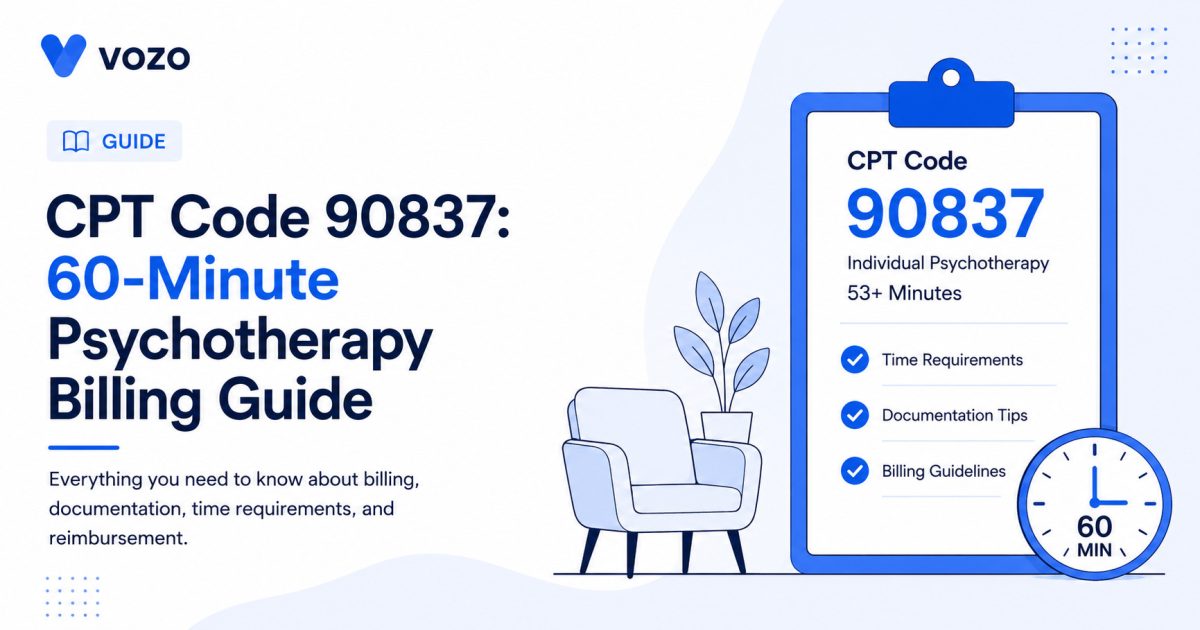
- CPT 90837 reports 53 minutes or more of psychotherapy with the patient.
- The “60-minute” label in the code’s name is rounded. The real minimum is 53 minutes.
- Only psychotherapy time counts toward the 90837 time threshold. Scheduling, administrative work, and documentation completed outside the psychotherapy service do not.
- When the same eligible clinician performs a separately identifiable E/M service and 53+ minutes of psychotherapy, report the E/M service with psychotherapy add-on code 90838 rather than standalone 90837.
- Document either the psychotherapy start and stop time or the total psychotherapy minutes, according to payer requirements.
- A scheduled 60-minute appointment does not itself support 90837; the record should document the psychotherapy time actually provided.
What Is CPT Code 90837?
CPT code 90837 reports 53 minutes or more of psychotherapy with the patient. Because 90837 is time-based, documented psychotherapy time is one of the most important elements supporting code selection.
The official CPT wording says “psychotherapy, 60 minutes with patient.” That number is a bit rounded. Under the CPT/CMS time ranges, 53 minutes or more supports 90837.
The therapy under this code can take many forms. It might be supportive talk, insight work, or structured behavior work. All of it shares one goal: helping the patient manage symptoms, build coping skills, and move toward their treatment goals.
The code covers most therapy styles, including:
- Cognitive behavioral therapy (CBT)
- Dialectical behavior therapy (DBT)
- EMDR and prolonged exposure work
- Psychodynamic therapy
- Acceptance and commitment therapy (ACT)
It does not cover a visit built mainly around a medical check-in or medication changes. When the service is primarily a medical evaluation or medication-management encounter, the appropriate E/M service may apply instead. A psychotherapy add-on code applies only when a separately identifiable psychotherapy service is also performed.
CPT Code 90837 Time Requirements
Because 90837 is time-based, the cutoff is central to correct code selection. CMS sets this code at 53 minutes or more, above the two other individual therapy codes.
| Standalone | With E/M | Time |
|---|---|---|
| 90832 | 90833 | 16–37 min |
| 90834 | 90836 | 38–52 min |
| 90837 | 90838 | 53+ min |
Do not report 90832, 90834, or 90837 for psychotherapy lasting less than 16 minutes. Past that lower limit, the right code depends on how long the session ran and whether the note shows that clearly.
Two common time-based coding risks are undercoding and overcoding.
Undercoding: Sessions run 54 to 58 minutes most of the time, but the provider defaults to 90834 out of habit. That can result in undercoding and lower reimbursement when 90837 is otherwise supported.
Overcoding: Sessions run 48 to 50 minutes most of the time, but 90837 gets billed anyway because it feels close enough. If only 48–50 minutes of psychotherapy are documented, the record does not support the 53-minute threshold for 90837.
Who Can Bill CPT Code 90837?
Qualified mental health professionals may report 90837 when psychotherapy is within their scope of practice and they meet the payer’s enrollment and credentialing requirements.
Eligible providers typically include:
- Psychiatrists (MD/DO)
- Clinical psychologists
- Licensed clinical social workers (LCSWs)
- Licensed marriage and family therapists (LMFTs)
- Licensed professional counselors (LPCs)
- Psychiatric nurse practitioners and clinical nurse specialists
Reimbursement can vary by practitioner type, payer contract, and setting, so verify the applicable payer fee schedule rather than assuming the same payment across credentials.
CPT 90837 can be billed in most care settings. That covers private offices, outpatient clinics, hospital-based care, and approved video visits. Rules can still vary by payer, provider type, and setting.
Keep 90837 Time and Notes Connected
Vozo EHR keeps session documentation and billing details in one workflow, reducing gaps between what happened in the visit and what reaches the claim.
What Documentation Supports CPT 90837?
Clear documentation helps show that the reported psychotherapy code is supported if the claim is reviewed. Documentation is especially important because 90837 is time-based and the record must support both the reported service and medical necessity.
A strong note should show the following.
Exact start and stop times, or total minutes. A line like “session ran 10:12 AM to 11:09 AM, 57 minutes of psychotherapy”. A scheduled 60-minute appointment does not by itself establish 90837; document the psychotherapy time actually provided.
The medical record should support the diagnosis reported on the claim through the documented clinical condition, treatment, and services provided.
When clinically relevant or required by the payer, document the factors supporting the duration and medical necessity of the psychotherapy, particularly for unusually long or repeatedly extended sessions.
Specific details. Describe what actually happened, in words specific enough to reflect what actually occurred during that patient’s encounter. “Continued session four of exposure work, finished the in-session exercise” is specific. “Talking about coping skills” is not.
The patient’s response. How engaged they were, their mood, and any safety concerns from the hour.
Document relevant mental-status and safety findings when clinically appropriate, and include the required provider signature/identification.
Overly repetitive or cloned documentation can weaken the record’s ability to demonstrate the individualized service provided during each encounter.
CPT 90837 vs. 90838: When Psychotherapy Is Performed With E/M
Say a psychiatrist adjusts medication in the same visit as a therapy session. If the E/M service is significant and separately identifiable from the psychotherapy, don’t bill 90837 alone that day.
When the same eligible clinician performs the E/M service and 53+ minutes of psychotherapy, report the appropriate E/M code plus add-on code 90838. The psychotherapy time must be separate from the E/M time.
Do not split one continuous psychotherapy encounter into multiple units simply to increase billing. Rules for genuinely separate psychotherapy encounters on the same date can vary by payer and circumstances, so verify the applicable payer policy.
Billing CPT Code 90837 for Telehealth
CPT 90837 may be reported for qualifying telehealth psychotherapy when the payer’s coverage and billing requirements are met. A few things matter for a clean claim.
- Telehealth modifier requirements vary by payer. For Medicare professional claims, use the applicable telehealth place-of-service rules; commercial plans may also require modifier 95 or another payer-specific modifier.
- For Medicare claims, use place of service 10 when the patient is at home, and 02 when they’re somewhere else. Check current rules with the payer directly.
- Note that video consent was given, plus the method used and where both sides were located.
- The core psychotherapy documentation remains the same, with any additional telehealth-specific elements required by the payer or applicable policy.
Audio-only behavioral-health coverage and modifier requirements vary by payer and setting. Verify whether audio-only psychotherapy is covered and which modifier, if any, the payer requires before submitting the claim.
Some payers may use utilization review to evaluate unusually high use of longer-duration psychotherapy codes. This does not mean providers should alter the distribution of codes; each claim should reflect the service and psychotherapy time actually provided.
Turn CPT Code 90837 Notes Into a Repeatable Process
One operational source of 90837 errors is disconnected scheduling, clinical documentation, and billing workflows. The scheduling tool, the clinical note, and the billing step don’t stay linked.
A session runs long, the note gets written later without the exact time on hand, and the claim ends up out of step with what really happened.
Vozo EHR keeps scheduling, encounter documentation, billing information, and claims workflows connected within the same EHR.
- Custom behavioral-health templates help standardize session documentation, treatment details, goals, and other required fields.
- AI-assisted charting captures the visit conversation and generates a draft clinical note for provider review, reducing repetitive manual documentation.
- Encounter and billing information can automatically populate a superbill, reducing duplicate entry when preparing billing documentation and claims.
- Real-time eligibility checks help identify coverage issues before the visit and reduce avoidable eligibility-related billing problems.
- Built-in video visits keep virtual care tied to the same notes and billing flow as in-person care.
90837 documentation problems can result from small mismatches between the actual session time, the clinical note, and the billing workflow. Keeping those workflows connected can reduce opportunities for duplicate entry and documentation-to-billing mismatches.
See how Vozo keeps behavioral-health documentation and billing connected in one workflow.
Frequently Asked Questions
1. How long does a session need to be to bill CPT 90837?
A session needs at least 53 minutes or more of psychotherapy with the patient. Time spent on paperwork, coordination calls, or notes written after the session doesn’t count toward that total. Anything between 38 and 52 minutes falls under CPT 90834 instead.
2. Can CPT 90837 be billed for a telehealth session?
Yes. 90837 may be reported for eligible video-based psychotherapy when telehealth coverage requirements are met. Medicare professional claims generally use POS 10 when the patient is at home and POS 02 when the patient is elsewhere. Modifier requirements vary by payer and setting, so verify the payer’s current policy before billing.
3. Can a psychiatrist bill 90837 with an evaluation and management visit?
When the same eligible clinician performs a separately identifiable E/M service and 53+ minutes of psychotherapy, the psychotherapy is generally reported with add-on code 90838 alongside the appropriate E/M code rather than standalone 90837. E/M time does not count toward the psychotherapy time.
4. Why can CPT 90837 receive additional payer review?
Some payers may review high utilization of 90837 or request documentation supporting individual claims. The record should show the actual psychotherapy time, support the diagnosis and service reported, and establish medical necessity.
Providers should code each encounter based on the service actually delivered rather than trying to maintain a particular distribution of psychotherapy codes.
Sources
CMS – Billing and Coding: Psychiatry and Psychology Services (A57480) (Jan 2026) https://www.cms.gov/medicare-coverage-database/view/article.aspx?articleId=57480
CMS – Physician Fee Schedule Look-Up Tool https://www.cms.gov/medicare/physician-fee-schedule/search
American Medical Association – CPT Code 90837: Psychotherapy, 60 Minutes https://www.ama-assn.org/practice-management/cpt/cpt-code-90837-psychotherapy-1
About the author
Lara Dixit


Lara Dixit is a Senior Business Manager at Vozo Health, specializing in EHR platforms, practice management, billing, and revenue cycle optimization. She helps healthcare providers improve operational efficiency, streamline workflows, and drive sustainable practice growth. At Vozo Health, she focuses on business strategy, healthcare automation, and scalable growth for modern medical practices.