


8 Key Metrics to Track Your Patient Portal’s Impact on Engagement
Patient portals have emerged as critical tools for increasing access, communication, and satisfaction in today’s digital healthcare environment. Providing a portal is insufficient; healthcare organizations must assess how well it promotes patient involvement.
Tracking the correct metrics indicates if your portal is genuinely empowering patients or falling short of expectations. Analyzing use statistics, communication activities, and satisfaction scores provides the data required to optimize the portal experience and improve outcomes.
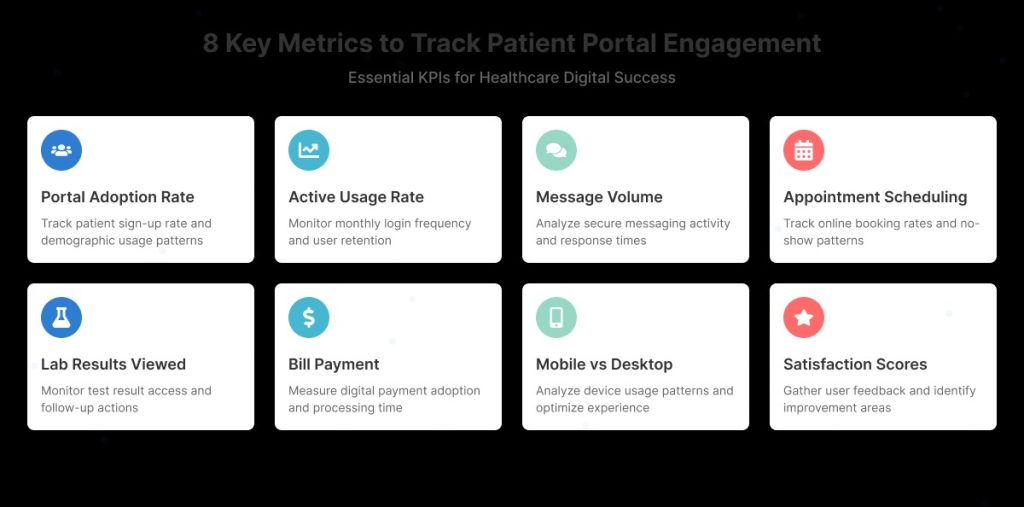
In this blog, you’ll learn the 8 essential parameters that every healthcare provider should track to determine the true impact of their patient portal.
Metrics to Track Patient Portal on Patient Engagement
1. Portal Adoption Rate
The adoption rate is your baseline indicator, indicating how many of your patients have signed up for the portal relative to your overall patient group. A low adoption rate indicates that patients are either unaware of the portal or do not perceive enough benefit in accessing it.
To improve adoption:
- Use front-desk scripts to promote sign-ups during in-person visits.
- Educate patients with email newsletters, website banners, and waiting room videos.
- Encourage sign-ups by emphasizing handy features such as e-prescriptions and online bill payment.
Also, divide the data by demographics to discover gaps. Are elders using the portal at the same rate as younger patients? If not, consider simplifying instructions or contacting technical help to bridge the gap.
2. Active Usage Rate
An adopted gateway does not always imply engagement. Tracking how many patients actively log in and use the features demonstrates how much value they get out of it.
- Analyze trends throughout time.
- How many users return at least once a month?
- Are new users becoming repeat users?
Re-engage inactive users by using engagement nudges such as push alerts or monthly health recommendations. Also, discover typical drop-off points inside the portal are patients signing in but not doing anything? If so, review the user experience and feature arrangement to reduce friction.
3. Message Volume and Response Time
The number of secure messages exchanged indicates how efficiently your gateway facilitates two-way communication. High message activity typically implies that patients see the portal as a reliable way to communicate with care professionals.
However, this raises the workload on employees. Slow response times might reduce patient satisfaction.
To manage effectively:
- Set internal response time goals such as within 24 hours.
- Implement message triaging to direct patient inquiries to the right departments.
- Use templates for popular replies to increase efficiency.
Training employees on portal etiquette and response quality can help improve communication while keeping workloads reasonable.
4. Appointment Scheduling via Portal
Self-service appointment booking is very beneficial to patients and saves staff time. Note the number of appointments that are booked online and the percentage of total reservations that they account for.
- What sorts of appointments, such as follow-ups, telehealth, are most commonly scheduled online?
- What providers or departments have the greatest portal scheduling rates?
This information can help you improve scheduling operations and broaden self-service possibilities. For example, if only primary care appointments are bookable online, consider expanding the functionality to include specialist treatment, wellness checks, and diagnostics.
Monitor the number of patients who do not show up. Because patients pick more convenient times, online self-scheduling usually results in improved adherence.
5. Lab Results Viewed
Providing patients with immediate access to their test results promotes transparency and informed decision-making. Monitoring the number of patients who access their findings through the portal is a reliable indicator of engagement.
- Monitor how fast patients may see test results when they are posted.
- Track follow-up actions, such as sending a message or scheduling a follow-up visit.
Additionally, you may program automated alerts to inform patients when new research is available. To help patients understand their results without calling the clinic, think about providing AI-powered result summaries or contextual health education.
6. Bill Payment and Financial Interactions
Revenue cycle success and patient satisfaction both rise with convenient digital billing. Patients are more likely to make on-time and clear payments when they can easily view, comprehend, and pay bills via the portal.
Monitor critical financial engagement measures, such as:
- Number of invoices paid via the portal
- Average payment processing time.
- % of patients enrolled in auto-pay or payment plans.
If utilization is low, evaluate the user interface to identify potential issues. Is the bill view confusing? Are there too many clicks necessary for payment? Offering mobile-friendly billing experiences and clear charge breakdowns can increase adoption and decrease payment delays.
7. Mobile vs. Desktop Access Trends
Understanding how patients visit your portal, whether by mobile, desktop, or tablet, informs design decisions and feature priority.
If 70% of customers access your portal through mobile devices, yet the mobile experience is cumbersome, your portal’s overall engagement will suffer. Mobile responsiveness is no longer optional; it is essential.
Utilize analytics to track:
- Device type breakdown by session
- Session Duration by Device
- Platform-specific conversion activities like booking and messaging
If mobile usage is dominant, consider investing in a native mobile app or a progressive web app. Ensure that all high-value functions such as messaging and bill pay work as smoothly on mobile as they do on desktop.
8. Portal Satisfaction Scores
Quantitative data tells what patients do, but qualitative feedback reveals how they feel. Portal satisfaction surveys highlight user pain spots, feature requests, and UX/UI issues that raw statistics cannot show.
Include brief in-app surveys or post-visit feedback requests.
- How simple was it to locate what you needed?
- Would you suggest this gateway to a friend?
- What features do you utilize the most or least?
Analyze satisfaction by feature and device type to identify patterns. If satisfaction is low with appointment scheduling but high with bill payment, you know where to make adjustments. Sharing survey findings with your development team promotes data-driven updates.
Related: Evaluating Patient Portal Software: A Guide for Healthcare Providers
Vozo Patient Portal Solution
Vozo patient portal software provides a comprehensive solution to help healthcare providers achieve clinical, financial, and operational excellence through a powerful patient portal.
Our exceptional Patient Portal Software will allow:
- Have complete access to patients’ medical records digitally
- Our cost-effective subscription plan helps healthcare practices at all levels.
- The Vozo patient portal can effortlessly be integrated and implemented with any EHR system to increase productivity.
- Vozo’s Patient Portal respects users’ privacy and safeguards health-related records and personal information.
- 24/7 availability to support you with your needs and requirements.
- By understanding your unique needs for your specialty healthcare practice, we will customize Vozo’s patient portal for a seamless workflow.
Patients can request appointments, access health records and lab results, and even pay bills online with the help of a patient portal, which creates a personal touch with you always.
Leverage the Vozo Patient Portal for Better Healthcare Solutions.
About the author
Lara Dixit


Lara Dixit is a Senior Business Manager at Vozo Health, specializing in EHR platforms, practice management, billing, and revenue cycle optimization. She helps healthcare providers improve operational efficiency, streamline workflows, and drive sustainable practice growth. At Vozo Health, she focuses on business strategy, healthcare automation, and scalable growth for modern medical practices.