
Electronic Superbills: The Smart Switch For Faster Billing And Fewer Denials
Efficiency, precision, and compliance are more important than ever in the hectic healthcare industry. Switching from paper to electronic superbills is one of the simplest yet most effective enhancements a medical office can undertake. This digital shift may appear small, but the advantages are significant.
In this blog, you’ll learn what electronic superbills are, how they compare to traditional paper-based systems, and the advantages of superbills. They assist in increasing medical billing accuracy, minimizing rejections, and improving the patient experience and all while increasing revenue cycle efficiency.
What are Electronic Superbills?
An electronic superbill is a computerized version of the standard paper form that healthcare providers use to document diagnoses, treatments, and services during patient visits. It includes crucial coding information like ICD-10, CPT, and HCPCS codes for medical billing and payment.
Rather than using handwritten notes or paper templates, electronic superbills are incorporated into the EHR or PMS. This guarantees that all charges are appropriately documented and sent immediately to the billing department or clearinghouse.
Benefits of Electronic Superbills
- Faster charge capture and submittal
- Reduced errors from manual data entry
- Smooth connection with EHRs
- Real-time code changes and compliance notifications
- Improved reporting and analytics
Hidden Costs of Paper-Based Charge Capture
Paper appears affordable until you consider the future expenses. First, employees must manually re-enter each code, a duplication process that might result in mismatched modifiers or incorrect units.
Second, forms are occasionally left on clipboards or missing in transit, extending days in A/R and resulting in timely-filing write-offs.
Common Pain Points of Paper Superbills
- Hand-offs might cause a whole billing cycle to pass before a claim is submitted.
- Illegible handwriting, where a single incorrect digit can convert a paying CPT into an immediate refusal.
- Missing forms lead to uncompensated services and compliance deficiencies.
- Paper has no audit trail, making it difficult to demonstrate medical need or identify under-coding tendencies.
These challenges don’t only reduce business margins; they also disturb physician productivity and upset revenue-cycle managers.
8 Business Advantages of Electronic Superbills
Digitalizing the superbill replaces manual friction with real-time validation and automated routing, resulting in demonstrable improvements.
Key Advantages
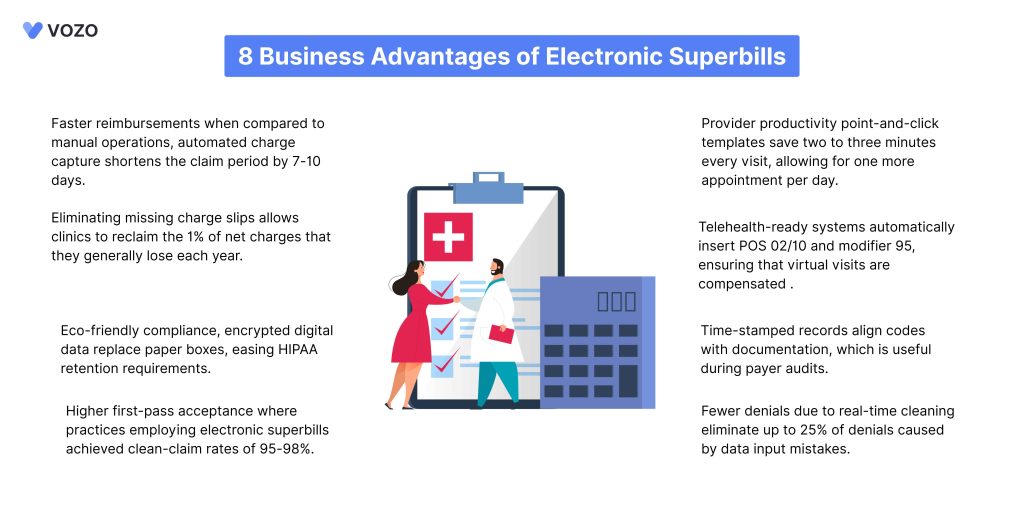
- Faster reimbursements when compared to manual operations, automated charge capture shortens the claim period by 7-10 days.
- Higher first-pass acceptance where practices employing electronic superbills achieved clean-claim rates of 95-98%, which is the MGMA best-practice threshold.
- Fewer denials due to real-time cleaning eliminate up to 25% of denials caused by data input mistakes.
- Eliminating missing charge slips allows clinics to reclaim the 1% of net charges that they generally lose each year.
- Provider productivity point-and-click templates save two to three minutes every visit, allowing for one more appointment per day.
- Telehealth-ready systems automatically insert POS 02/10 and modifier 95, ensuring that virtual visits are compensated without user intervention.
- Time-stamped records align codes with documentation, which is useful during payer audits.
- Eco-friendly compliance, encrypted digital data replace paper boxes, easing HIPAA retention requirements.
Seamless Integration with Existing Systems
The smooth integration of electronic superbills with other health information systems is among the strongest arguments in favor of this change.
The majority of electronic superbill systems are designed to sync automatically, eliminating the need for redundant data entry, regardless of whether you use an EHR, billing software, or a clearinghouse platform.
This implies that a provider may complete paperwork, code services, and submit charges all from the same dashboard, expediting the entire process.
Features of Integrated Electronic Superbills
- Extracts real-time patient data from the EHR.
- Allows unique templates for specialty-specific billing.
- Connects directly to clearinghouses for claims filing.
- Allows mobile access for on-the-go charge capture.
Best-Practice Checklist for Implementation
- Real-time payer-specific modifications and CCI bundle checks
- Mobile capture for rounding physicians.
- Using role-based code views to decrease clicks
- HIPAA-compliant hosting, including encryption at rest and in transit.
- Out-of-network reimbursement requests can be exported to PDF or CSV format by patients.
The Actual Value of Electronic Superbills
Making the switch to electronic superbills is a deliberate investment in the long-term viability of your business, not just the latest trend.
Although adopting new technology could seem difficult at first, most healthcare organizations can afford it due to its proven benefits.
By reducing administrative labor, accelerating reimbursement times, and removing claim errors, electronic superbills contribute to increased revenue and operational efficiency. Shorter billing response times and increased staff productivity are reported by practices that adopt digital billing systems.
Related: A Smart Guide To Electronic Superbills In 2025
Vozo Cloud EHR Integrated with Medical Billing
Medical billing is a complex healthcare operation that requires efficiency and precision. Delayed payments, claim denials, and manual errors can slow your revenue cycle and affect cash flow.
With Vozo’s Cloud EHR solution, you get an integrated medical billing system that simplifies your billing process and enhances real-time claim tracking to improve payment turnaround.
How Vozo EHR Transforms Medical Billing:
- Streamline billing workflows and reduce administrative workload.
- Instantly identifies and corrects coding errors before claim submission.
- Speeds up claim verification with automated payer communication.
- Ensures compliance with built-in coding checks and regulatory updates.
- Offers real-time analytics and reporting for better decision-making.
- Minimizes delays by automating claims processing and payments.
- Reduces billing disputes with accurate, transparent invoicing.
Vozo EHR’s seamless integration with medical billing empowers healthcare providers to reduce errors, prevent delays, and optimize revenue cycles, all while focusing on delivering better patient care.
About the author
Lara Dixit


Lara Dixit is a Senior Business Manager at Vozo Health, specializing in EHR platforms, practice management, billing, and revenue cycle optimization. She helps healthcare providers improve operational efficiency, streamline workflows, and drive sustainable practice growth. At Vozo Health, she focuses on business strategy, healthcare automation, and scalable growth for modern medical practices.