
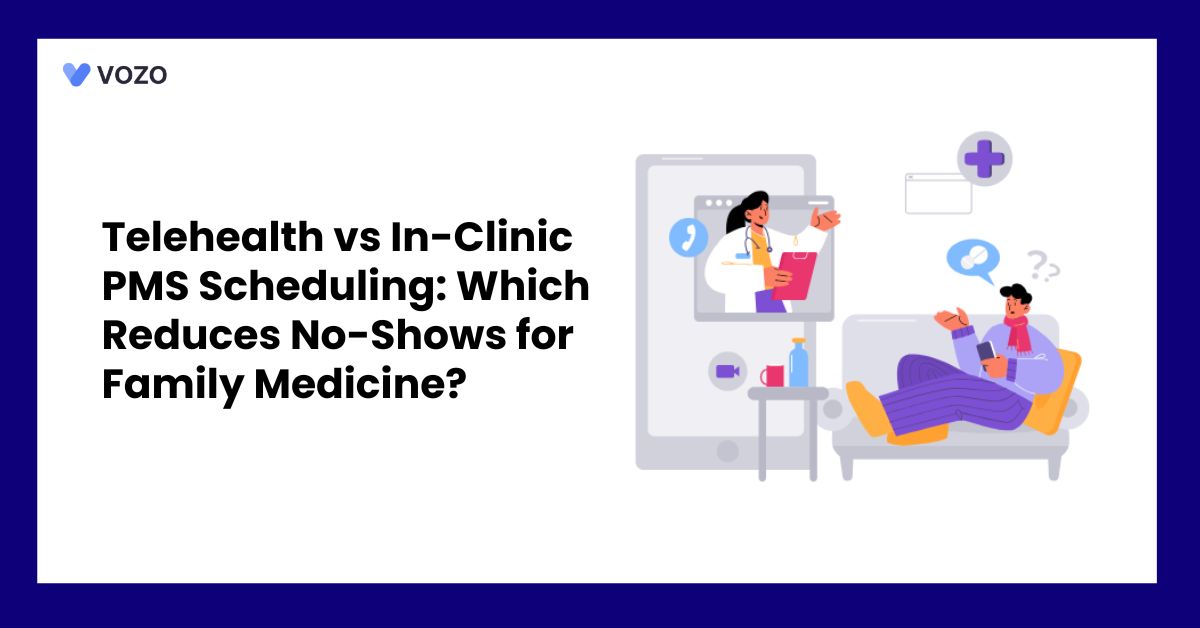
Telehealth vs In-Clinic PMS Scheduling: Which Reduces No-Shows for Family Medicine?
No‑show appointments disrupt continuity of care, waste scarce clinical capacity and strain practice finances. Primary‑care clinics, particularly family medicine practices that coordinate routine, chronic and acute care, have long struggled to predict and prevent missed appointments.
In recent years two scheduling paradigms have emerged as tools to reduce no‑shows: telehealth scheduling, which delivers care via audio or video and eliminates many logistical barriers, and in‑clinic practice‑management system scheduling, which aims to reduce missed visits by optimising appointment lead time and making it easy to book or reschedule in‑person appointments. This post synthesises recent evidence to compare these strategies and provides recommendations for family medicine practices.
Why no‑shows matter in family medicine
Family physicians offer preventive care, chronic disease management and acute visits for all ages. Missed appointments disrupt continuity of care, delay diagnoses and reduce revenue.
- MGMA’s January 2025 poll found that patient no‑show rates have returned to pre‑pandemic levels
- 58 % of practice leaders said no‑show rates in 2024 were similar to 2023
- 22 % saw improvement and 20 % reported worse rates.
Practices with no‑show fees reported greater improvement in 2024 compared with practices without fees (16 %), but fee policies risk alienating patients and may not be permitted for Medicaid visits. To tackle no‑shows without compromising access, practices are turning to telehealth and scheduling innovations.
Telehealth scheduling and its impact on missed appointments
Evidence that telehealth reduces no‑shows
The COVID‑19 pandemic accelerated telehealth adoption. Several large studies now show that telehealth appointments are less likely to be missed than equivalent in‑person visits:
Safety‑net health centre study
A retrospective cohort study of 474,212 appointments in an Arizona safety‑net health system found a 12 % no‑show rate for telemedicine appointments versus 25 % for in‑person appointments; after adjusting for patient demographics and comorbidities, telemedicine was associated with a 60 % lower odds of no‑show. The protective effect of telemedicine was strongest for Native American and non‑Hispanic Black patients, indicating telehealth may reduce inequities.
University of South Florida cohort
Among 87,376 appointments, telemedicine visits had a 73.4 % completion rate compared with 64.2 % for in‑person visits; the adjusted odds ratio for telemedicine vs. in‑person completion was 1.64. Authors attributed higher completion to telemedicine’s ability to overcome transportation and childcare barriers.
Rural return visits
In a rural integrated health‑care study covering behavioral health and endocrinology return visits, telehealth no‑show rates were significantly lower than in‑person visits: 11.5 % vs. 16.1 % for behavioral health and 3.3 % vs. 11.1 % for endocrinology. For new patient visits, the difference was not significant, suggesting telehealth is most effective for follow‑ups and medication checks.
American Academy of Family Physicians practice report
Clinicians integrating telehealth into primary care observed that it reduces cancellations and no‑shows because visits can quickly switch from in‑clinic to telehealth when patients face transportation or child‑care problems. Telehealth improves chronic disease follow‑up and allows providers to salvage last‑minute cancellations by converting them to virtual visits.
Scoping review on telemedicine in family medicine
A scoping review of telemedicine in family medicine noted that telehealth improves practice efficiency by saving time spent on admissions and room preparation; as a result, no‑show appointments are reduced, yielding operational benefits.
These studies collectively show that telehealth scheduling reduces missed appointments by removing barriers such as transportation, childcare, mobility issues and appointment lead time. Telehealth also allows clinicians to convert a scheduled in‑clinic visit to a virtual one when unexpected conflicts arise, a key advantage for chronic care and follow‑ups.
Limitations and patient considerations
Telehealth is not a universal solution. Evidence shows that telehealth reduces no‑shows mainly for established patients; new‑patient visits still benefit from in‑person evaluation. A scoping review cautions that telehealth can compromise physical examination quality, requires reliable internet access and may not suit complex diagnoses. Practices serving older adults, limited‑English speakers or low‑income patients need to offer technical support and choose platforms patients already use.
Finally, regulations on video visits and reimbursement continue to evolve; practices must monitor payer policies and ensure HIPAA compliance.
In‑clinic PMS scheduling: open access and other tactics
Practice‑management systems power appointment scheduling, reminders and patient communications. Traditional scheduling often books patients weeks in advance, creating long lead times that increase no‑show risk. Two innovations aim to counter this: open‑access scheduling and enhanced reminder/communication systems.
Open‑access (same‑day) scheduling
Open‑access scheduling makes a large portion of appointments available for same‑day or next‑day booking. This reduces the interval between scheduling and the visit.
- Shorter lead times decrease no‑show rates because patients are less likely to forget or encounter schedule conflicts.
- 10 showed a significant decrease in no‑show rates, four saw no significant reduction and two observed no change.
- Most included studies were in family medicine settings.
- The authors concluded that successful open‑access implementation requires needs assessments, system redesign tailored to patient and provider needs, and stakeholder cooperation.
However, a multiclinic project published in 2008 showed no change in no‑shows, highlighting that simply converting schedules without addressing workflow and patient communication may not yield improvement.
A survey of residency practices with low no‑show rates found that all used multiple strategies, patient education, reminders, sanctions and some degree of open‑access scheduling.
Reminder and communication strategies
Patient communication plays a critical role.
- Practices with stable or improving no‑show rates credit consistent patient communication
- Frequent digital reminders
- Automated calls and
- Two‑way text messaging, often coupled with financial incentives or deposits.
In primary care, two‑way texting allows patients to confirm or reschedule with ease, and unanswered reminders can trigger live calls for high‑risk visits. MGMA also emphasises shrinking wait times, offering a balanced mix of virtual and in‑person appointments and proactively addressing coverage and transportation gaps.
In addition to communication, schedule lead time is a strong predictor of missed appointments. A 2025 machine‑learning study analysing more than one million appointments across 15 family medicine clinics found that schedule lead time was the most important predictor of missed appointments; the gradient‑boost model achieved an area‑under‑curve of 0.852 for predicting no‑shows. This reinforces the importance of keeping appointment lead times short and dynamically adjusting schedules.
Fees and policies
Fee policies can influence behaviour. MGMA’s January 2025 poll reported that 42 % of medical groups use a no‑show fee and those practices experienced more improvement in no‑show rates. Clear communication of the policy, reasonable notice periods, flexible waiver options and consistent fee collection processes. However, fees may not be allowed for Medicaid visits and can deter patients if not applied thoughtfully.
Comparing telehealth and in‑clinic scheduling
| Approach | Key elements | Best used for |
| Telehealth scheduling | Virtual appointments via video or phone, often accompanied by digital reminders; ability to convert in‑clinic visits to telehealth when barriers arise. | Follow‑up visits, medication management, chronic disease check‑ins, quick result discussions, visits with mobility/transportation challenges; not ideal for new patients or complex exams. |
| Open‑access in‑clinic scheduling | Same‑day/next‑day booking with reduced lead time; reserved slots for urgent visits; part of practice‑management system. | Acute visits, patients needing physical exams, preventive care; improves access and patient satisfaction when combined with reminders and overbooking. |
| Enhanced reminders & communication | Two‑way texting, automated calls, email reminders, patient portal messages; integration with PMS. | All visit types; especially effective when combined with either telehealth or open‑access scheduling. |
| No‑show fee policies | Fees for missed appointments, deposits for procedures; clear notice periods and waiver options. | Elective procedures, specialty care; use cautiously in primary care, mindful of payer restrictions. |
Recommendations for family medicine practices
- Adopt a hybrid scheduling model. Offer telehealth for medication checks, chronic disease management, results discussions and follow‑ups. Maintain in‑clinic slots for new patients, physical exams and complex cases. Track no‑show and completion rates by visit type and adjust the mix accordingly.
- Reduce lead time and implement open‑access capacity. Monitor the “third‑next‑available” appointment metric and maintain same‑day or next‑day slots to reduce no‑show risk. Use backlog scrubs to move appointments forward. When introducing open access, conduct needs assessments and train staff to ensure workflows support same‑day demand.
- Strengthen patient communication. Use multi‑channel reminders (text, email, phone) and allow patients to confirm or reschedule easily. Escalate unanswered reminders with a live call for high‑risk visits. Provide patient education at each touchpoint (booking, confirmation, day of visit) and use language‑appropriate scripts to improve understanding.
- Offer telehealth “rescue” options. Train front‑desk staff to convert an in‑person appointment to telehealth when a patient calls about transportation or childcare issues. Provide technical assistance, test video connections before the visit and use platforms that patients are familiar with.
- Use data to identify high‑risk appointments. Analyse appointment histories and demographic data to flag patients at risk of no‑shows. Schedule high‑risk patients into shorter lead‑time slots, provide additional reminders and consider overbooking if capacity allows. Machine‑learning models can aid prediction; schedule lead time has been identified as the most important predictor.
- Implement fair and transparent no‑show policies. If using fees, communicate the policy clearly, offer reasonable notice periods and allow hardship waivers. Avoid punitive measures that discourage patients from seeking care.
- Address social determinants of health. Telehealth can reveal transportation, housing and support needs. Use this information to connect patients with community resources, ride‑share programs or social services. Proactively verify insurance coverage and discuss cost expectations seven days before the visit to prevent no‑shows due to financial uncertainty.
Vozo Cloud EHR With Built-In Telehealth Platform
If you are searching for the best EHR system for your healthcare practice, Vozo EHR can be your go-to choice. Our comprehensive EHR solution lets you focus more on patient care while carrying all the burdens and simplifying them.
- Vozo Cloud EHR’s cost-effective cloud subscription benefits all levels of practice.
- Our feature-rich EHR helps you rectify mistakes efficiently and speed up the process.
- Vozo Specialty EHR resonates with specialty practice needs and requirements.
- Our expert technical team gets you covered 24/7 if any needs arise.
Our EHR System continues to scale as your healthcare practice grows to improve the user experience.
The Vozo Customized EHR solution benefits your healthcare practice by:
- Streamlining the administrative process
- Improving workflow efficiency
- Reducing proneness to errors
- Manages all the patients’ records in one place
- Offers greater efficiency and cost savings across the board.
Our specialty-specific tools, like scheduling, patient portals, lab integration, cloud hosting, and more, meet the specific needs and requirements of your healthcare practice.
“Embrace Vozo EHR to Reduce Your Burdens and Enhance Patient Care”.
About the author
Lara Dixit


Lara Dixit is a Senior Business Manager at Vozo Health, specializing in EHR platforms, practice management, billing, and revenue cycle optimization. She helps healthcare providers improve operational efficiency, streamline workflows, and drive sustainable practice growth. At Vozo Health, she focuses on business strategy, healthcare automation, and scalable growth for modern medical practices.