
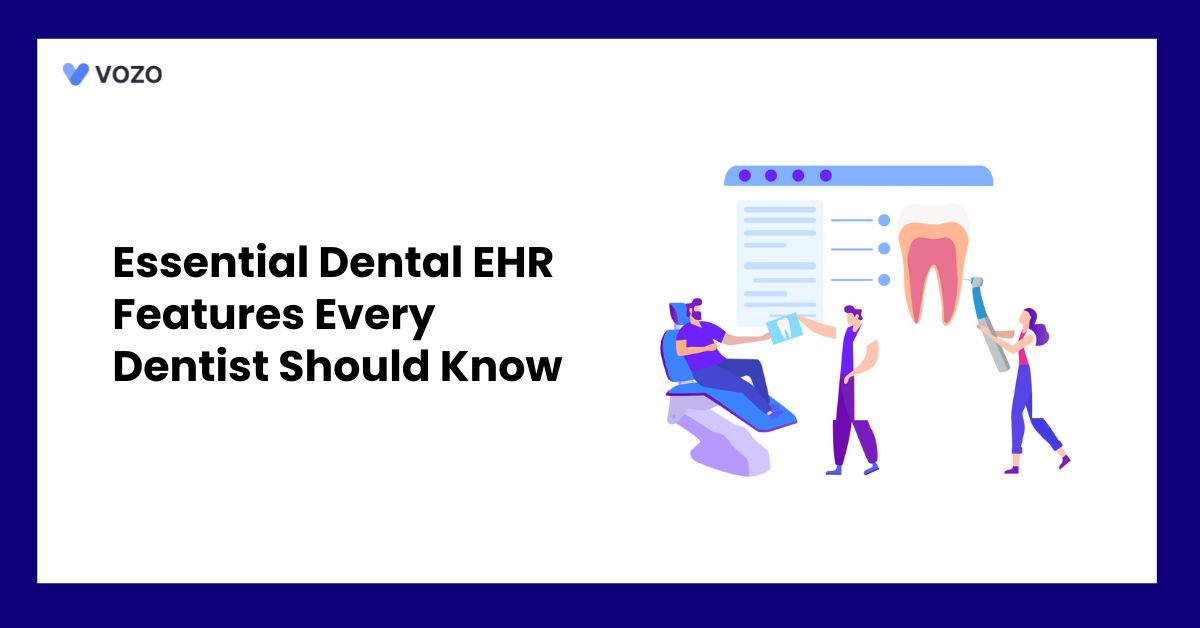
Essential Dental EHR Features Every Dentist Should Know
The modern dental practice requires not just clinical excellence but also a smooth-running administration with absolute regulatory adherence. To dentists who find themselves in this sector, proper technology is not just a luxury anymore but a necessity. A robust Dental EHR system comes to the rescue, making the paper-based processes digital giants.
The implementation of a specialized Dental EHR is crucial to increasing productivity, complying with regulations, and improving the overall experience with patients.
It redirects emphasis from the boring paperwork to exceptional care delivery. In this blog, you’ll learn the important Dental EHR features that dentists must know.
What Is a Dental EHR?
A Dental EHR is a computer-based system that has been developed with the special purpose of handling the records of patients and administration within a dental clinic.
The general EHR systems can manage general medical information; a dental EHR is specific to the requirements of dentistry. It contains specialized odontograms (tooth charts), periodontal charting instruments, and workflows that are consistent with standard dental procedures, ranging from simple routine cleanings and complicated restorative and cosmetic services.
It is literally a complete dental practice management software, which brings both the clinical and business aspects of your clinic into one safe place.
Top Dental EHR Features Dentists Should Know
A digital system is strong because of its functions. A powerful array of tools that facilitates the workflow and improves clinical decision-making is the most appropriate EHR software in dental clinics.
1. Patient Charting and Treatment Planning
The first and foremost element of a good Dental EHR is a user-friendly electronic patient chart. The feature enables charting of existing restorations, decay, and conditions digitally onto an odontogram in outline.
Functionality – Charting through drag-and-drop, periodontal exams with specialization, and automatic generation of clinical notes.
Impact – Accelerates documentation, minimizes mistakes related to poorly written handwriting, and ensures dynamic treatment planning that a patient can visualize, which greatly enhances their acceptance of a case.
2. Appointment Scheduling and Reminders
One of the biggest wastes of practice revenue is no-shows. A unified scheduling program in your Dental EHR can significantly lessen the problem.
Key Feature – Centralized calendar, differentiating between types of appointments by color, and automatic reminder by using text, email, or even voice calls.
Impact – It will optimize the chair time, reduce the administrative burden of front-desk personnel, and enhance patient compliance with recalls.
3. Dental Imaging Integration
Dental practices heavily depend on imaging in terms of X-rays, intraoral photos taken by a camera, and even 3D scans. A key Dental EHR capability is the capacity to be interoperable with your digital imaging devices.
Key Functionality – The ability to immediately capture and store all images in the patient chart of patients, tools for image manipulation to view and diagnose, and sharing images with specialists or laboratories.
Impact – It will mean that diagnostic tools are available instantly at the point of care without having to physically search and acquire physical films, and improve the accuracy of the outcome.
4. Billing and Insurance Management
The most time-consuming administrative process is usually dealing with claims and the payment of patients. The revenue cycle is improved with the help of a specialized system.
Feature – Electronic claims submission (e-claims), real-time insurance eligibility check, automatic posting of ledger, and powerful accounts receivable tracking.
Impact – Decelerates the reimbursement period, minimizes reimbursements (lost claims) as a result of errors, and brings a clear understanding of financial realities to the practice and the patient.
Related: How to Implement Practice Management Software to Streamline Dental Clinic
5. E-Lab Integration E-Prescribing
It is essential to have safe and efficient medication. E-prescribing enables dentists to transmit prescriptions to a pharmacy.
Functionality – Checks of drug-allergy interaction, follow-up of previous prescriptions, and direct and safe transmission to pharmacies.
There is lab integration whereby case information and instructions can be electronically sent to dental labs, and this enhances turnaround time and accuracy of restorations and appliances.
Impact – Patient safety is improved, and regulations potentially requiring e-prescribing are followed, as well as the communication with external partners is simplified.
6. Patient Portal and Communication Tools
Patients today demand online communication. A patient portal is an online portal that is secure and is incorporated into a Dental EHR.
Features – Booking appointments online, safe communication with the practice, medical records, software to fill in digital forms such as patient intake and consent forms, and payment facilities.
Impact – Patients will become more engaged, the staff will use less time when doing phone calls and data entry, and a 24/7 self-service is offered, which is convenient and easy to use.
7. Compliance (HIPAA, ADA standards)
Security and compliance with regulations are not a bargain. An excellent dental EHR system based on the Cloud should be developed with compliance in place.
Key Functionality – Data encryption, audit trail, like identifying who has accessed what data and when, role-based access control, and compliance with security standards established by organizations, such as the ADA and, most importantly, HIPAA-compliant dental software guidelines to protect PHI.
Impact – Reduces the risk of expensive data breaches, remains legally compliant, and will earn patient trust through the display of a culture of data privacy.
Benefits of Adopting a Dental EHR System
1. Enhanced Productivity – The process of automating routine activities such as scheduling, billing, and others enables the staff to concentrate on the patient and productivity.
2. Increased Data Security – Compared to physical records, a secure EHR, with or without automatically included disaster recovery and backup, offers greater protection of PHI.
3. Enhanced Patient Care – The patient can gain faster and more informed decision-making due to instant access to a complete patient history, current medications, and imaging.
4. Improvement of Collaboration – Simple transfer of records with specialists or labs (securely and in compliance) enhances coordinated care.
5. Data-Driven Growth – In-built reporting tools offer an informative view of the practice performance, which facilitates determining the challenges and the growth opportunities.
Frequently Asked Questions
1. What is the need for a specialized Dental EHR?
A dental EHR is designed around dentistry-specific processes such as odontograms, image integration, and treatment planning. It enhances precision, eases administration, and improves patient care.
2. What is the effect of a Dental EHR on patient experience?
Online scheduling, secure messaging, as well as easy record access keep patients informed and connected. It enhances trust, convenience, and improved communication.
3. Does a cloud-based Dental EHR qualify as secure and compliant?
Yes. Credible dental EHR systems contain HIPAA conformity, data encryption, and data ADA-conformity, securing the health information of patients and preventing breaches.
Vozo Dental EHR Solution
With Vozo Dental EHR, your dental practice gains a smarter, more efficient, and fully connected digital backbone.
Our Dental EHR is designed to streamline workflows, enhance charting precision, and provide complete visibility into both clinical and administrative operations, all in one secure, cloud-based platform.
With Vozo, you get:
- Intuitive patient charting and treatment planning with visual odontograms
- Seamless dental imaging integration for accurate diagnosis
- Automated billing and insurance management to speed up reimbursements
- Patient portal and communication tools for 24/7 engagement
- HIPAA-compliant data protection and ADA-standard security controls
- Real-time analytics and reports to track performance and optimize workflows
Vozo’s Dental EHR Solution helps dentists eliminate administrative roadblocks, improve care coordination, and create a practice that runs smarter, not harder.
Transform your dental practice today with Vozo. Book your free demo now.
About the author
Lara Dixit


Lara Dixit is a Senior Business Manager at Vozo Health, specializing in EHR platforms, practice management, billing, and revenue cycle optimization. She helps healthcare providers improve operational efficiency, streamline workflows, and drive sustainable practice growth. At Vozo Health, she focuses on business strategy, healthcare automation, and scalable growth for modern medical practices.