


Benefits of E-Prescribing for Optometry Specialty?
Technology continues to alter modern healthcare; optometry offices are implementing digital technologies to improve clinical and administrative procedures. One such innovation, e-prescribing, is becoming an important part of optometric care delivery.
This blog discusses how e-prescribing improves optometry practices by improving patient safety, simplifying regulatory compliance, and increasing overall efficiency and satisfaction.
What is e-prescribing in Optometry?
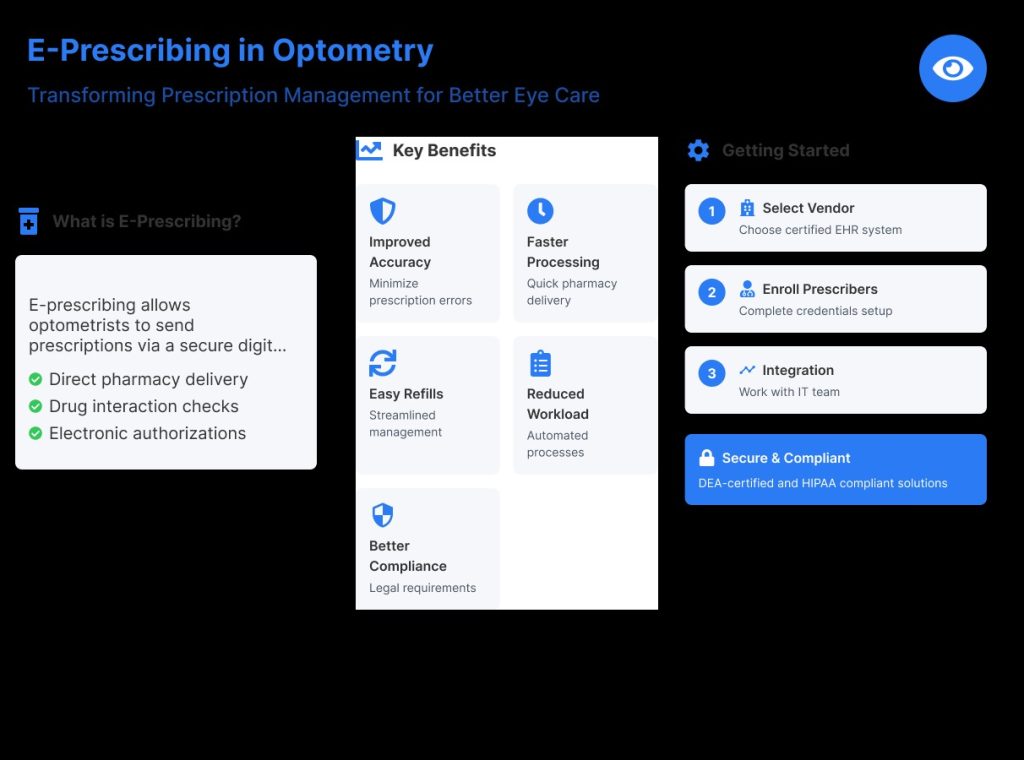
E-prescribing allows optometrists to send prescriptions via a secure digital network straight to a patient’s pharmacy. Optometrists use an integrated system inside their EHR to handle and communicate medication orders instead of writing them by hand or calling in prescriptions.
In optometry, e-prescribing is frequently used to prescribe drugs for eye infections, inflammation, allergies, dry eye diseases, and glaucoma. It can also handle prohibited drugs with the correct authorization and compliance. E-prescribing is governed by federal and state legislation, and it is increasingly mandated by insurance companies and pharmacy networks.
- Direct delivery of medications to pharmacies
- Checking for drug interactions and receiving allergy notifications
- Electronic prior authorizations
- Refill management and renewal requests
- Medication history tracking
Why are Optometry Practices adopting e-prescribing?
E-prescribing in optometry is increasing due to its potential to decrease inefficiencies and ensure drug accuracy. Paper-based processes are insufficient in light of the growing complexity of eye care and patient expectations..
National measures like the Medicare Modernization Act and EPCS have accelerated the digitalization process. E-prescribing also promotes optometry clinics as modern, tech-savvy physicians who support greater healthcare interoperability.
Key drivers of adoption include:
- Providing correct drug information to ensure patient safety
- Enhanced adherence to national and state laws
- Improvements to processes and time savings
- Improved documentation and audit trails
- Reduced telephone calls and manual follow-ups with pharmacists.
Benefits of E-Prescribing for Optometry Practices
1. Improved Prescription Accuracy and Patient Safety
E-prescribing significantly minimizes prescription mistakes due to illegible handwriting, wrong doses, or verbal misunderstanding. Optometrists can choose drugs from standardized drug databases, assuring precise dose, form, and frequency.
In addition, the system does real-time checks for patient allergies, medication interactions, and duplication therapy. These precautions are necessary for treating eye infections, glaucoma, or chronic ocular inflammation, when medication accuracy is essential.
The key safety elements are as follows:
- Alerts for allergies and medication interactions
- Standardized drug nomenclature
- Dosing calculators for pediatric and elderly patients
2. Faster Prescription and Better Patient Experience
E-prescribing sends prescriptions straight to the patient’s preferred pharmacy, frequently before they leave your office. This reduces therapy turnaround time, particularly for severe eye problems that require prompt attention.
Patients like the convenience and shorter wait times, which increases satisfaction and loyalty. They are no longer concerned about losing paper prescriptions or waiting in long lines for an explanation.
- Faster access to medicines
- Increased patient satisfaction.
- Fewer abandoned prescriptions
3. Simpler Refill Management and Medication Adherence
Refilling prescriptions manually takes time. E-prescribing enables optometrists to approve, alter, or refuse refill requests using a few clicks inside the EHR.
Patients with chronic eye disorders, such as glaucoma or dry eye, benefit from automatic refill reminders, which reduce the likelihood of missed doses. This promotes long-term drug adherence and better health results.
- Sending automated refill reminders
- Accepting digital refill requests
- Tracking patient refill history
4. Reduced Administrative Workload for Staff
Clinical and administrative personnel are strained by manual prescription administration tasks including faxing, calling pharmacies, and following up on missing information. By offering a standardized digital procedure, e-prescribing removes these repetitive tasks.
Pharmacy phone calls will decrease, freeing up front desk employees and technicians to focus on patient-facing duties. Employee productivity is also raised, and burnout is reduced as a result.
- Decreased pharmacy callbacks
- Reduced paperwork and manual entry
- Streamlined paperwork for audits and billing
5. Compliance and the Management of Controlled Substances
Electronic prescriptions for prohibited chemicals, particularly Schedule III-V drugs used to treat inflammation or irritation in the eyes, are now required in many jurisdictions. Optometry offices are guaranteed to adhere to state and DEA laws thanks to e-prescribing systems.
Secure, legally compliant controlled medication prescribing is made possible by features including audit trails, two-factor authentication, and communication with state Prescription Medication Monitoring Programs.
- EPCS-ready workflows
- Digital audit logs
- DEA-certified prescriber identification checks.
How to Set Up E-Prescribing in Your Optometry Practice
If your clinic still uses paper prescriptions or unconnected systems, switching to e-prescribing is a good decision.
1. Select a Certified E-Prescription Vendor
- Surescripts-certified
- DEA/EPCS-compliant
- Compatible with your existing EHR.
2. Enroll and Credential Prescribers
- Submit your identification verification and credentials.
- Complete 2FA setup for EPCS.
- Train all users on system usage.
3. Integrate into your Practice Workflow
Work with your IT or EHR vendor to integrate e-prescribing into your clinical workflow. Monitor performance and get input from employees for improvements.
Related: Navigating the Challenges of Cloud EHR for Multi-Specialty Practices
Vozo Specialty EHR for Optometry
Specialty healthcare practices like optometry workflow need to be streamlined. The EHR solution will help you to digitize the workflow and streamline the process.
Whether you are looking for a specialized EHR for your practice or need to streamline your practice workflow, Vozo EHR is here to help you.
Vozo’s EHR system offers a vast range of benefits for your optometry practice.
- Streamline the optometry practice workflow and speed up the process
- Easy transition from paper workflow to digital workflow
- Provides complete access to the patient’s up-to-date medical records
- Accurate reporting and analytics
- Our EHR system continues to scale as your healthcare practice grows
- 24/7 Tech support to assist you with any needs or requirements
Our EHR system allows you to manage all patient records under one roof, reducing the heavy workload for your healthcare practice staff.
Trust in Vozo EHR as we reduce your burdens and let you focus more on better patient outcomes.
About the author
Lara Dixit


Lara Dixit is a Senior Business Manager at Vozo Health, specializing in EHR platforms, practice management, billing, and revenue cycle optimization. She helps healthcare providers improve operational efficiency, streamline workflows, and drive sustainable practice growth. At Vozo Health, she focuses on business strategy, healthcare automation, and scalable growth for modern medical practices.