

5 Ways Integrated Labs in Oncology EHRs Improve Diagnostic Accuracy
In modern oncology, every hour that passes between obtaining a sample and acting on the results can have a considerable impact on survival rates. Many cancer programs still use paper requisitions, third-party portals, and emailed PDFs, resulting in blind spots that hinder prompt and correct judgments.
Connecting LIS, molecular-genomics vendors, and point-of-care devices to the oncology EHR eliminates data gaps and creates a continuous stream of information. In this blog, you’ll learn the 5 ways integrated labs provide significant benefits.
Why Laboratory-EHR Integration is More Important in Oncology
A single missing decimal in a tumor marker result or a delayed next-generation sequencing panel can significantly impact staging, treatment selection, and patient survival.
Traditional oncology processes manage separate LIS, imaging portals, and paper requisitions, creating an environment ripe for errors and delays.
Modern oncology-specific EHRs integrate comprehensive laboratory capability directly into the clinical workflow.
1. Reducing Turnaround Time from Days to Hours
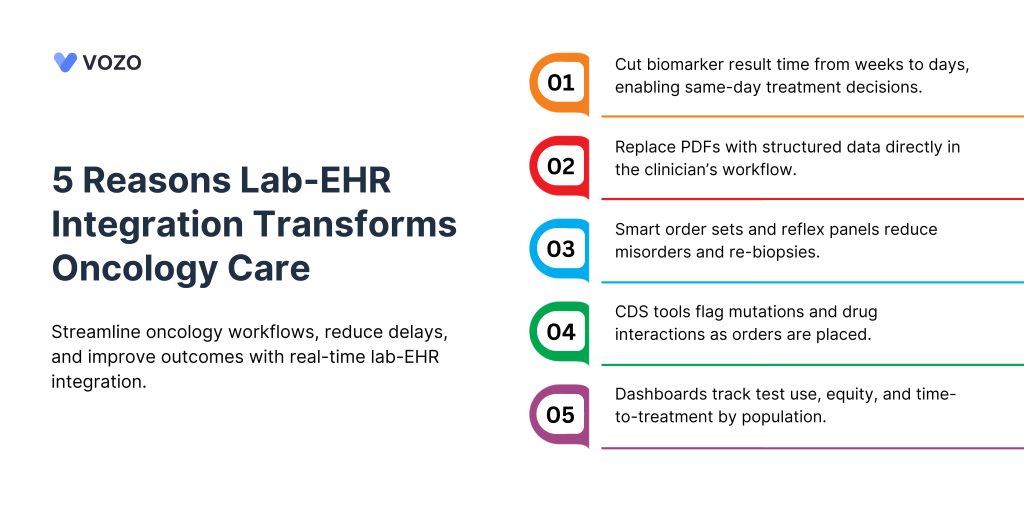
Faster specimen-to-result cycles. TriHealth’s Epic-integrated genomics process reduced average biomarker turnaround time from 27 to 9 days, resulting in a remarkable 67% reduction.
Prepare for chemotherapy on the same day by redesigning workflows to include phlebotomy and auto-routed labs. Within infusion units has reduced wait times have been reduced by up to 53% for patients who require labs before treatment.
Why it Matters
Shorter lab cycles allow oncologists to begin targeted therapy earlier and avoid potentially unsuccessful or hazardous empiric regimens.
Implementation Tips
- Standardize CPOE templates so that every common biomarker order includes the relevant tubes, CPT codes, and courier tags.
- Negotiate HL7 or FHIR bidirectional interfaces with your reference laboratories; most sites report a 4–6 month construction and test timeframe per lab.
2. Integrating Discrete Genomic Data into the Clinician Workflow
Instead of scanned PDFs, use smart words. Discrete variant fields automatically populate progress notes, saving approximately 10 minutes per genomic order and 167 FTE hours every 1,000 somatic tests.
Ensures team visibility with a single click. Surgeons, pathologists, pharmacists, and tumor board coordinators can access integrated results in the same chart tabs, eliminating the need for portal logins or manual file uploads.
Why it Matters
Structured data enables filters, dashboards, and CDS rules that identify actionable mutations like KRAS G12C when therapeutic choices grow.
Implementation Tips
- Map LIS result codes to specific EHR genomic objects such as Epic Genomics Module, Cerner OncoEMR “Molecular Result”.
- Use role-specific views, such as “Pending Liquid Biopsies” for interventional radiology and “New EGFR+ Stage IV NSCLC” for pharmacy prior-authorization teams.
3. Reducing Ordering and Documentation Errors
The ACCC identified confusing EHR order protocols, different lab portals, and free-text requisitions as leading causes of biomarker delays and misorders.
Missed or delayed diagnoses, often due to incorrect test ordering or interpretation, were responsible for 23% of ICU transfers or hospital fatalities.
Why This Matters
Integrated decision-tree order sets trigger the appropriate reflex panels automatically, like IHC-ER/PR/HER2 → multigene NGS, reducing false negatives and repeat biopsies.
Implementation Tips
- Create hard stops for clinical context, like primary site, stage, to ensure specimens are sent to the appropriate protocol in the EHR system.
- Implement closed-loop result acknowledgement notifications; unsigned critical results trigger escalation within a defined SLA.
4. Enabling Real-Time Precision Medical & Decision Support
Memorial Sloan Kettering used automated annotation of 705,000 radiological records to predict organ-specific metastases and speed up trial matching.
EHR-embedded tumor-board software has reduced manual document preparation by 41%, allowing oncologists to focus on subtle genetic evidence.
Why This Matters
Near-real-time lab data allows CDS algorithms to detect resistance mutations or drug-gene interactions as physicians write orders.
Implementation Tips
- Feed discrete lab and variant data into pharmacogenomic CDS rules like DPYD, UGT1A1.
- Use natural language processing to extract essential biomarkers from narrative pathology if discrete feeds are delayed.
5. Continuous Quality Improvement and Equity Monitoring
Dashboards that encourage action. Tableau and Epic SlicerDicer provide real-time views of test utilization, turnaround, and outcomes by site, clinician, and ZIP code.
Equity lens. After analyzing discrete data, TriHealth found no significant differences in tumor-profiling uptake based on race or socioeconomic status.
Why It Matters
Leaders may identify patient groups who wait longer for NGS or receive fewer precision-therapy visits and respond swiftly.
Implementation Tips
- Connect FHIR-enabled lab data to population health tools for cohort management and automated outreach.
- Conduct quarterly assessments to align biomarker TAT with time-to-treatment and progression-free survival targets.
Related: How Specialty EHRs Boost Efficiency, Revenue, and Patient Outcomes
Vozo Cloud EHR For Your Specialty Practice
Specialty healthcare practices’ workflow needs to be streamlined. The Cloud EHR solution will help you to digitize the workflow and streamline the process.
Whether you are looking for a specialized EHR for your practice or need to streamline your practice workflow, Vozo EHR is here to help you.
Vozo’s EHR system offers a vast range of benefits for your specialty practice.
- Streamline your specialty practice workflow and speed up the process
- Easy transition from paper workflow to digital workflow
- Provides complete access to the patient’s up-to-date medical records
- Accurate reporting and analytics for better decision-making
- Our Cloud EHR system continues to scale as your healthcare practice grows
- 24/7 Tech support to assist you with any needs or requirements
Our EHR system allows you to manage all patient records under one roof, reducing the heavy workload for your healthcare practice staff.
Trust in Vozo EHR as we reduce your burdens and let you focus more on better patient outcomes.
About the author
Lara Dixit


Lara Dixit is a Senior Business Manager at Vozo Health, specializing in EHR platforms, practice management, billing, and revenue cycle optimization. She helps healthcare providers improve operational efficiency, streamline workflows, and drive sustainable practice growth. At Vozo Health, she focuses on business strategy, healthcare automation, and scalable growth for modern medical practices.