

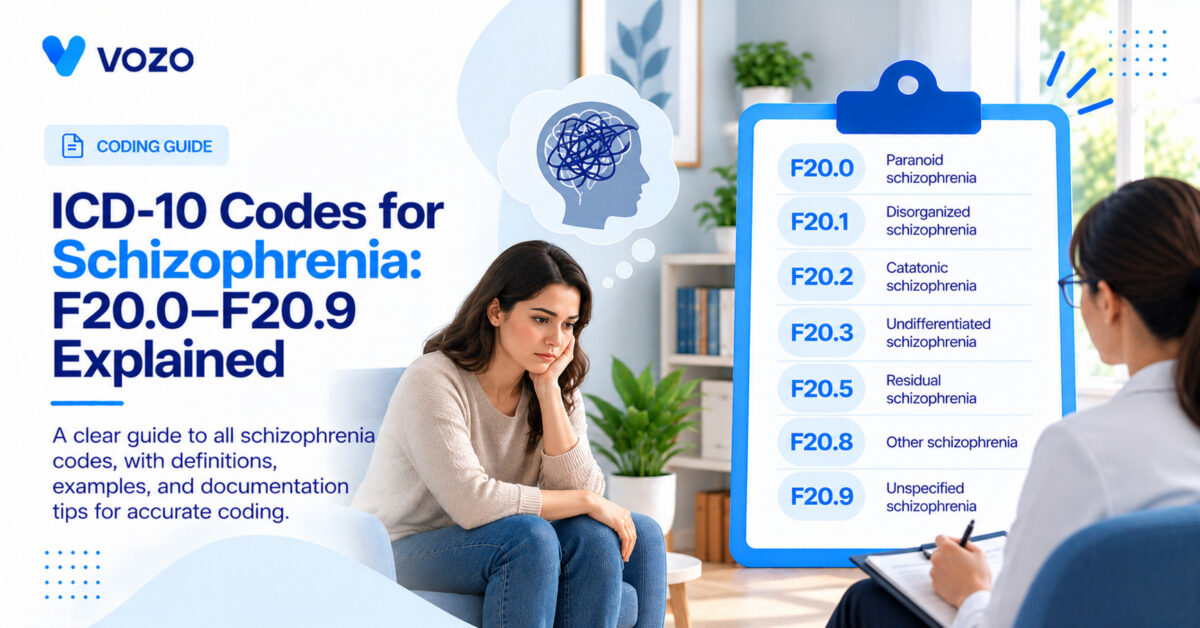
ICD-10 Codes for Schizophrenia: F20.0–F20.9 Explained
A psychiatrist documents schizophrenia during a follow-up visit. But which ICD-10-CM code should be reported: F20.9 or a more specific code under F20?
The answer depends on the documented diagnosis. F20.9 identifies schizophrenia, unspecified, while other codes represent paranoid, disorganized, catatonic, and other forms.
This guide covers the FY 2027 schizophrenia ICD-10-CM codes, billable status, and clinical documentation requirements for accurate coding.
What Is ICD-10-CM Code for Schizophrenia?
F20 is the ICD-10-CM category for schizophrenia, a psychiatric disorder that affects thinking, perception, behavior, and emotional expression. It belongs to the F20–F29 code range, covering schizophrenia and related non-mood psychotic disorders.
F20 is not a billable diagnosis code. Healthcare providers must select a complete code, such as F20.9, that reflects the documented diagnosis.
| Coding detail | Information |
| ICD-10-CM category | F20 |
| Description | Schizophrenia |
| Default diagnosis code | F20.9 |
| F20.9 description | Schizophrenia, unspecified |
| Is F20 billable? | No |
| Is F20.9 billable? | Yes |
| Code set | FY 2027 ICD-10-CM |
These codes apply to U.S. healthcare services provided from October 1, 2026, through September 30, 2027.
List of ICD-10 Codes for Schizophrenia
The following table includes the ICD-10-CM codes under category F20 and their billable status.
| ICD-10-CM code | Diagnosis description | Billable |
| F20.0 | Paranoid schizophrenia | Yes |
| F20.1 | Disorganized schizophrenia | Yes |
| F20.2 | Catatonic schizophrenia | Yes |
| F20.3 | Undifferentiated schizophrenia | Yes |
| F20.5 | Residual schizophrenia | Yes |
| F20.8 | Other schizophrenia | No |
| F20.81 | Schizophreniform disorder | Yes |
| F20.89 | Other schizophrenia | Yes |
| F20.9 | Schizophrenia, unspecified | Yes |
Important: ICD-10-CM retains several historical schizophrenia subtypes that DSM-5-TR no longer recognizes as separate diagnoses. Clinicians should document their current diagnostic assessment, and coders should assign the ICD-10-CM code supported by that documentation.
ICD-10-CM Codes for Different Types of Schizophrenia
F20.0 – Paranoid Schizophrenia
F20.0 identifies paranoid schizophrenia, historically associated with prominent delusions or hallucinations, particularly involving persecution or perceived threats.
Use this code when paranoid schizophrenia is explicitly documented. Paranoid symptoms alone do not justify assigning F20.0.
F20.1 – Disorganized Schizophrenia
F20.1 identifies disorganized schizophrenia, also historically called hebephrenic schizophrenia.
This subtype was characterized by disorganized speech, behavior, and emotional expression. Select F20.1 when the clinician documents this specific diagnosis.
F20.2 – Catatonic Schizophrenia
F20.2 identifies catatonic schizophrenia, historically associated with significant disturbances in movement and responsiveness.
Catatonia can occur with other psychiatric or medical conditions. Therefore, catatonic symptoms alone do not establish catatonic schizophrenia.
F20.3 – Undifferentiated Schizophrenia
F20.3 identifies undifferentiated schizophrenia, a historical classification used when symptoms did not fit clearly into one schizophrenia subtype.
Use this code when the documented diagnosis supports undifferentiated schizophrenia. Do not confuse it with F20.9, which applies when the schizophrenia type is unspecified.
F20.5 – Residual Schizophrenia
F20.5 identifies residual schizophrenia, historically used when prominent psychotic symptoms had diminished but other features remained.
Assign this code only when residual schizophrenia is documented. Symptom improvement or maintenance treatment alone does not establish this diagnosis.
F20.81 – Schizophreniform Disorder
F20.81 identifies schizophreniform disorder, a diagnosis with symptoms similar to schizophrenia but a different duration requirement.
Schizophreniform disorder generally lasts at least one month but less than six months. Although classified under F20, it is a distinct diagnosis.
F20.89 – Other Schizophrenia
F20.89 identifies other specified forms of schizophrenia that do not have a dedicated ICD-10-CM code.
The classification includes simple schizophrenia and cenesthopathic schizophrenia under F20.89. Use this code when the clinician’s documented diagnosis is indexed to this category.
F20.9 – Schizophrenia, Unspecified
F20.9 identifies schizophrenia when the clinician establishes the diagnosis but the documentation does not support a more specific ICD-10-CM code.
For example, a psychiatrist documents schizophrenia during a medication-management visit without specifying a historical subtype. F20.9 may be appropriate. It is a valid billable code and does not automatically indicate incomplete documentation.
Spend Less Time on Psychiatric Documentation
Managing diagnoses, medication notes, and follow-up records across patient visits can add to a psychiatrist’s workload. Vozo EHR helps organize clinical documentation, prescriptions, and patient information in one place.
Schizophrenia vs. Related Psychotic Disorders: ICD-10 Codes
Schizophrenia shares symptoms with other psychotic disorders. However, these conditions have different diagnostic requirements and ICD-10-CM codes.
| Condition | ICD-10 code | Key distinction |
| Schizophrenia, unspecified | F20.9 | Confirmed schizophrenia without a specified type |
| Schizophreniform disorder | F20.81 | Similar symptoms with a shorter duration requirement |
| Schizoaffective disorder, bipolar type | F25.0 | Schizoaffective disorder with a bipolar-type presentation |
| Schizoaffective disorder, depressive type | F25.1 | Schizoaffective disorder with a depressive-type presentation |
| Schizoaffective disorder, unspecified | F25.9 | Schizoaffective disorder without a specified type |
| Brief psychotic disorder | F23 | Short-duration psychotic disorder |
| Delusional disorders | F22 | Delusions meeting criteria for a delusional disorder |
| Unspecified psychosis not due to a substance or known physiological condition | F29 | Psychosis without a more specific established diagnosis |
Key distinction: Hallucinations, delusions, or disorganized behavior do not automatically establish schizophrenia. The code must reflect the clinician’s confirmed diagnosis.
How to Choose the Correct Schizophrenia ICD-10 Code
Accurate coding requires matching the clinical documentation with the ICD-10-CM classification.
Step 1: Confirm the diagnosis
Determine whether the clinician has established schizophrenia or documented only suspected psychosis. For outpatient visits, diagnoses described as suspected, probable, or rule-out are not coded as confirmed.
Step 2: Review the documented type
Check whether the diagnosis specifies a form of schizophrenia. Do not assign a particular subtype based solely on symptoms.
Step 3: Select a complete billable code
F20 and F20.8 are non-billable headings. Select the appropriate complete code, such as F20.9 or F20.89, based on the documented diagnosis.
Using an incomplete or unsupported diagnosis code can lead to claim submission errors and disrupt medical billing workflows.
Step 4: Check coding exclusions
Category F20 includes Excludes1 notes for schizoaffective disorder (F25.-), brief psychotic disorder (F23), and specified mood disorders with psychotic symptoms. These codes generally should not be reported together. An exception may apply when the conditions are clearly unrelated. Query the clinician if the relationship is unclear.
Step 5: Review additional code requirements
The F20 category instructs coders to use an additional code, when applicable, to identify another specified cognitive deficit (R41.84-). Assign additional codes only when the documentation and coding instructions support them.
Documentation Requirements for Schizophrenia Coding
Clear documentation helps mental health practices support accurate schizophrenia coding by connecting the recorded diagnosis with clinical findings and treatment decisions.
Relevant documentation includes:
- Confirmed diagnosis: Record schizophrenia or the specific documented form.
- Clinical findings: Describe relevant symptoms, assessment findings, and changes in presentation.
- Clinical course: Document symptom duration, progression, or remission when relevant.
- Treatment and follow-up: Record medication management, interventions, monitoring, and care plans.
The documentation should support the selected ICD-10-CM code and services provided. Follow-up notes should reflect the patient’s current condition without requiring a complete psychiatric evaluation at every visit.
Common Schizophrenia ICD-10 Coding Errors
| Coding error | Correct approach |
| Reporting F20 on a claim | Select a complete billable code |
| Confusing F20.3 with F20.9 | Distinguish undifferentiated from unspecified schizophrenia |
| Coding schizophrenia from hallucinations alone | Use the clinician’s established diagnosis |
| Confusing schizophrenia with schizoaffective disorder | Review the distinction between F20 and F25 |
| Reporting suspected schizophrenia as confirmed in outpatient care | Code the supported symptoms or reasons for the visit |
| Assigning a subtype without documentation | Use the code supported by the documented diagnosis |
These checks help behavioral health providers reduce unsupported diagnosis selection and maintain consistent clinical and billing records.
Manage Schizophrenia Documentation and Follow-Up Care With Vozo EHR
Psychiatry practices need organized clinical records for ongoing assessments, medication management, and patient follow-ups.
Vozo Psychiatry EHR brings clinical documentation, e-prescribing, scheduling, telehealth, and billing workflows together in one platform.
Keep patient information accessible, organize treatment records, and reduce administrative work without switching between disconnected systems.
Frequently Asked Questions
1. Can schizophrenia and depression be coded together?
Schizophrenia and a separately diagnosed depressive disorder may both be reportable, depending on the specific diagnoses. However, ICD-10-CM category F20 includes Excludes1 notes for certain mood disorders with psychotic symptoms. Review the documented conditions and applicable exclusion rules before assigning both codes.
2. Does schizophrenia in remission have a separate ICD-10-CM code?
ICD-10-CM does not provide a separate remission-status code for schizophrenia comparable to those available for certain other psychiatric conditions. Clinicians should document the current diagnosis and remission status when clinically relevant. Code selection follows the established diagnosis and applicable classification instructions.
3. Can schizophrenia be reported as a secondary diagnosis?
Yes. In outpatient care, schizophrenia may be reported as an additional diagnosis when it affects evaluation, treatment, or management during the encounter. The first-listed diagnosis depends on the primary reason for the visit. Inpatient reporting follows separate additional-diagnosis requirements.
4. What happens if an incorrect ICD-10 code is reported for schizophrenia?
An incorrect schizophrenia ICD-10-CM code may lead to claim rejections, denials, or inaccurate clinical records. Providers should verify that the selected code is valid, billable, and supported by the documented diagnosis before submitting a claim.
5. Should a schizophrenia ICD-10 code change when symptoms improve?
Not automatically. Symptom improvement, treatment response, or stabilization does not independently require a different schizophrenia diagnosis code. Clinicians should reassess the diagnosis during patient follow-up appointments when appropriate and document meaningful changes in the patient’s condition. Coding should reflect the established diagnosis and current medical record.
Official Sources
CMS – ICD-10-CM Code Files and Updates
CMS – FY 2027 Official ICD-10-CM Coding Guidelines
CDC/NCHS – ICD-10-CM Classification
AAPC – F20.9 Code Reference
About the author
Lara Dixit


Lara Dixit is a Senior Business Manager at Vozo Health, specializing in EHR platforms, practice management, billing, and revenue cycle optimization. She helps healthcare providers improve operational efficiency, streamline workflows, and drive sustainable practice growth. At Vozo Health, she focuses on business strategy, healthcare automation, and scalable growth for modern medical practices.